 |
 |
 |
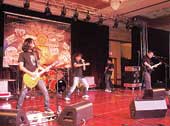
| (From top) Herbie Hancock; Lisa Henry; Wayne Shorter in performance at Dalhousie Institute. Pictures by Amit Datta |
One hour before the show, the best seats on the Dalhousie Institute (DI) lawn had already been occupied. By 6.30, the sitting capacity of 1,200 was full, and late early-comers had to content themselves with extra plastic chairs on the tennis court, from where they could barely see the stage, let alone the celebrities on it.
By the time the Thelonious Monk Institute marched out for their warm-up tune shortly after 7, at least another 500 people had gathered to stand along the edges for the rest of the cool Sunday evening. The sheer numbers could have precipitated a riot elsewhere, but the SRO (standing-room-only) crowd maintained the peace, all for the sake of hearing Herbie Hancock and Wayne Shorter.
Sobering news opened the concert, that tenor saxophonist Michael Brecker, formerly of the Brecker Brothers, author of a brilliant eponymous album in 1987 and a sideman for Hancock on his superb The New Standard (1996), had died the previous day. The ensemble dedicated the Calcutta performance to his memory. Equally significantly, the following day was Martin Luther King’s birthday, a national holiday in the US.
The two events set a disparate mood, and the students of the Institute began tentatively, if not nervously. But Hancock set them at ease as he came on, his warm smile betraying no emotion at the loss of Brecker except the equanimity of his Buddhist beliefs. He jumped into a “new alternative” version of his lithe classic Dolphin Dance. Like a lioness teaching her cubs how to hunt, he led the band with his pounding hands, showing them how to attack their instruments. His solo recalled his scintillating CD Gershwin’s World (1998).
The smile never left him. When an agitated club official announced that cars parked on Mayfair Road had to be moved pronto, Hancock quickly improvised as well as he does on piano: “Give me your keys, especially if you own a Ferrari or Rolls Royce.” And then he introduced a “real Rolls Royce”.
Enter Wayne Shorter, looking shy and even apologetic, not at all like the undisputed current master of the soprano sax who is probably at his peak right now, also consistently rated among the top few composers and tenor saxophonists.
His quartet is among the top two jazz combos today. Pick up any of their last three CDs — Footprints Live! (2002), Alegria (2003) and Beyond the Sound Barrier (2005) — and you’ll get what I mean.
Using only the soprano the entire evening, he launched into a save-the-tiger variation of Footprints, “of Sher Khan” as he put it, “Watch out for the tiger.” Who knows, Panthera tigris might prowl a little easier with Shorter on its side. Better than the Pink Panther theme, for sure. But easily the gem of the evening was his spontaneous duet with Hancock, its intuitive musical understanding and bonding reminiscent of their sparkling album of just duets titled 1+1 (1997).
Half the fun that night lay in watching the eyes and mouths of the awestruck boys in the band, as they registered their heroes’ surprise tricks and twists. They finally got a thorough workout themselves on Monk’s Straight, No Chaser, which of course they knew like the backs of their hands. And Lisa Henry, their vocalist who returned to Calcutta, belted out Every Day I Got the Blues, imitating the trumpet too, in a reversal of what normally happens (instrument emulating human voice).
The encore — predictably, Watermelon Man by popular demand from the beer stalls — sent everyone home with Hancock’s famous street-vendor chant echoing on their lips. It was all very enjoyable, though not the best jazz concert I have heard; understandably.
There were three gradations of playing present: the youngsters, somewhat wet behind the ears in such exalted company; the two stars, accustomed to accompaniment of such stratospheric no-holds-barred dimensions that they had to lower their levels here; and Ms Henry, an entertaining showwoman in the middle.
The result: a diffusion of focus. Thanks, nonetheless, to American Center and Congo Square for bringing back Hancock after 11 years and Shorter for the first time.
VOICEOVER
 |
Herbie Hancock, the most influential living jazz pianist
I see a greater interest in jazz in India compared to 11 years ago. We seem to be reaching out to many more young people on this trip and I can sense a deeper understanding and knowledge, in fact, deeper than in some American communities!
Wayne Shorter, at the forefront of tenor saxophone modernists
Jazz isn’t about technical virtuosity. It’s about telling a story. There’s a narrative, and it’s full of surprises, the more the better the music. There’s also a great deal of fantasy in it. Jazz is all about feeling, it’s about the development of the human being.
Thomas Carter, president, Thelonious Monk Institute of Jazz
We’ve been here before, so we insisted that we couldn’t play in India without Calcutta on the itinerary. I’d like you to tell your readers that we want college-level musicians to study in the Institute. Our deadline for next year is coming up; you can apply online and send us a recording. If you make it to the next round, we will fly you there for the auditions. And if we finally choose you (among 25 international students), we provide you a full scholarship.