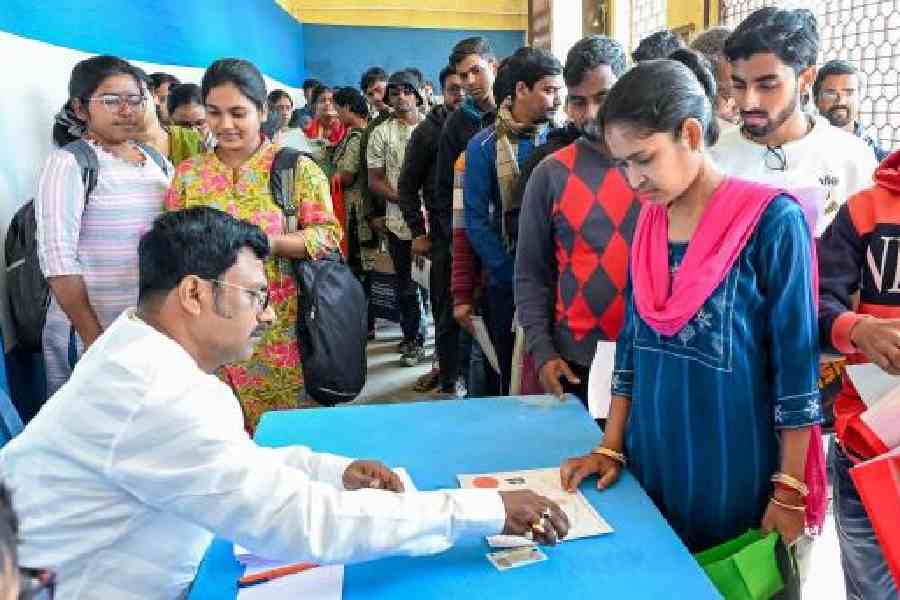
The Bengal government on Sunday began distributing application forms for Banglar Yuva Sathi scheme, a monthly financial assistance scheme for unemployed youths, in what is being seen as a major welfare pitch ahead of the Assembly polls.
Initially planned for August, chief minister Mamata Banerjee hastened the launch of the scheme from April 1.
The scheme, which will offer eligible jobless youths a monthly sum of ₹1,500, has generated visible enthusiasm among Trinamool Congress supporters, who believe that after the immense success of Lakshmir Bhandar, the new scheme could become another decisive welfare plank for the Mamata government.
At the same time, long queues of applicants across districts have fuelled sharp criticism from the Opposition, which says the crowds are a “stark reflection of Bengal’s persistent unemployment crisis”.

Trinamool sees the turnout as a sign that the scheme has struck an emotional chord among the youth. Opposition leaders alleged that Trinamool was trying to “glorify a shame”.
Hundreds of unemployed youths gathered at camps across the state from the very first day to collect application forms, with many highly educated jobseekers seen waiting in queues.
Trinamool leaders and workers described the response as proof that Mamata correctly gauged the aspirations of a generation struggling with economic uncertainty.
Announced in the state government’s vote-on-account earlier this month, the “Banglar Yuva Sathi” scheme has been pitched as a transitional support mechanism for unemployed individuals aged between 18 and 41, who have completed secondary education. Beneficiaries will receive the monthly stipend for five years to help sustain themselves while searching for jobs. The government has allocated ₹5,000 crore for the initiative.
Those availing benefits under certain state welfare schemes such as Lakshmir Bhandar or Kanyashree will not be eligible, though recipients of scholarships like Aikyashree, Medhashree and the Swami Vivekananda merit-cum-means scholarship can apply.
Trinamool spokesperson and minister Sashi Panja said: “This scheme is launched out of our responsibility towards unemployed youths. They have started attending camps in large numbers, which indicates that they have accepted Mamata Banerjee’s initiative. We now simply want to implement the scheme as early as possible.”
Her colleague, state finance minister Chandrima Bhattacharya, called the scheme a morale boost for unemployed youths.
She claimed that the new welfare initiative unsettled Opposition parties, arguing that even those who once criticised Lakshmir Bhandar were later compelled to accept its popularity and promise to replicate the scheme with higher payouts if they were voted to power, indicating the BJP.
The political messaging around the scheme has been unmistakable. Within Trinamool circles, Yuva Sathi is being viewed as a potential game-changer in the electoral landscape, particularly among first-time voters and unemployed youths. Welfare schemes centred on direct financial assistance have historically delivered electoral dividends for the ruling party, and leaders believe Yuva Sathi could consolidate that base further. Yet the optics of massive queues have simultaneously sharpened the Opposition narrative — that while the scheme may bring immediate relief, it also underscores the scarcity of jobs and the widening gap between education and employment in Bengal.
Leader of the Opposition Suvendu Adhikari accused Mamata of using dole as a political tool when nearly 3.8 lakh government posts remained vacant due to a lack of recruitment drives.
“Since 2013, chief minister Mamata Banerjee and her government have been cheating educated unemployed youths with such schemes,” Adhikari said, recalling the earlier Juvashree initiative and Employment Bank.
“In October 2013, the state government announced the scheme and received 17 lakh applications, but nothing was done. Later, in the 2017–18 budget, no funds were allocated,” he alleged.
Adhikari further claimed that the BJP state unit would reach out to applicants to highlight their experiences. “They will prove how anti-employment Mamata Banerjee and her government are. This government not only showed the door to Tata Motors but also damaged employment prospects in the private sector,” he said, launching a campaign titled “Chakri Chai Bangla (Bengal wants jobs)”.
The CPM dismissed the scheme as a pre-election sop. Senior CPM leader Sujan Chakraborty said: “In Bengal, there is no Employment Exchange now, there is no scope of job opportunities for unemployed youths. The Yuva Sathi scheme is actually an open admission that the government cannot provide jobs.”
He added that the initiative also contradicted earlier claims of large-scale job
creation.
Echoing similar concerns, Suman Roy Chaudhuri, Congress spokesperson, said financial assistance could not be a permanent solution. “We are not against financial empowerment, but for how long? This is no proper solution. It may be a temporary measure, but where is wealth generation? Where are scopes of job creation and industrialisation? There are opportunities in agro-based industries, fisheries and manufacturing, but is there any indication of that in Bengal?”
he asked.
The scheme’s rollout also witnessed scuffles at Chanchal in Malda and Chopra in North Dinajpur. As crowds swelled on Chanchal College Ground, where camps for multiple welfare schemes were being held simultaneously, there were scuffles as Yuva Sathi form distribution began, prompting local leaders and police to intervene and restore order. Chanchal MLA Niharranjan Ghosh later said: “It is a new project, so there is major eagerness among youths.”
In Chopra, some of those who came to submit applications at the BDO office got involved in a scuffle with an on-duty constable.