 |
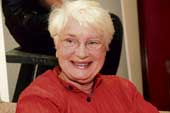
| Liz Calder in Calcutta on Thursday. Picture by Sanjoy Chattopadhyaya |
Liz Calder is the attractive face of Bloomsbury, the independent British firm that launched Harry Potter. But two decades ago, Calder had launched another wizard: Salman Rushdie.
Calder, 67, visiting the city on a British Council project, says it is the ?same thing? that leads her to pick out writers. ?An original voice. And authors who write about partly imaginary worlds, but explaining the real world and people,? says the founding editor of Bloomsbury, who also launched Julian Barnes and Anita Brookner. ?The book should take you somewhere you don?t know. To new places of the mind,? says Calder.
This is as true of Rushdie, as of Rowling, who has single-handedly changed Bloomsbury?s ?fortune? (Bloomsbury?s turnover is ?109 million; and half of its business is said to be Harry Potter.) But she makes other people more responsible for the sensation that is Rowling.
?It was our children?s editors who discovered Rowling. She writes vividly, with great wit and the ability to create loveable and believable characters,? says Calder. Their marketing official Rosamund Delahaye, she adds, ?single-handedly created the buzz around Harry Potter with word-of-mouth publicity, banging on about him?. She also cannot stress the importance of networking enough.
The publisher owns up more to Rushdie. In 1975, Rushdie?s Grimus was Calder?s first commission at Gollancz, the UK publishing firm that she had joined after her stint as a fashion model, if a half-hearted one, for a few years in Sao Paolo. She is still in love with Brazil, though, where she has founded a literary fest, FLIP, and finds Calcutta a bit like Brazil in its ?energy and buzz?.
?Grimus didn?t please the critics. We both wondered if we were in the wrong business.? She joined Jonathan Cape later, and persuaded the firm to buy Midnight?s Children, after Rushdie had dropped a pivotal character on her advice.
?It was a little tough selling Rushdie,? she recounts. ?They asked ?who is this writer who has sold only 700 copies?? But I was used to arguing my case from Gollancz, where I had to argue everything with my boss,? says Calder, her eyes twinkling. ?Cape agreed? The Booker was a wonderful surprise.? It changed everything.
As the first woman on the board of Jonathan Cape, Calder was responsible for another change. When she joined, the list was all-male. That changed. Authors commissioned by Calder include John Irving, Michael Ondaatje and David Guterson as well as Margaret Atwood, Angela Carter and Joanna Trollope.
?I would not prefer a woman writer to a better writer who is a man, but I was actively looking for women writers,? says Calder, who was behind the Orange prize, the woman?s alternative to the Booker.
In 1986, she founded Bloomsbury, which did well as a start-up, but hit the jackpot with Rowling in 1997. What after Harry Potter? ?We have acquired two companies, one in New York, another in Berlin. We are building up our non-fiction area? And Harry Potter may end with Book 7, but J.K. Rowling will not stop writing.?
Calder ? here as part of Creative Future, a British Council talent hunt to spot young minds with the best business ideas ? says she is also looking out for Indian authors, aware that ?someone in a College Street caf?? may be writing a novel.