 |
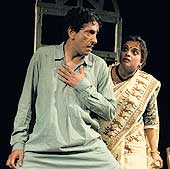
| Screen to stage: Sabyasachi Chakraborty and Kheyali Dastidar in a moment from Charbak’s Chalo Patol Tuli, staged on Friday at Kala Mandir, in association with The Telegraph. The play is directed by Sabyasachi and Arindam Ganguli. Proceeds will go to the All Bengal Women’s Union. Picture by Bishwarup Dutta |
Over the last 10 years, Ganakrishti had lifted itself from the crowded realms of middle-level Bengali theatre groups into a name to reckon with and high visibility on the local stage. Then last year it imploded under bitter internal dissension, and many of us wondered whether it could ever rise from the ashes. Well, it has proved the doubting Tapases wrong with two new productions, both well worth viewing.
First, it blasts the myth that committed Bengali troupes cannot stand a hearty laugh. Taskar Brittanta, from The Virtuous Burglar by Italian Nobel Prize-winner Dario Fo, is a riot. By adapting a lesser-known Fo play, Amitava Dutta does a service to Bengali theatregoers, familiar only with Fo’s Accidental Death of an Anarchist. Despite the communism common to Fo and the group theatre, the latter has evinced no great interest in exploring his other work it has with Brecht. One hopes that Ganakrishti shows them the way.
From the opening sight of a cat burglar breaking into a dark flat, Taskar Brittanta keeps the audience on its toes — with humour, not suspense. The thief gets helplessly embroiled in the marital infidelities of two couples, to the disgust of his own faithful wife when she gets to know. The political point that Fo makes uproariously is that a petty crook’s activities pale before the fundamental immorality of the bourgeoisie, promiscuously cheating on their own spouses.
Under Dutta’s direction, the four lovers (Tirthankar Mukhopadhyay, Soma Dutta, Soma Naha, Sabyasachi Chattopadhyay) ride a carnivalesque merry-go-round, leaving the burglar (Taranga Sarkar) in the middle awestruck and discombobulated by what he sees and has to go through. Although the dance at the very end is admittedly silly, if you want to laugh your blues away, watch this play.
But if you find farce infra-dig and desire poetic heights from theatre, Ganakrishti supplies that, too, in Meghmanabi. An original concept of the director Jahar Das, it actually stitches together a narrative from widely disparate Bengali verse selected by him. The poets cover the entire spectrum: from Rabindranath Tagore to Sukumar Ray, Buddhadev Bose to Premendra Mitra in the past, such seniors as Sankha Ghosh and Purnendu Pattrea, down to contemporaries like Joy Goswami, Subodh Sarkar, Mallika Sengupta, Sunanda Bhaumik, Abhishek Sarkar and Prabal Chakraborty.
It is easy enough perhaps to choose poems on the theme of woman by this variety of authors. But to weave a story out of them and transfer them into the medium of theatre are difficult tasks that Das has achieved. The plot follows a woman’s journey into disillusion from rural natural innocence to urban experience, including college romance, exploitation, prostitution and disease. The cycle appears never-ending with the birth of another girl child.
Das developed Meghmanabi through the workshop process with young trainees, directing 20 of them in elaborate dance and musical sequences, folk and modern.
Not all succeed equally, and Das certainly could tighten the production, but one must applaud his adventurous and experimental vision in his very first directorial effort.
Ananda Lal
 |
| Ishtishadi being staged at the Greenwood Theatre Festival. Picture by Sanjoy Chattopadhyaya |
The Greenwood Theatre Festival organised by Bengal Shrachi drew to a close on November 7 with a performance of Ishtishadi (The Suicide Squad) by city group Spandan, which won the Tripti Mitra Smriti Puraskar for the Best Production of the Year (City).
Ishtishadi was a take on a corruption-riddled defence establishment in Delhi where arms dealing and fake encounters are taken for granted.
Sometimes like a commercial Hindi film with weepy dialogue, slapstick comedy and coy hints of romance, the scenes do not hang together with characters breaking into Hindi in a presumable attempt at regional authenticity.
Sanskritik Shantipur (Nadia) received the Bijon Bhattacharya Smriti Puraskar for the Best Production of the Year (District) for Ramgaan. Actor and playwright Manoj Mitra was awarded the Utpal Dutt Smarak Samman Lifetime Achievement Award by star guest Amol Palekar, who remarked that “theatre will retain its value in spite of the increasing influence of other media because of the opportunity for live interaction between the performer and the audience which no other media offers”.
Ankur’s treatment of Utpal Dutt’s play Surya Shikar refused realism for the idiom of jatra on November 3 and transported the audience to the age of King Samudragupta where the Buddhist sage Kalahan tries and fails to root out religious superstition through the light of scientific knowledge.
Ankur handled its large cast of 26 deftly, with its corrupt general Hoyogrib who changes under the influence of love as believable as Samudragupta, portrayed as a later-day Nero who prefers to compose poetry although his empire is crumbling.
The pick of the week was surely Homa Pakhi. Directed by Soumitra Chatterjee for Cinetel, it dealt with the loneliness of existence in a fragmented universe.
Soumitra enacted the maverick Professor Niranjan Ganguly with panache, whether reciting Tagore and Sukumar Ray or doing a twist with students. The play slid between past and present, madness and imagination to question the notion of normalcy in an increasingly chaotic world.
Romila Saha