Oct. 16: About 35 per cent of the land in Singur has suffered topsoil loss because of construction at the Tata Nano plant site while 65 per cent of the total 997 acres is fertile for farming, analysts who tested the soil and examined the results have said.

Part of the land was dug up to make a drainage system, water bodies and to lay roads, totalling 35 per cent of the land area which once was the small-car plant.
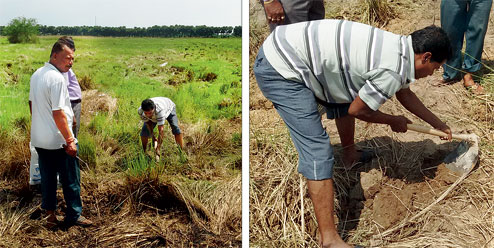
Two farmers, Srikant Sahari and Sailen Sahana, whose plots were untouched by the construction, had taken samples of soil from their land and given it for testing at Vivekananda Samabay Krishi Unnayan Samiti, a co-operative in Hooghly's Mohanbati.
Sahana owned two plots of 12 and six bighas (3.96 acres and 1.98 acres, respectively) and Sahari owned four bighas (1.32 acres).
The results of the samples collected from Singherbheri and Beraberi were sent to Bidhan Chandra Krishi Vishwavidyalay in Kalyani, Nadia, where another analyst interpreted the readings.
Analyst Goutam Chatterjee who tested the soil at the Vivekananda Samabay Krishi Unnayan Samiti and is a former student of the Krishi Vishwavidyalay, and Pranab Chatterjee, a pro-fessor in the Kalyani institute's seed science department, were the two experts this paper spoke to about the results.
Goutam Chatterjee said: "We tested the soil samples three times in a span of 10 days to get accurate results. The delayed and repeated tests were done to get the moisture dried up so that ingredients such as organic carbon and phosphates could be measured perfectly. No major difference was found in the three tests."
The 35 per cent area had built-up structures on 140 acres, apart from water bodies and the drainage system.
"It is not possible to do agriculture right now on the portion where construction has come up or where the land was dug up, even after removing concrete and filling the land with soil taken from outside. It will take a few years get the most fertile portion, the topsoil, back," said Sarthak Burma, a former director in the state's agriculture department.
The Mamata Banerjee-led government had said it wanted to return all the 997 acres to farmers in arable condition.
Minister Partha Chatterjee, who visited the site, said that 870 acres of cultivable land was ready to be handed over to farmers. "Singur is ready. Now we are waiting for the go ahead from the chief minister," he said.
Land without topsoil
The assessment of agriculture scientists was important for 35 per cent of the 997-acre land as a soil test in the area could not be done. The land is either under concrete or roads laid for the factory. Samples could not be collected from the dug-up areas as these were under water.
The top eight inches on any plot of land is called the topsoil. This part contains organic matter and micro-organisms. "It takes years to get fertile topsoil. If the topsoil is buried under concrete or has been excavated, all the biological cycles stop, leaving the land unfit for agriculture even after the concrete is removed," said Pranab Chatterjee, the professor at the Kalyani institute.
In the built-up area in Singur, the topsoil has been under concrete or fly ash for about 10 years.
Solution: Scientists said first the government has to remove the concrete and fly ash from the built-up area and fill the portion with soil. Then, time has to be given for the soil to settle down and only this process can trigger enrichment through micro-organisms and organic matter.
The low-lying areas and water bodies would have to be filled up with soil and the same process followed.
"As the government cannot fill the area with topsoil by cutting it from fertile areas, the farmers will have to wait for a few years, may be 3 to 4 years, to allow the biological cycles in the topsoil to start," said Pranab Chatterjee.
Burma, the former director of agriculture, suggested that the land should be treated with organic fertilisers for the next few years.
With topsoil
Around 650 acres free of any excavation has been uncultivated for 10 years and its topsoil was not affected.
The test results suggest that this portion possesses almost all the required ingredients for a good crop yield.
The presence of organic carbon - the most important ingredient required for cultivation - was found to be within the required limit in the samples taken from Sahari and Sahana.
Pranab Chatterjee, a former resident of Singur and the Krishi Vishwavidyalay professor, said: "The presence of organic carbon is one of the most important parameters. It ensures existence of a range of nutrients that helps in the growth of the root zone of a plant because of increased population of microbes in the soil."
Though the test has found the soil to be slightly acidic, scientists said the range is close to natural level and would not have much impact on yields.
Soil analyst Goutam Chatterjee said: "Generally the soil with a pH below 7 is considered acidic and above 7 is considered alkaline. The available pH level of 6.89 and 6.91 found in the two plots is close to neutral level of 7." This is near ideal for cultivation, he said.
The soil samples have been found to be poor in potassium. While the desired range of potassium is between 240kg/hectare and 350kg/hectare, the Singur samples gave readings of 192kg/hectare and 180kg/hectare.
"Potassium is an essential nutrient in soil that is required for proper growth and reproduction as well as the immunity of plants. It is considered important like nitrogen when it comes to nutrients. But these can be treated easily," said a scientist.
Solution: Scientists suggested sufficient use of vermicompost - compost with worms - or decomposed dung and phosphate soluble bacteria are needed to overcome deficiency such as the lack of potassium.
Additional reporting by Uttam Dutta