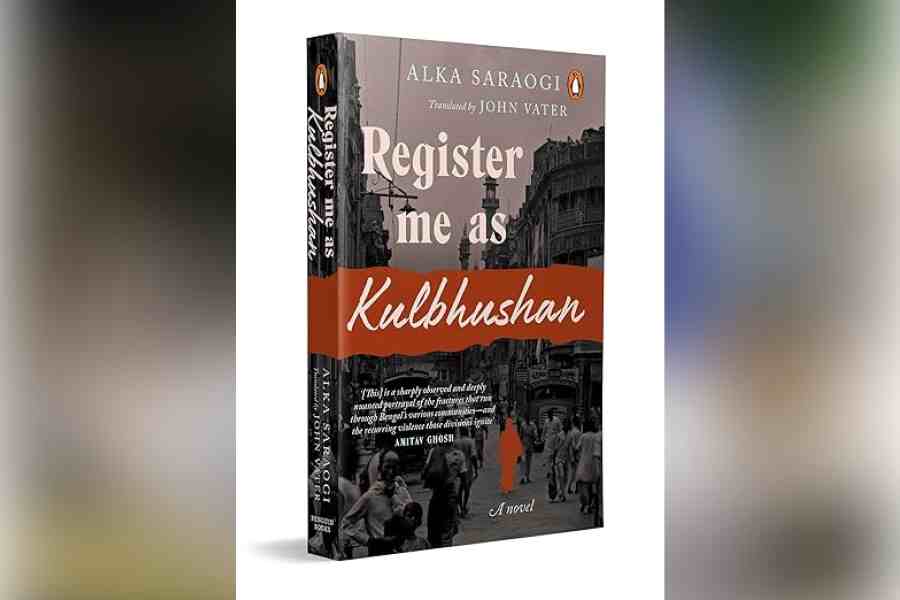
An uncanny and discomforting similarity emerged when we started reading Register Me As Kulbhushan. While Alka Saraogi’s Kulbhushan Jain was searching for his identity as East Bengal was at the precipice of a new chapter in its history in the late 1960s, we were witnessing a changing political landscape in the state dominated by debates and discourses on identity politics and citizenship a few months ago. The nightmares of Partition and who belongs where haunted people.
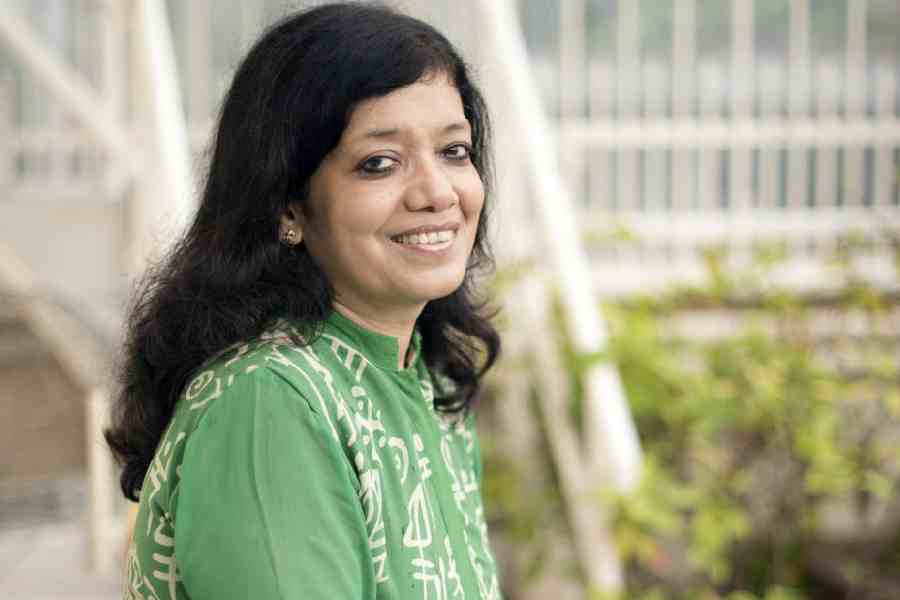
The English translation of the novel, written originally in Hindi in 2020, was released recently, making us revisit the Partition of 1971 — citizens turning into refugees, families being displaced, lives being lost, nationality and livelihood changing overnight, homes no longer secure, and the question of identity looming large. Saraogi, who won the Sahitya Akademi Award in 2001, and who was 11 when the Bangladesh Liberation War started, recalled, “When I was growing up, there were so many refugees. We lived on a major artery of the city, Hazra Road, and we could see so many refugees walking by. One day, I saw my grandmother crying a lot because she had seen another woman, who looked like she was from a good family, wearing a white sari like her, rummaging through the garbage to find something to eat. The whole thing stayed with me. One saw how refugees in those days were suffering. They must have left behind their homes and their comfort zone and their country and probably their rivers, like Kulbhushan.” These memories impacted Saraogi greatly, and over the years, it became much bigger, ultimately shaping up into Register Me As Kulbhushan.
The issue of migration and refugees is not local or national, but transcends boundaries and is a burning topic in many Asian, European and American countries. News of deportation, families risking lives to cross borders, people living in camps and new border policies being implemented keep making headlines. Though Saraogi — who has books like Kali-Katha Via Bypass, Doosri Kahani, Over To You Kadambari, and others in her repertoire — acknowledges it as a global one, the issues at home feel more personal and stronger to her. “It is very much a global issue, but living in Calcutta and having lived through them, I think that matters a lot. There’s no denying that it is universal in its scope, but, at the same time, it’s very personal to me. I have spoken to so many people, heard their aching stories about migration and forced migration, literally like a journalist.”
Joining us, John Vater, an American writer and literary translator currently based in Singapore, who is quite familiar with reading different kinds of arguments and data points and policies on issues like migration, started by praising the book. “What I appreciate about this book is that it stripped away a lot of the academic hair-splitting of the refugee debate by placing it squarely into the perspective of somebody who had lost his home, somebody who had moved to a new land and had to build a new life there, and also the way that he was treated and discriminated against,” he shared, pointing out how Kulbhushan acts as cipher for the experiences of many different types of refugees in the world.
Yes, Kulbhushan, who belonged to a wealthy Jain family in East Bengal, and who was forced to look for greener pastures and move to an unfamiliar city, Calcutta, and start life afresh, was a refugee at many levels. His ‘refugeeship’ was not just defined by external borders but internal as well. He was a refugee in his homeland, and he was a refugee in his family. Shedding more light on it, John added: “Kulbhushan’s experience is personal, but also it is a bit more expansive. I think it’s very important that we have this type of work of literature, and Alka’s creative perspective to show us what the human story of these refugees is, is commendable. Also, it’s important to read a book like this so that we can empathise with them and not just look at them as data points or numbers.”
We ask the Oklahoma-born translator if, as an American living in an Asian state, he had any encounter with the subject. Speaking from his experience, which is not as visceral as Alka’s, John shared how the refugee and migration issue is unfolding in the US. “In Oklahoma, which is along the southwest part of the US, it is quite common to see a lot of Mexican workers who do landscaping and construction work. For a very long time, people did not really ask a lot of questions about whether they had all their papers in line or not because it was understood that they were doing good work and that it wasn’t a political issue. But more recently, it has become a political issue, and a lot of grievances have been manipulated around the idea of ‘the other’.” John also informs how, moving to Singapore as an American, he has become much more aware of the kind of cultural fault lines and differences that exist.
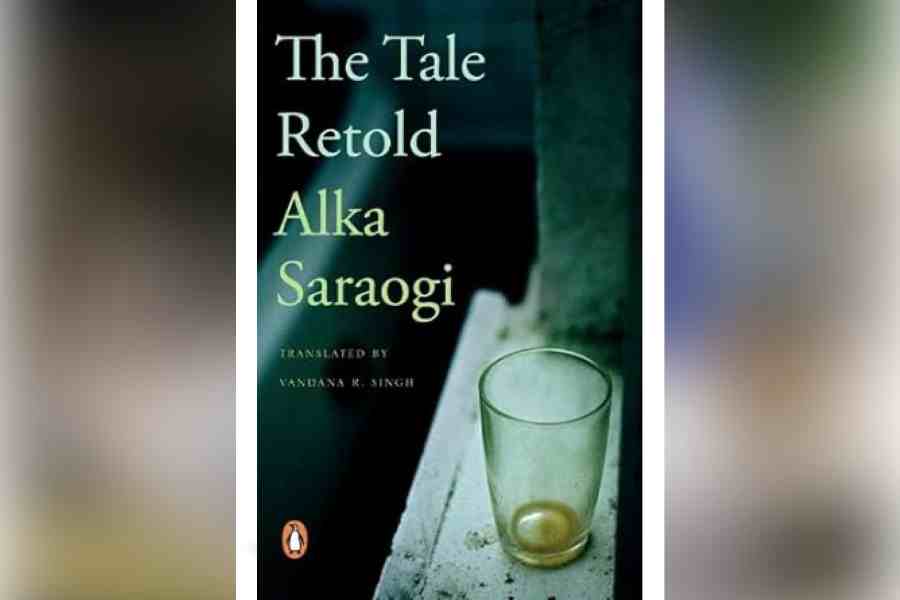
Bringing the focus back on the novel, Alka pointed out how her first book, Kali-Katha Via Bypass, published in 1998, talked about the Marwari migration from Rajasthan to Bengal, which is different from the migration that her latest novel explores. “There are two types of migration, and this book is about forced migration: when you are forced by the larger political powers who do not care about so many people getting dislocated and disenfranchised. They have to reassemble their lives from the scraps of memories that they have.
They have to forge new identities,” said Saraogi before discussing the layers of her protagonist, Kulbhushan.
“It’s the story of a man who has many names, and he sets out to find his true identity among the many selves that he’s forced to adopt. It’s not that he’s done it willingly. He’s been forced to adopt that. So these fragmented selves, and these divided nations, the boundaries, tell you this story of longing and yearning; to belong, to be known by the name that was given by his parents,” decodes Saraogi, pointing out how Kulbhushan had to adapt a new name, a Bengali name, Gopal Chandra Das, to survive.
Sharing his view of Kulbhushan, John weighed in, “I felt intrigued and enchanted by Kulbhushan’s character. Partially because he’s a bit of a mystery and a paradox, and also a mystery tohimself. He is trying to figure out where he belongs, and who he is or who we are amidst many different cross-cutting identities and how we say that story to ourselves.”
Complementing Kulbhushan’s story is a parallel narrative about adhobi or washerman, which is equally intriguing and layered. The plot gets thicker and so does the question of identity with Shyama Dhobi, who, though belongs to a lower caste, was treated equally by Kulbhushan. “As a writer, I felt that there are so many strands of injustice in our society. And one of them is the caste system. I’ve been reading a lot about dhobis, off late, and how so many dhobis have now come into the mainstream, doing other things. You had so many dhobis who had migrated to Calcutta. In fact, there was one in Kachrapada whom I visited and spoke to. He also migrated during the same time as Kulbhushan.”
John’s explanation about the need to have a parallel narrative to Kulbhushan’s story made more sense. “I think if the book were only about Kulbhushan, then it would have been very limited and confined to one particular realm. Also, I think another accomplishment of this novel is that it brings a very complex, very multi-religious and ethnic space like Asia, into one cohesive narrative, which is extremely difficult. Without Shyama we wouldn’t really understand Kulbhushan’s desperation, his paradoxes, the caste system, the hierarchy and everything that made his character so layered and interesting,” shared John, who is working on his debut book.
Before we wrapped the conversation, we had to ask Saraogi, who is almost ready with her new book, about the “forgetting button” that both the protagonists had at their disposal. A unique concept that adds a magic realism of sorts to the serious novel, the author explained: “Don’t you think that people in India, most of them have a forgetting button? Otherwise, how do you see people going smiling about their lives? I have been talking about voluntary amnesia and whitewashing of history in Kali-katha Via Bypass. But this is some other kind of amnesia; if you want to survive, you have to forget. The way Kulbhushan goes about so joyfully, with all the humiliations that he has to bear within the family and in the outer world, it will not be possible without something like a magical potion or a button.”
It only made us wish that we all had a forgetting button, or a reset button that would help us erase a bad memory or a bad feeling. The world would be a better place.