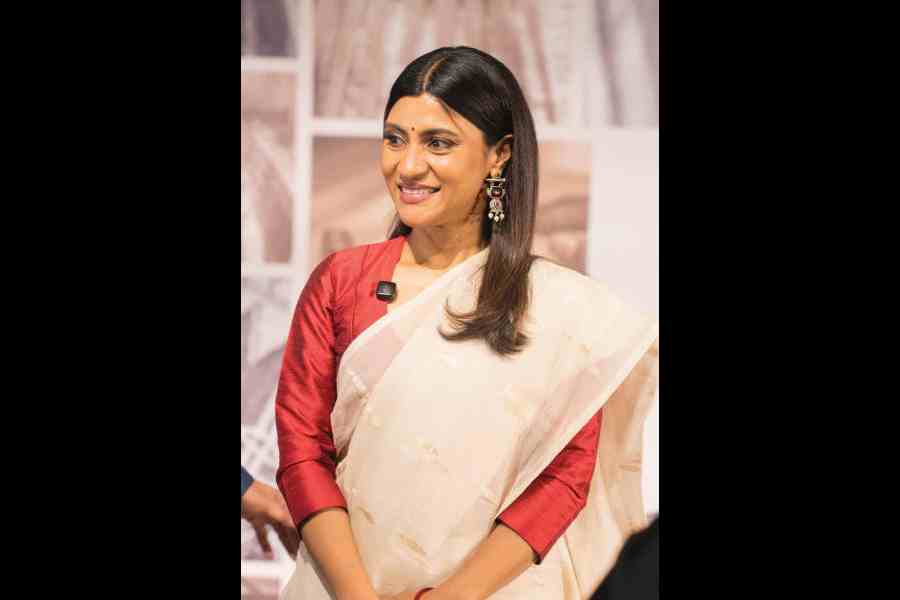
Aadyam Handwoven, the corporate social enterprise from the House of Aditya Birla, recently celebrated its ongoing collaboration with actor-filmmaker Konkona Sensharma through an intimate gathering in Mumbai. Rooted in a shared belief in authenticity and meaningful storytelling, the association highlights the human stories behind India’s rich handloom traditions, while reinforcing the importance of sustaining artisan livelihoods.
Speaking about the collaboration, Konkona shared her reflections on growing up around handloom and her admiration for Aadyam’s commitment to keeping the artisan at the centre of the narrative. Adding to this, Manish Saksena, buisness lead at Aadyam Handwoven, spoke about how Konkona’s cultural sensibilities and storytelling ethos align seamlessly with the brand’s philosophy of creating #HeirloomsForTheFuture, and how through initiatives like #CultureBeyondTextiles, Aadyam continues to expand the role of craft in contemporary culture, bridging textiles with music, performance, and storytelling. Konkona took some questions from t2 on the association, what handloom and heritage mean to her and more.
What spurred the association with Aadyam and how does the brand’s philosophy align with your personal beliefs?
It didn’t require much deliberation, honestly. Textiles have been part of my life since childhood very organically. So when I encountered Aadyam, something clicked.
What also struck me is that they aren’t just selling beautiful things. They are building an ecosystem with weaver communities across Bhuj, Varanasi, Pochampally, Gadwal, Kashmir, and beyond as genuine partners, not extractors, and that matters to me. My own sensibility has always leaned towards authenticity over spectacle.
What can you tell us about Aadyam’s #HeirloomsForTheFuture philosophy and what makes you believe in it?
The idea that an heirloom is not defined by age, but by the meaning it carries, resonates with me. We tend to think of heirlooms as things already old, already consecrated by time. But every heirloom that exists today was once new. Someone chose it, cared for it and decided it was worth passing on. That act of considered keeping is what makes something an heirloom and not time alone.
What are the earliest memories that shaped your love for handloom and textiles?
Growing up in the home I did, surrounded by cinema, literature, art... aesthetics were never separable from everyday life. I remember the saris my mother (actor-director Aparna Sen) wore. The soft cottons in her cupboard, the particular rustle of a good silk. These weren’t things explained to me, they were simply there, and I absorbed them the way children absorb everything, the way it just sits with your subconscious mind. Then, of course, there is the native cultural context and its relevance that plays its own role in how an individual sees their everyday life and wearables.
What more, in your opinion, can be done to honour and promote the artisan communities of India?
The most fundamental thing is fair, consistent livelihoods, which requires sustained effort. There is a kind of engagement with craft that is essentially touristic. We arrive with enthusiasm, buy something, feel good, and move on. What artisan communities need is something steadier and not transactional at all times... more reliable demand.
Visibility matters too — the kind that comes with genuine storytelling. When you know the name of the weaver who made your sari, the relationship between you and the object changes entirely... it becomes personal. Brands like Aadyam Handwoven play an important role here by creating sustained platforms for artisans, rather than one-time exposure.
We see you wearing a lot of saris. Besides your love for it, is there a specific thought that goes into wearing them?
There is thought — but it is more instinctive than deliberate by now. A sari isn’t separate from how I am feeling or what I am trying to communicate in a particular context. There is something about the drape that is both anchoring and freeing. You have to be present in a sari — it requires a certain awareness of your body, your movement. I actually like that.
There is also a quiet political dimension, though I resist making it into a statement. Choosing handloom in spaces where so much else competes for attention is a choice. One I make consciously, even if it doesn’t feel like a grand gesture. Sometimes the most meaningful things are quietly, stubbornly ordinary.
And, practically, a well-chosen cotton sari in a beautiful weave is just deeply comfortable. I am not very interested in beauty that requires suffering.
Though the costumes on screen are first in service of the story and the character you are playing, is there a way in which you try to ensure that they showcase our handloom heritage in any way?
The costume’s primary duty is always to the character and story and that is non-negotiable. You can’t impose your own preferences on that.
But when there is latitude, when a character’s world allows for it, I do gravitate towards handloom naturally. I don’t go into every project with a mandate about handloom. What I try to do is remain open to the possibility.
What is your favourite textile, one which you also feel spells comfort and sustainability?
Cotton, without hesitation. Handwoven cotton, specifically. Nothing is more comfortable. It breathes, softens with washing, improves with age. From a sustainability perspective, it makes profound sense. The handloom consumes no electricity. The process is slow, but clean. And the cloth, when it completes its life, returns to the earth. Compare that to synthetic fabric, and there really is no contest.
I am also deeply drawn to traditional dyes — particularly indigo. There is something timeless about its depth and character... it ages beautifully and carries with it a long history of craft and natural dyeing practices.
I also think about the communities around cotton — the farmers, the spinners, the dyers, the weavers.... When you choose handwoven cotton, you are participating in an economy that has sustained millions of people across this subcontinent for centuries. That kind of rootedness isn’t nostalgia, it is good sense.
Is there a sari or any other piece of clothing that you have inherited from your mother that you absolutely cherish?
Yes. My mother has given me a few saris over the years. There is a particular Batik sari with mukaish work. It is from the ’70s and I don’t see saris like that anymore. There are also some lovely Dhakais that my mother wore and passed on to me. There is also a Tanchoi that my mother has worn and I have too.