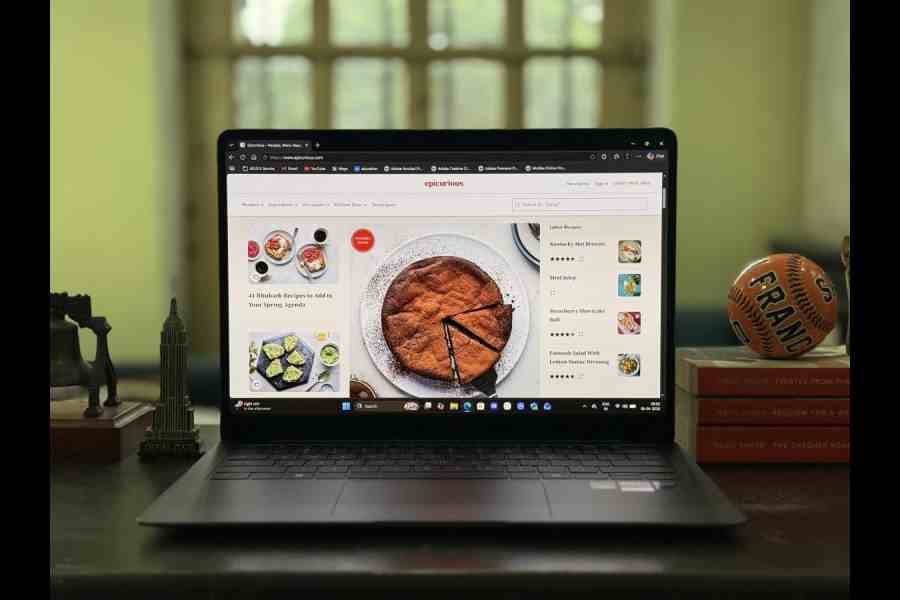
Windows laptops have long had a reputation for being clunky and, at times, rather uninspired in their design. The new Samsung Galaxy Book6 Pro does a fine job of turning that notion on its head, thanks to its ultraportable build, excellent OLED touchscreen, and a capable chipset. In many ways, it goes toe-to-toe with a MacBook Pro.
The design has been refreshed and is thinner than ever. At just 11.6mm (14-inch model), it’s about the thickness of stacking two Galaxy S25 Edge devices — impressively slim by any standard.
Coming from an M4-powered MacBook Pro, which had been our daily driver, the first thing that really stands out is just how light the Samsung machine feels. You can choose between a 14-inch and a 16-inch display, but at roughly 1.24kg, it’s wonderfully portable. It slips into a bag with ease and can be carried around all day without so much as a second thought.
The 16-inch variant is equally compelling, though it’s better suited to a desk setup at home or in the office. Trying to use a 16-inch laptop on a plane, given the rather tight squeeze airlines offer these days, would be quite the tall order.
There’s a smart silver finish across the chassis. The Samsung logo sits centred, though interestingly closer to the lip of the lid. Open it up and the branding is clearly visible. It’s tasteful and not over the top. Build quality is reassuringly sturdy, with barely any flex, even at the centre of the lid.
The design team has clearly thought things through. There are no visible screws at the back, so if you ever fancy opening it up, you’ll likely need to peel off the rubber feet.
In terms of ports, you’re getting a USB-A port, a headphone jack, two USB-C ports (both Thunderbolt 4), and an HDMI port — a well-rounded selection that should cover most bases.
Keyboard, speakers and day-to-day use
What about the keyboard and touchpad? Thankfully, Samsung has made some sensible improvements here. Place it next to a MacBook Pro and you’ll notice a few similarities from a distance — and frankly, that’s no bad thing. On closer inspection, there’s a neat two-tone finish and a set of excellent top-firing speakers.
The keyboard is comfortable for long typing sessions, with a reassuring feel under the fingers. The haptic touchpad is smooth and responsive, and, importantly, perfectly centred — making it easy to use without awkward stretches.
One of the bigger changes is the removal of the number pad, allowing for a centralised keyboard layout that’s far more ergonomic over extended periods. On either side sits a new quad-speaker system, delivering fuller and richer audio than before.
Display, performance and battery life
The first thing that catches the eye is the striking Dynamic AMOLED 2X display. With 1000 nits of brightness in HDR and a resolution of 2880x1800, it’s a proper treat. Crucially, the display remains steady — no wobble — which is especially important given that this is a touchscreen, something Macs still don’t offer.
It’s easily among the best laptop displays going. Text appears crisp with no noticeable fringing, and colours are beautifully calibrated — accurate without being overly punchy. Whether you’re editing photos or videos, it holds up admirably.
You can comfortably use it in bright sunlight or in a dimly lit room. The anti-reflective properties do a commendable job of handling glare. Add to that sharp contrasts and vivid detail, and it becomes a joy for watching your favourite shows or YouTube videos.
The sRGB coverage comfortably exceeds 100 per cent, while the DCI-P3 colour gamut hits the mark without making colours look overcooked.
Under the bonnet, you’ll find Intel’s latest Ultra Series 3 processor. Our unit runs the Intel Core Ultra X7 358H, paired with integrated graphics, 32GB RAM and 1TB of storage.
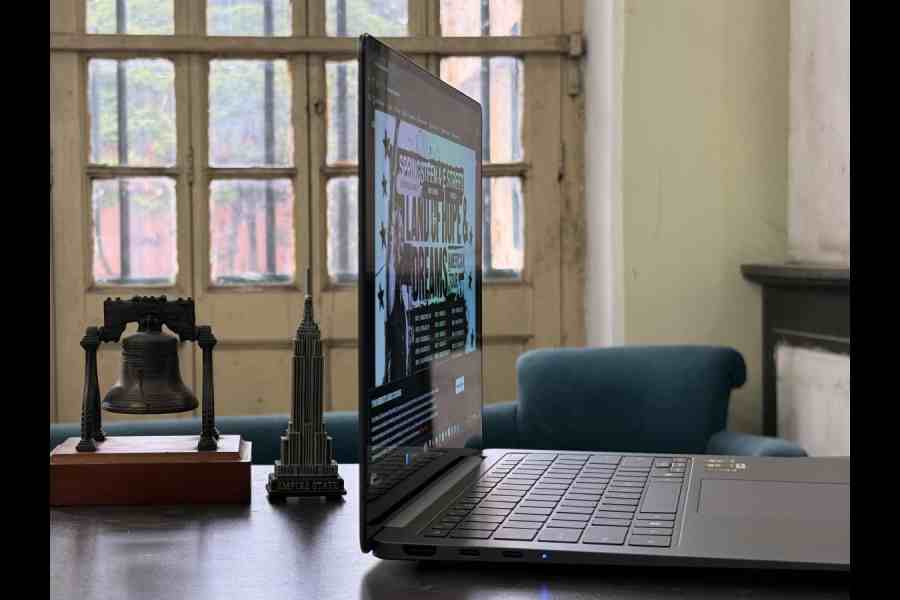
Samsung Galaxy Book6 Pro can be bought with up to 32GB of RAM and 1TB of SSD storage, has Wi-Fi 7 and Bluetooth 5.4.
Plenty of people will turn to benchmarks like Cinebench, and while the scores are impressive, they only tell part of the story. Day-to-day performance is what really matters, and on that front, the laptop acquits itself rather well.
With an integrated NPU that delivers up to 50 TOPS (trillion operations per second), AI-driven tasks like image cleanup, instant translation and intelligent search happen instantly, without relying on the Cloud. This is well equipped for AI-related tasks.
Even gaming on battery is surprisingly capable. Street Fighter 6 runs at 60fps, Battlefield 6 can nudge close to 100fps on medium settings, and Tekken 8 also delivers 60fps. Not bad at all for a slim machine running unplugged.
Battery life is another strong suit. Heavy AAA gaming will drain it in around three hours — to be expected. But in everyday use, including office work, some video editing, and media playback, you’re looking at anywhere between 15 and 18 hours. Even with a bit of gaming in the mix, it comfortably manages around 15 hours.
Thermals are handled well too. The laptop never becomes uncomfortably hot — not even on the keyboard deck — which is always reassuring.
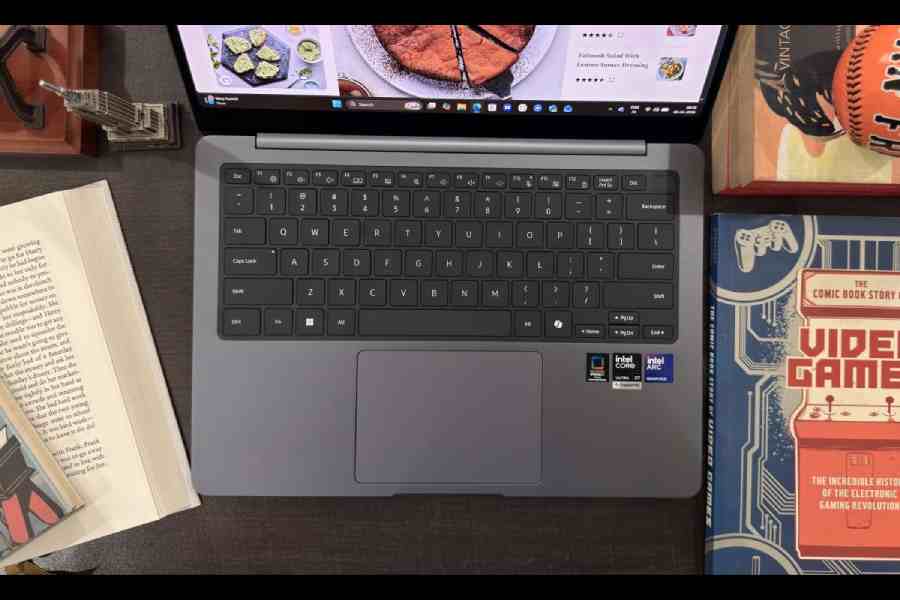
The keyboard sits dead centre, providing a more natural feeling typing position. It looks neater than before.
If you compare performance to a MacBook, Apple’s advantage comes in the form of a tightly integrated hardware and software ecosystem. Apple plans out its feature set and fine tunes the chipset to deliver exactly those. That said, Samsung has done a commendable job here.
There are a couple of things one might have liked to see. For a machine aimed at professionals, a full-sized SD card slot would have been handy.
Even though it runs Windows, Samsung has added a few thoughtful touches. Quick Settings, for instance, is far more intuitive than the usual Windows clutter. If you’re using Galaxy Buds or a Galaxy phone, pairing is seamless, and file transfers are pleasantly straightforward.
Samsung is also leaning into its Galaxy AI branding. Features like AI Select and AI Cutout bring a touch of smartphone-style convenience — highlight text for instant information or quickly remove a background from an image.
If you’re already part of the Samsung ecosystem, you’ll appreciate how well everything works together. You can drag your cursor onto a Galaxy tablet or edit photos from your phone as though they were stored locally.
That said, while these AI features are clever, they don’t fundamentally change how most people will use the laptop day to day. They’re nice to have up your sleeve, but not essential.
Both the Samsung Galaxy Book and Apple’s MacBook aim to offer portability without major compromises. Each has its own strengths in terms of design and usability.
The call
Where Samsung has a clear edge is the touchscreen. Steve Jobs may have famously dismissed the idea, citing hand/finger fatigue, but times have changed. Touch has become second nature, and it feels like a natural addition here.
Performance is brisk, the design is premium, and battery life is genuinely impressive. Even with an OLED panel — typically quite power-hungry — managing over 15 hours is no mean feat. It places this machine firmly alongside the MacBook Pro when it comes to all-day endurance. You can, quite happily, leave the charger at home.
Choosing between the Samsung Galaxy Book and a MacBook ultimately comes down to priorities and ecosystem preference. But when compared with most Windows laptops, Samsung is clearly ahead of the pack.
Carved out of a solid block of aluminium, the Samsung Galaxy Book6 Pro is not just a handsome bit of kit — it’s arguably one of the finest Windows laptops for the modern office-goer, and very much in the running for the best of the year.
At a glance
Device: Samsung Galaxy Book6 Pro
Price: ₹214,990 (32GB RAM, 1TB storage, 14 inch, Intel Core Ultra X7 processor 358H)
High notes
- Ultra-thin and lightweight design
- Premium aluminium build
- Stunning AMOLED 2X touchscreen
- Excellent colour accuracy and brightness
- Strong everyday performance
- Capable of casual AAA gaming unplugged
- Long battery life for daily use
- Comfortable, well-centred keyboard
- Useful Samsung ecosystem features
Muffled notes
- No full-sized SD card slot
- Premium pricing