
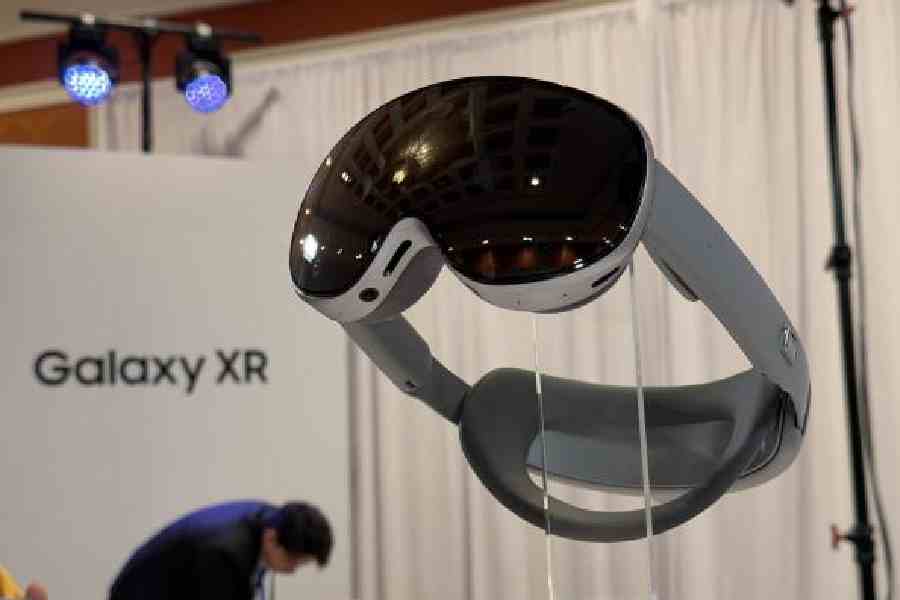
In 2024, Apple’s Vision Pro was undoubtedly the most ambitious bit of kit to hit the shelves. Since then, it has been busy gathering momentum and winning over a vast cohort of developers. But what of those on the other side of the fence? For the Android faithful, Samsung has stepped up to the plate with the Galaxy XR, a mixed-reality headset born from a high-powered collaboration between Samsung, Google, and Qualcomm.
We had the opportunity to experience an in-depth demo on the sidelines of the Consumer Electronics Show in Las Vegas. What sets this particular gadget apart is its “multimodal AI” experience. In plain English, it has deep integration with Google Gemini.
A different sort of device
Formerly known as Project Moohan, the Galaxy XR is Samsung’s maiden voyage into the world of extended-reality headsets. While it is clearly designed to give Apple a run for its money, it goes about its business with confidence, rather than attempting to out-shout the competition.
The device runs on Google’s Android XR platform and comes stuffed to the gills with sensors. It handles eye tracking and hand tracking with aplomb, meaning you can navigate the digital world without faffing about with controllers. That said, if you are looking to get stuck into some gaming or serious work, you can pick up a pair of optional controllers or even pair it with a PC, wireless mouse, and keyboard.
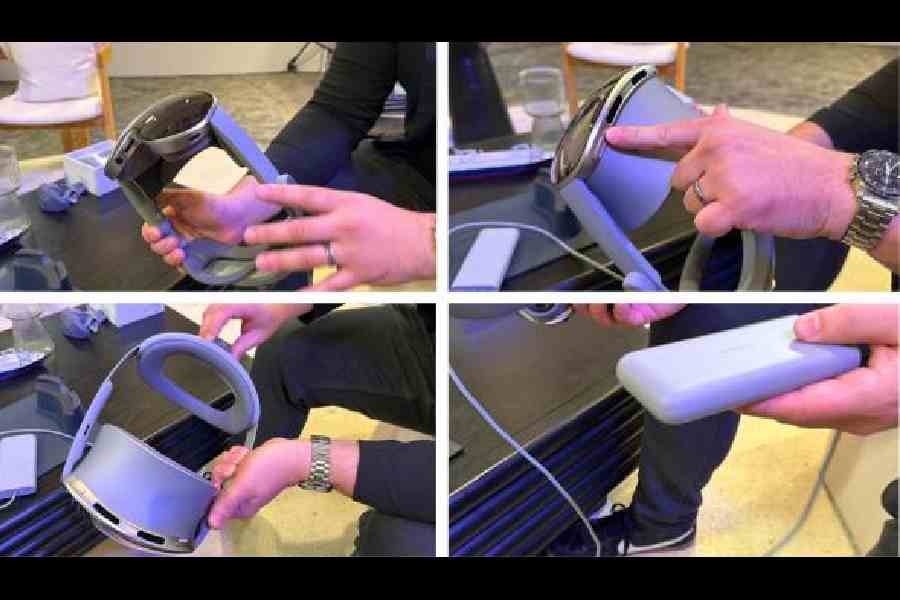
(Clockswise from top left) Below the main display are sensors, easy control for volume, battery pack and using the rear fit dial. Picture: Mathures Paul
Comfort is king
From the front, one notices a significant sensor array for tracking one’s every move, with even more tucked away at the bottom. The headset is lined with a collection of cameras and features a removable, cushioned head pad that makes the whole thing feel remarkably posh.
There is a physical adjustment knob at the back that allows you to dial things in with a simple twist until it is sitting snugly. Compared to the Vision Pro, the Galaxy XR feels lighter. It is not nearly as front-heavy, and getting the fit right is a completely fuss-free affair.
For those of us who rely on prescription spectacles, one can have the lenses customised. While one could technically wear the device with glasses on, it is a bit of a bodge; it will not activate the eye tracking properly and is not recommended. To help with the fit, Samsung has included two different spacers to ensure there is just the right amount of breathing room between your face and the glass.
An open outlook
One of the most striking differences is how “open” the Galaxy XR feels. By default, it does not completely wall you off from the real world. Your peripheral vision stays partially clear, which is a godsend if you want to avoid tripping over the cat or knocking over your tea.
If you do wish to disappear entirely into a digital cocoon, there is an optional “light seal” available.
As for the aesthetics, it is very much in the eye of the beholder. If you are a bit of a tech-head, you will likely find its futuristic charm rather appealing. More importantly, it feels secure. At no point during our time with it did it feel as though it might slip off or cause a neck ache. In many ways, it feels like a spiritual successor to the earlier Oculus headsets.
By leaving the peripheral vision intact, Samsung has made a distinct philosophical choice. Where Apple’s design feels like a solitary retreat into a private cinema, the Galaxy XR acknowledges that we still live in a shared world. It is a device for the person who wants to browse the digital ether without entirely snubbing the person (or the cat!) sitting on the other end of the sofa.
Much like Apple’s offering, the power comes from a small external battery pack connected by a cable. You simply pop it in your pocket and go about work. It is a sensible trade-off; it keeps the weight off the headset, which is no bad thing when you have a computer strapped to your face for a couple of hours.
Gemini: The brains of the operation
The Galaxy XR simply would not exist without the combined forces of Samsung, Google, and Qualcomm. The primary selling point here is that artificial intelligence is the beating heart of the device. Most of the bells and whistles revolve around Google’s Gemini, particularly within the various Google apps.
Netflix, YouTube, and the usual Google staples are all present and correct, with Gemini woven through the lot. Gemini is always on standby, and this deep integration is arguably the headset’s “killer app”. The assistant understands what you are looking at, responds to your voice or gestures, and generally gets on with the job without needing a lot of hand-holding. You can look at an object, give a little gesture to highlight it, and the information pops up almost instantly. It is quite effective.
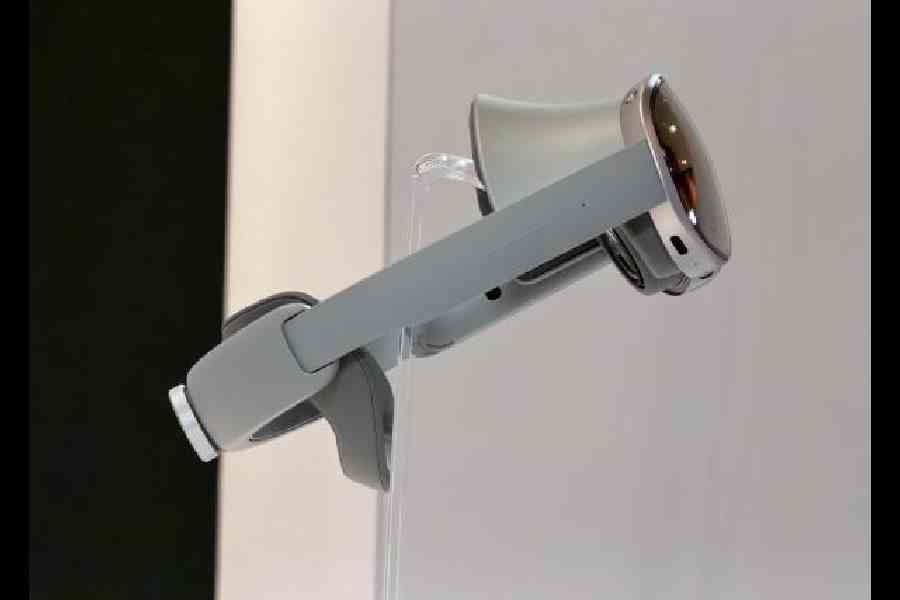
Snapdragon XR2+ Gen 2 processor delivers 15 per cent higher GPU and 20 per cent higher CPU performance than previous generations. Picture: Mathures Paul
The presence of Gemini feels less like a tool and more like a cognitive layer. When you can look at a landmark or a line of text and receive an answer instantly, the act of “wondering” begins to change. We are moving away from the era of the ‘search query’ and into a world where information is simply an atmospheric quality of the room.
The viewing experience
The display resolution and field of view are broadly on par with the Vision Pro. Samsung has managed to deliver similar visual fidelity but in a package that is lighter and, crucially, carries a much more sensible price tag.
While we were not allowed to film the actual displays, the visuals were top-notch. It uses dual 4K micro-OLED panels that are bright, punchy, and thoroughly immersive. Text rendering is very tidy indeed — though Apple still holds a slight lead in the “crispness” department. For watching films or falling down a YouTube rabbit hole, however, you will have absolutely no complaints.
Photos in the gallery have been “spatialised”, giving flat images a subtle sense of depth. Even old 2D YouTube videos get the same treatment, and it worked a treat in our testing. Watching Netflix across multiple floating windows felt slightly indulgent, but in the best possible way.
Exploring from the sofa
Gemini is never more than a whisper away. You can ask questions about what you are watching without ever leaving the app. Google Maps is a particular highlight in XR; you can pinch and zoom your way across the globe, examining landmarks in incredible detail. We spent a good portion of the demo wandering around Central Park in New York without having to leave the comfort of the room.
Even in the middle of a noisy, bustling demo area, Gemini handled language translation without breaking a sweat. When we asked it to translate Bengali, it got it spot on — a first for the headset, and a very satisfying moment indeed.
A professional touch
While the Galaxy XR is perfect for a bit of quiet time at home, it has a serious side too. One of the more impressive demos involved a patient on an operating table. Suddenly, we were in full Grey’s Anatomy mode, performing something like an intubation. Unlike the television show, where the medical accuracy is often a bit “creative”, here everything was pitch-perfect. At the end of the procedure, you even receive a score... minus the over-the-top drama of a Hollywood hospital.
The final reckoning
Physical controls have been kept simple: A power button, a dedicated Gemini button, and volume controls. The app ecosystem is still finding its feet, which is to be expected at this stage. Apple currently has the lead in terms of sheer numbers, but Samsung’s platform is catching up at a fair old lick.
Audio is another pleasant surprise. The built-in speakers are rich and full, with a convincing sense of space. While the Vision Pro remains the gold standard for sound, the Galaxy XR comes impressively close.
The Galaxy XR appears to be a solid product for the price. At $1,799.99 for the 256GB model, it is roughly half the price of the Vision Pro. Depending on your specific use case, we think you are getting value for the money.
Things will undoubtedly improve for VR headsets in the coming months. We are reminded of the early days of Android versus iOS, where both platforms competed for their share of the audience. “Feel” is an important element when it comes to mixed reality... that sensation of moving windows around, snapping a window to a wall, and allowing it to have its place in your world. It all feels important, and both headsets get it right.
In terms of an overall recommendation, if you are already in the Apple ecosystem, you know your options. Furthermore, one can now acquire a used Vision Pro M2 for a lower price. There are definitely some edge cases where you are going to get more value out of that new M5 processor, especially when it comes to peak performance.
For Android users, the Galaxy XR is an easy recommendation. It undercuts the Vision Pro by nearly $1,700. The clever use of plastic makes it lighter and far more comfortable for long-term use. It is a device that does not feel as though it is trying too hard to show off.
The new M5 Vision Pro should keep Apple in the performance lead, but if you want a sneak peek of what the future of mixed reality looks like, the Galaxy XR is a solid evolutionary step forward for spatial computing. Ultimately, if you are already part of the Apple fold, you will likely stick the Vision Pro. For those using Android, this is a smashing start from Samsung. It fits perfectly into the Android environment, has a proper YouTube app (crucial!), and boasts AI features that actually feel useful. It is an exciting new chapter for spatial awareness.
The Galaxy XR marks the opening of the gates, the moment a niche fascination becomes a legitimate industry. We are witnessing a new marketplace take shape.