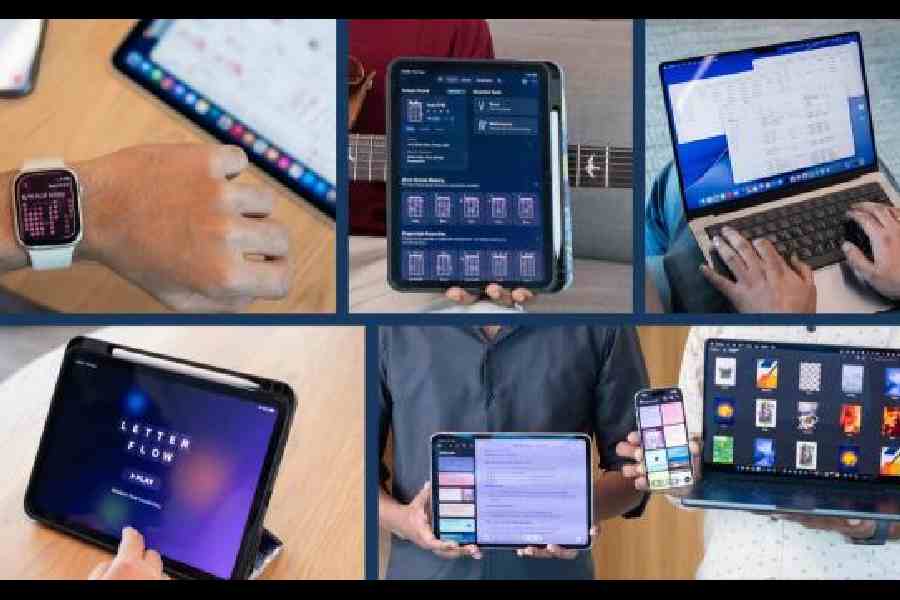
Many readers could be feeling the embrace of Andy Weir’s words, the man behind Project Hail Mary. He has been writing for years. The Martian is another of his famous novels that originally began as a blog. He wrote what pleased him. App development can be much the same.
Developers often stumble upon problems and come up with solutions, many of which make their way to Apple’s App Store before finding popularity around the world.
The life of an app developer can be rewarding, and especially joyful around this time of year as they prepare for Apple’s Worldwide Developers Conference, which this year will take place between June 8 and 12.
There are many developers in India making a living through app development. Recently, we had the opportunity to meet several of them in Bengaluru. They shared their experiences of building apps and spoke about how it can be a financially sustainable career.
Peak: Fitness meets flexibility
There is a particular kind of tranquility that settles over a city during a lockdown. No honking, no crowds, no gym bags slung over shoulders on the morning commute. We all remember the world that swallowed us in 2020.
For Harshil Shah, an iOS engineer based in Mumbai, that stillness was a mirror he didn’t entirely like looking into.
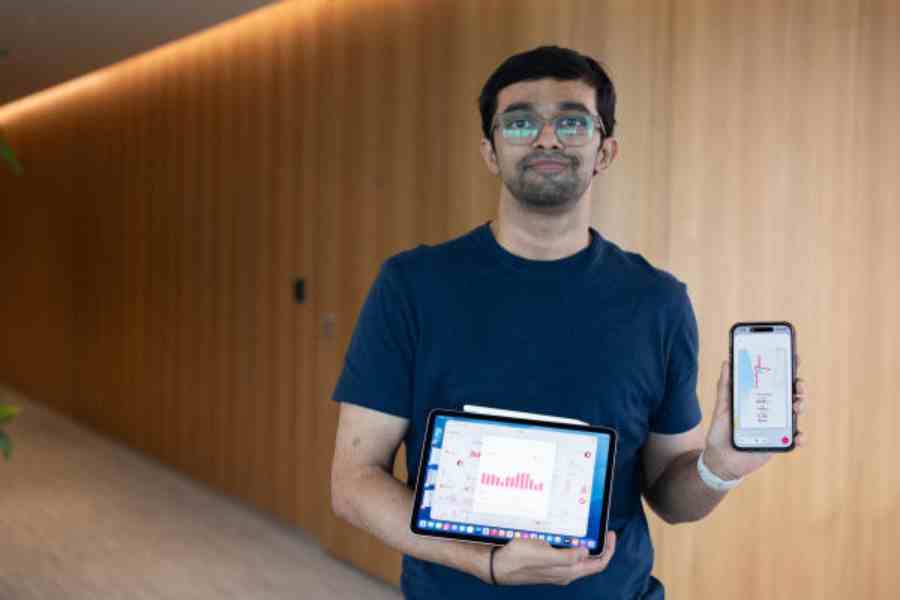
Harshil Shah has come up with the fitness app, Peak
“I was very sedentary and I didn’t like what happened with my body and I decided I need to change,” he says, with the matter-of-fact candour when we meet in Bengaluru.What followed was something extraordinary. Shah, who had previously worked at American companies Riff and Stopwatch building social apps, and most recently on Foodnoms — a nutrition tracker for keeping an eye on protein, carbs, and calories — did what engineers do when they encounter a problem: he tried to solve it with technology.
First, he did what any self-respecting Apple nerd would, he bought an Apple Watch.“I don’t need to buy a gym membership. The Apple Watch comes first,” he says with a smile.
The Watch came with its signature three rings — Move, Exercise, Stand, which is a deceptively simple system that has nudged millions of people off their sofas. Shah found it effective. He also found it, over time, a little rigid.“If I go on a hike, if I go play football with my friends, the next day I just won’t be able to be as active because maybe I would be tired. I wanted some more flexibility.”
There was also something more philosophically unsatisfying about the ring system — the sense that closing three circles each day did not necessarily mean you were getting anywhere. “You can be going to the gym for one month, every single day, but you can stand on the scale and the weight can read the same.”
This gap between effort and outcome, between daily discipline and meaningful progress, is the seed from which Peak grew.
Shah’s insight was that most fitness apps hand you a predetermined framework and ask you to fit yourself inside it. Peak inverts that logic. Built on Apple’s HealthKit platform, the app lets users construct their own health dashboard, choosing metrics that matter — steps, workouts, activity rings, sleep, and more — and populating it with blocks like charts, goals, totals, and trends. Every widget can be themed for light and dark mode. The experience feels less like filling out a form and more like decorating a room.
“There are some people who want to gain weight. There are some people who want to lose weight. There are some people who want to walk more. There are some people who want to lift more. So the app is built with customisation in mind. The idea is every single person can build and track exactly whatever they want to.”
It also takes a gentler approach to goal-setting. “Every year in January, a lot of people will be like joining a gym because of New Year’s resolutions and then they give up after the first or second week. You can’t set out from one day going from zero workouts a week to seven workouts the very next day.”
Peak nudges users toward flexible, incremental targets and gives them the longer view — weekly and monthly patterns — that makes it easier to see real change even on days when the scale refuses to cooperate.
Privacy, Shah emphasises, is not an afterthought. “Health data is sensitive, so privacy is an important issue.” Peak uses no Internet connection. There is no tracking, no data collection. “Your data is used locally, retrieved from HealthKit, and that’s it. It does not leave your device ever.”
The app launched in July 2023 and was swiftly picked up by 9to5Mac. A significant proportion of users come from Germany — and one of them, entirely unprompted, localised the entire app into German. “He helped localise the app by himself, for free, without a request, without me saying anything, he just offered it.”
That gentleman still handles German translations with every new update. Shah has since added Spanish himself.
The app also supports wheelchair movement tracking and VoiceOver for users with motor and visual impairments.
The most affecting feedback arrived from a user who said Peak was helping them manage body dysmorphia — the condition characterised by an obsessive preoccupation with perceived physical flaws. “This sort of a response,” Shah says, “it just makes me feel very happy.”
There is a philosophy baked into Peak that is also, in a sense, autobiographical. “I am the number one user. The best person to solve a problem is someone who has that problem.” Since beginning work on the app, Shah has lost 30 kilograms.
What Peak ultimately offers is something the wellness industry rarely does: a framework that adapts to human life rather than demanding life adapt to it. Weddings happen. Injuries happen. Long nights at work happen.
A good health app, Shah believes, should know that and help you keep going anyway.
Pockity: Smarter money habits
There is something radical about a developer who admits, without embarrassment, that he has had a poor relationship with money. Nikhil Nigade, an indie developer with 16 years of experience, speaks like someone who has simply lived the problem and decided, in the way that engineers tend to, to build his way out of it.
“I’ve struggled with budgeting, tracking my expenses. And I’ve had a very poor relationship with money in the past. So I wanted to fix this,” he says.
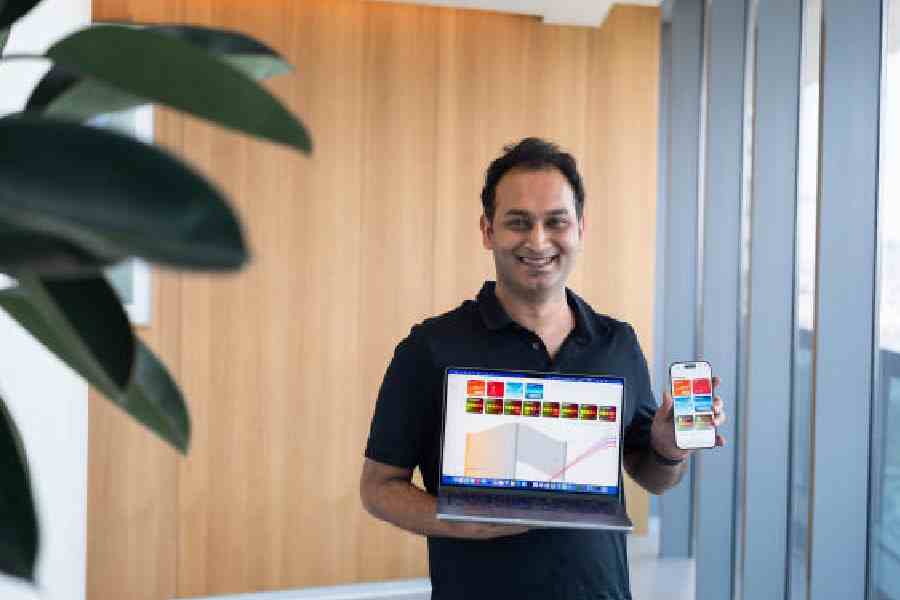
Nikhil Nigade is behind Pockity
“To understand where my money goes, I decided to make Pockity.”
Pockity, his privacy-friendly budgeting and expense tracking app, has been in development since 2017 and launched in 2019. It sits in a crowded category — finance apps are among the most downloaded on any platform — yet it approaches the problem from an angle that most of its competitors don’t bother with: what if managing money didn’t feel like a chore?
The app is built on three pillars, Nigade explains: privacy, accessibility and localisation. The first is non-negotiable in a category where your financial ledger is, arguably, one of the most intimate documents you own. Pockity syncs exclusively through iCloud, and only if you choose to enable it. “If you don’t have it enabled, no problem; it’s always only on that device.” No third-party servers, no data harvesting, no quiet clauses buried in a privacy policy.
Notably, the app also supports shared ledgers — a thoughtful feature for couples or families managing household spending together, though Nigade notes, with a wry pragmatism, that sometimes we hide things from a spouse or parent as well.
Accessibility and localisation are where Nigade leans heavily on Apple’s frameworks — pre-built collections of code, resources, and interfaces that allow indie developers to punch well above their weight. Pockity is currently localised in nine languages, with more in progress. For a one-person operation, that is no small feat.
But the feature that genuinely sets Pockity apart is its use of natural language input. Rather than navigating a series of dropdown menus and form fields, you simply type — or dictate — something like “350 breakfast at Cafe Max” and the app does the rest. Category, amount, merchant: all prefilled in seconds. If you have a monthly budget set for food, Pockity will immediately tell you how much of it remains after the entry.
“This is okay if it was the beginning of the month,” Nigade says, “but maybe a critical factor if you’re towards the end of the month.”
The app’s widget system extends this logic into the physical world. Picture yourself at a supermarket, arms full of grocery bags, with neither the time nor the hands to open an app and fill in every field.
Pockity’s widget lets you log the amount instantly — say, ₹450 — and optionally capture your location. “When you come back to the app, you can go back and dive in with more information,” Nigade explains. “If you’re out throughout the day, shopping with your kids, with your spouse, or with your friends — these location markers are gonna help. They will act as hints.”
Beyond the basics, Pockity offers a surprisingly robust set of tools for those who want to go deeper. There are visual charts for breaking down income and spending by account, category, month, quarter, or year.
The app can scan receipts with automatic edge detection. It takes automatic backups. On macOS, power users can reach for AppleScript to generate custom reports, trigger Apple Shortcuts for hands-free logging, or even interact with their financial data via a Model Context Protocol server — a feature that lets AI tools speak directly to your ledger.
The double-entry accounting system ensures every transaction is fully accounted for. These are not features you typically find in an app designed to feel approachable.And approachable is the word Nigade returns to.
“I want Pockity to be personal, approachable, and not feel like a chore, which is the case with most other financial management apps.”
The budgeting system reflects this: each category can have weekly or monthly limits, and once you hit them, you hit them. There is no rollover. “This kind of helps you anchor yourself into spending just that much and build a habit.”
Nigade describes himself, with some amusement, as an accidental engineer. “I’m not supposed to be here, but I am here.” He has been at this since school, where computer science classes sparked something that never really left. “I go on to think about my problems and solve them using technology.”
Apple has been in touch for several years, helping him navigate various aspects of development over the years.
Sixteen years in, the passion, evidently, has not dimmed. Pockity is what happens when someone stops waiting for the right app to exist and simply builds it themselves.
Zoho Notebook: Beyond note taking
The modern smartphone is overflowing with apps that solve individual problems. One app records audio. Another handles reminders. A separate one scans documents. Yet another transcribes meetings. Somewhere between all this, productivity starts feeling exhausting. That is the problem Zoho Notebook is trying to solve.
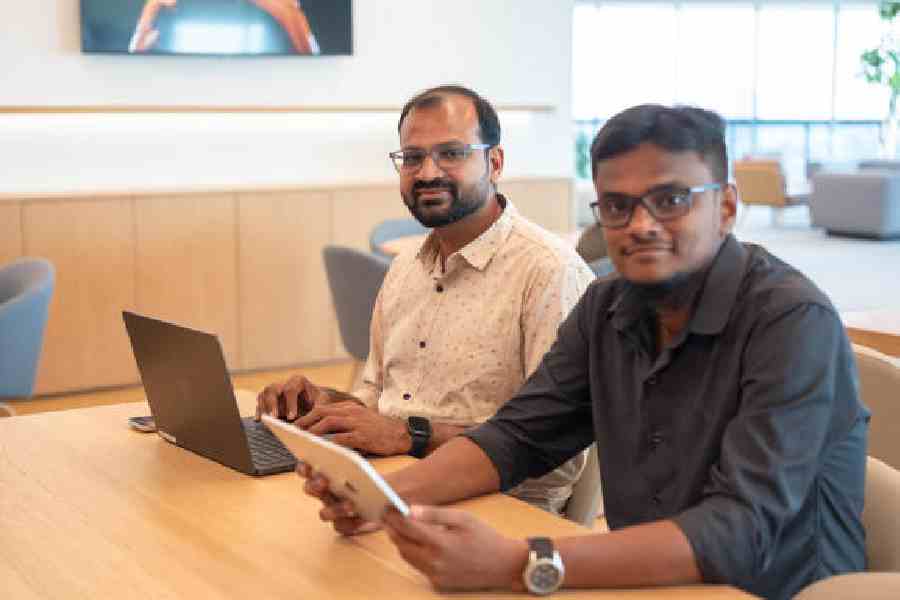
Mohideen Sheik Sulaiman and Ashok Ramamoorthy from Zoho Corporation; they have worked on the highly successful app Zoho Notebook
Built by Zoho Corporation, Notebook began as a note-taking app in 2015 but has steadily evolved into something much broader — a digital workspace where users can write, sketch, record lectures, scan documents, organise reminders and even generate AI-powered summaries from conversations.In a conversation with Mohideen Sheik Sulaiman (principal architect, Apple Platform) and Ashok Ramamoorthy (director of product managment), the two executives spoke about how the app was built around three ideas: native performance, privacy and design.
“We wanted to give a real experience to Apple platform users,” said the Zoho representatives.
“The devices already provide smooth animations and a connected ecosystem experience, so we decided to fully go native instead of relying on cross-platform technologies.”
That decision shaped Notebook from the very beginning. The app launched in 2016 with support for iOS 10 and has continued to evolve alongside Apple’s ecosystem ever since.
Today, it runs across iPhone, iPad, Mac and even the Apple Vision Pro.Zoho’s scale within Apple’s developer ecosystem is larger than many people realise. The company now has more than 500 iOS developers internally, and every year during Apple’s Worldwide Developers Conference, teams gather to discuss new technologies and features announced by Apple.
Notebook’s philosophy extends beyond performance optimisation.“Privacy is not a feature; it is a product in itself,” said the representatives. “Privacy is in Zoho’s DNA.”
That stance feels increasingly relevant at a time when many productivity apps are deeply tied to data collection and advertising models. Notebook remains ad-free, and Zoho repeatedly stressed its focus on protecting user information through strict internal policies.
The app’s design language also reflects a conscious departure from traditional productivity software. Instead of plain text-heavy layouts, Notebook uses colourful cards and different visual identities for each type of content. Audio recordings look different from checklists. Sketches feel separate from scanned documents.“We wanted to give users an aesthetically pleasing interface,” said the representatives.
More importantly, the app tries to reduce the constant switching between different tools.
“If you want to record something, you usually open a separate app. If you want reminders, you move somewhere else. If you want to draw, there is another app for that,” said the representatives.
“We wanted all of this to happen inside one application.”That explains the sheer breadth of features packed into Notebook. Users can create text notes, make to-do lists, sketch ideas, scan printed documents, capture videos and record audio directly inside the app.
The AI-driven tools are where the experience starts becoming more layered. Record a lecture or a meeting and Notebook can generate transcriptions with timestamps. The app can also identify key discussion topics and organise them into structured summaries.
“There is an option to view the discussion as a mind map,” said the representatives. “You can directly go to a topic and listen to the exact point where it was discussed.”
For students, the functionality feels especially useful. Lectures can be recorded and converted into searchable text. Teams can structure meeting notes and reminders inside the app. Researchers can organise material through tags, linked notes and scanned references.
Notebook also includes handwriting recognition, allowing handwritten notes to become searchable later. Its document-scanning tools can preserve layouts while converting printed pages into editable text.
The app can even scan business cards, extract contact details and convert them into shareable contact files.
What is notable is that Zoho rarely speaks about AI in the exaggerated language common across the tech industry right now. The company seems more interested in quietly integrating these tools into everyday workflows rather than treating them like standalone headline features.
Notebook’s user base has steadily grown alongside that approach. According to Zoho, the app has crossed eight million downloads across devices, with more than a million users on Mac alone.
The company has also focused heavily on localisation. Notebook now supports over 30 languages, including 10 Indian languages.
“We want the app to feel global while respecting regional preferences,” said the representatives. “For users in countries like Japan or China, dates and numerical formats appear in ways familiar to them.”
The team is now working with technologies linked to Apple Intelligence as Apple expands its AI ecosystem across devices.
Yet despite all the AI integrations and productivity features, Notebook’s core ambition remains fairly simple. It wants to become the one place where daily digital clutter feels manageable — whether that means organising research papers, recording lectures, planning meetings or simply remembering to buy groceries on the way home.
Letter Flow: Learning through play
One of the most meaningful apps to emerge from the Covid-induced pandemic was Lil Artist — a product born from creativity, curiosity, and a great deal of free time. Behind it are siblings Arima Jain and Aman Jain, two developers deeply embedded in the Apple ecosystem.
Now, the duo is back with a new offering: Letter Flow, an app that takes full advantage of the Liquid Glass design language introduced with iOS 26. Like its predecessor, the app is aimed at children and, once again, places learning at its heart.
Much has remained the same between the two launches, though one thing has changed notably — Aman’s circumstances. He is now dedicating himself entirely to app development, while Arima is currently in the second year of her bachelor’s degree.

Aman Jain and Arima Jain, the developers of Letter Flow
Arima’s path into the world of technology was anything but conventional. “My journey didn’t start with coding,” she explains. “It started during the lockdown, like everyone else’s did. I had a lot of free time, I’ve always liked drawing, and so I thought I’d try my hand at graphic design. I watched some YouTube tutorials, and I even made an NFT collection — those were quite popular at the time. I ended up selling a few of them.”
Aman, a self-taught iOS developer, began his journey while still at college. He is a WWDC Scholar from 2016, a milestone that set the tone for his career. Arima followed in her own right, participating in the WWDC Swift Student Challenge in 2022 — and winning. That victory proved to be a turning point. She is also Distinguished Winner of this year’s Swift Student Challenge.
“To be honest, for a 16-year-old, that was more than enough motivation,” Arima recalls. “I started learning through Paul Hudson’s 100 Days of SwiftUI. I made a game called Crack the Code, and it made me realise that perhaps I could pursue this as a career.”
The lockdown also gave the siblings a broader perspective. With children glued to screens and starved of meaningful engagement, Arima and Aman saw an opportunity — and Lil Artist was born.
When Apple unveiled iOS 26 and its Liquid Glass design language, the duo saw another opportunity worth celebrating. “I play Wordle quite a lot,” Arima admits with a smile. “That gave me the idea for this new app. It’s very interactive.” The result is Letter Flow, an engaging word-based experience for young learners, wrapped in the fluid, translucent aesthetic that defines iOS 26.
Although the app is still new, Aman says it is already finding takers both within India and beyond. “We’re seeing demand for native languages,” he says. “We recently integrated Apple’s Translation APIs and now support over 15 languages.” To illustrate the point, the two gave a live demonstration of the app in Spanish — and it worked flawlessly.
Their relationship with Apple has also been a source of support. “We are in constant touch with Apple and they are always ready to help,” says Aman. On matters of design in particular, he notes, the company has been especially forthcoming.
At present, Letter Flow operates on a freemium model, with the first 30 levels available at no cost. “We’re targeting ages four and above, and we’re planning to categorise content by difficulty level,” says Arima.
For Aman, life looks quite different now that app development is his full-time pursuit. “I’m able to sustain myself and do what I love. Lil Artist is generating decent revenue, and I’m hopeful Letter Flow will follow suit.” Artificial intelligence has also played a quiet but significant role in how the pair work. “We’re able to build much faster,” he notes.
Arima elaborates on how AI has transformed their content pipeline: “Previously, we used to outsource the stories and then create artwork for them. It could take weeks to complete a single story.
Now, we use foundation models to generate the narrative and an image creator to produce the visuals. A whole new story comes together in a fraction of the time.”
Guitar Wiz: Chords meet code
Steve Zubin Alfred has been playing the guitar for 19 years and has performed with a handful of Mumbai-based bands, most notably The Western Ghats, which has enjoyed considerable success. For some time now, he has been a user of the app Guitar Wiz, and his role has been to get it “in the hands of guitar players all over the world and then get their honest feedback.”
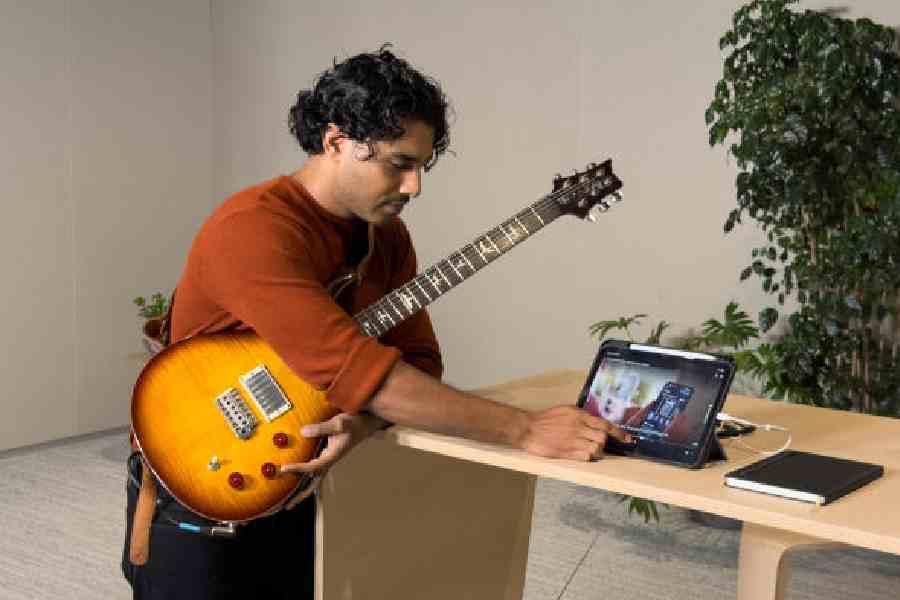
Steve Zubin Alfred is associated with the app Guitar Wiz
“Being in the music industry and also working as a guitar instructor, I have a pretty good idea of what effective practice looks like,” Alfred says. “And I’m equally familiar with the frustration points that come with it.”
The man behind Guitar Wiz is Bijoy Thangaraj — software developer, music producer, and entrepreneur. He is the founder and CEO of JSplash Studios, a Bengaluru-based company specialising in music education and performance tools. Thangaraj has been crafting innovative iOS applications since 2011, blending technical expertise with a genuine passion for music.
“Bijoy is an extraordinary musician and a professional piano player — he’s just the whole package,” says Alfred. “He and I go back 15 years. We played at church together and he has been something of a mentor to me. When my career was just taking off, he was already successful with apps like Tuner T1 and GtrLib Chords” — the latter being a comprehensive guitar chord library offering every possible chord position across the fretboard, complete with suggested fingering and audio demonstrations.
Thangaraj had accumulated a wealth of feedback over the years, and what he chose to do with it was bring it all together into something deeply personal. Guitar Wiz has since become one of the go-to apps on the App Store. Central to Thangaraj’s vision is accessibility — a value that sits at the heart of the iPhone experience as well.
Guitar Wiz is one of those rare music apps that genuinely delivers on that front, offering a range of thoughtful accessibility features. For example, it addresses the challenges colour-blind users. Alfred says, “Personally, I use the built-in metronome to keep time during practice. Before Guitar Wiz, I needed a separate app to look up chords, another to find song structures, and yet another if I wanted to compose something. It was a fragmented experience — I was constantly switching between apps and it was killing my creative flow. Guitar Wiz has solved all of that. It’s an app built by someone who truly loves music.”
In a market crowded with tools that feel designed by engineers for engineers, Guitar Wiz stands apart. It is the product of a musician who understood the gaps, gathered the feedback, and had the skill to close them — one feature at a time.