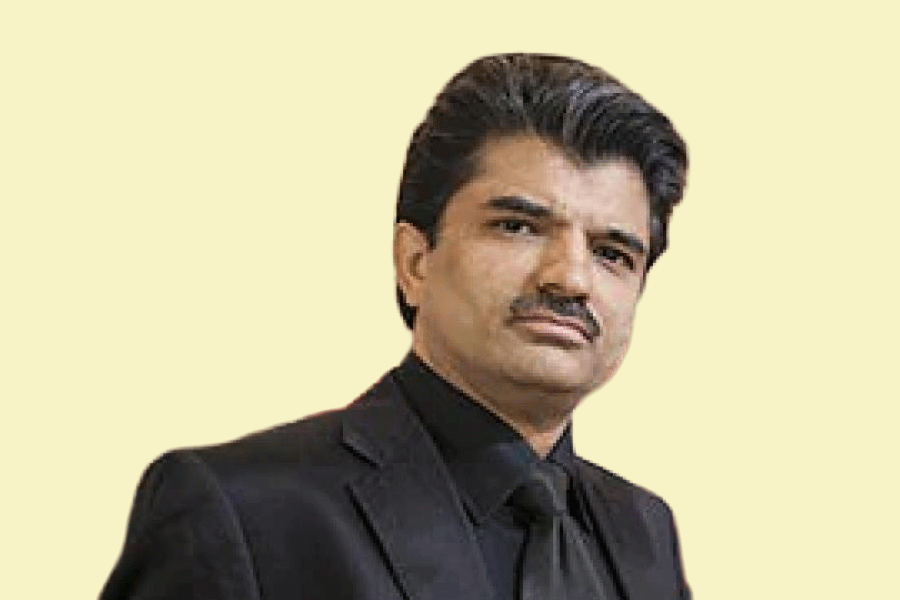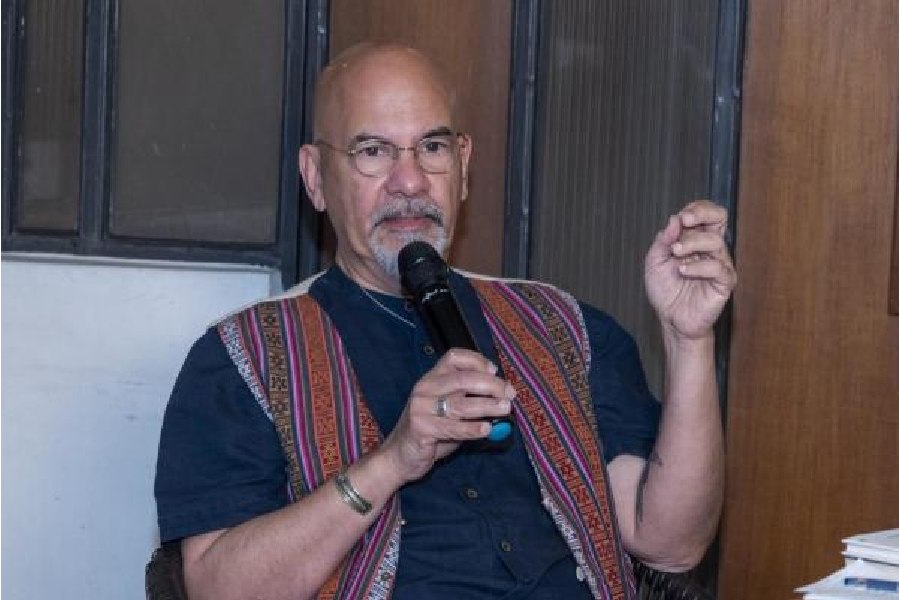
Nirmal Ghosh wears multiple hats. Born in Calcutta to German parents, he has been a former foreign correspondent who has written about politics and elections. He is also a passionate wildlife conservationist. And in between these two very serious pursuits, resides a poet. Ghosh, an alumnus of La Martiniere for Boys and St. Xavier’s College, has written half a dozen books and his latest one, The Weeds that Grow in Cemeteries, is an anthology of 109 poems of love, loss, longing and nature, and has a Haiku spirit.
The author and poet was recently in conversation with Julie Banerjee Mehta at the Rising Asia Literary Circle session at The Bhawanipur House. Before getting on his debut book of poetry, he shared the genesis of his pull towards nature. “My father was a hunter, and I was dragged out and taken to the wilderness. I learnt growing up in that background, and we travelled to jungles, wetlands, paddy fields... I learnt the language of the forest and migration of the animals, interpreted the call of the birds, and all of these have stayed with me,” said Ghosh, sharing that his Blue Sky, White Clouds, which he wrote while working in Switzerland, was like a therapy, as he missed the wilderness. The other titles in his oeuvre include Indian Wildlife: A Selection, The Jungle Life of India, and Lord of the Grassland.
Appreciating and giving out the dominant flavour of his prose like Blue Sky, White Clouds, Mehta said: “What strikes you is a haunting feeling of impending doom somewhere on the horizon; of being trapped, something that a human would feel.” Further, Mehta made Ghosh recall his father and in a surreal way, he explained that “We are a manifestation of our parents. My father very well lives in me.”
Coming back to the themes, Ghosh shared that coincidences, confluences and fates in life fascinate him. “I am fascinated with these intersecting worlds that carry forward into human relationships and I try to express it through my poetry.” And it worked like an antidote to him, a refuge from the world full of intensifying anxiety of being a foreign correspondent.
The discussion soon segued to Ghosh’s writing process, and given that he has worked for 30 years on deadlines, he shared, “With creative writing, it’s different. I have the freedom as the deadline pressure is not there, but I become directionless. However, it’s good for poetry because poetry comes in short creative bursts.”
Coming back to poetry and his latest book, it was evident that it is a form that has proved liberating to him. He quoted English novelist Martin Amis: “A novel has to have shape and momentum, a poem stops the clock.” With this liberating form, he expresses himself and follows Haiku’s spirit — minimal and impactful. He shared that he was impressed by the classical Japanese poetry, its minimalism, and elegance. “I was drawn to the minimalist style. In three lines, you can describe a scene and leave the rest to the imagination of a person. It resonates like a piece of art,” shared Ghosh, taking all through his Wild Cranes, an installation in Chinese calligraphy, which aimed to create beauty during a time of anxiety and challenge prevailing narratives.
“The crane symbolises longevity, freedom, faithfulness, and beauty across Asian cultures,” summed up Ghosh. The audience that consisted of passionate readers, fans of Ghosh and his writing, got to know about his fondness for graveyards and cemeteries. Refusing to term it macabre, he quoted Margaret Atwood’s words, “In the end, we’ll all become stories”, and shared his experiences of visiting war cemeteries and a memorial in Washington DC.