Actor Trina Saha completes a decade in Bengali television tomorrow — 10 years of living under relentless studio lights, of slipping in and out of women who slowly found permanent homes in the hearts of audiences across Bengal. With this shoot at Bunaphile Roasters on Southern Avenue, t2 revisited five of Trina’s most loved looks from across her television journey, dressed in creations by designer Roy Abhisek. With every drape, hairstyle and gesture came flashes of memory: the uncertainty of her early days, the thrill of finding acceptance, joy, heartbreak, reinvention and survival. Between shots, Trina sat down with a cup of coffee in hand and reflected on ambition, and the lessons television has taught her: emotional endurance, the strange intimacy actors develop with their characters, and the quiet milestones that continue to matter more to her than the idea of fame itself.
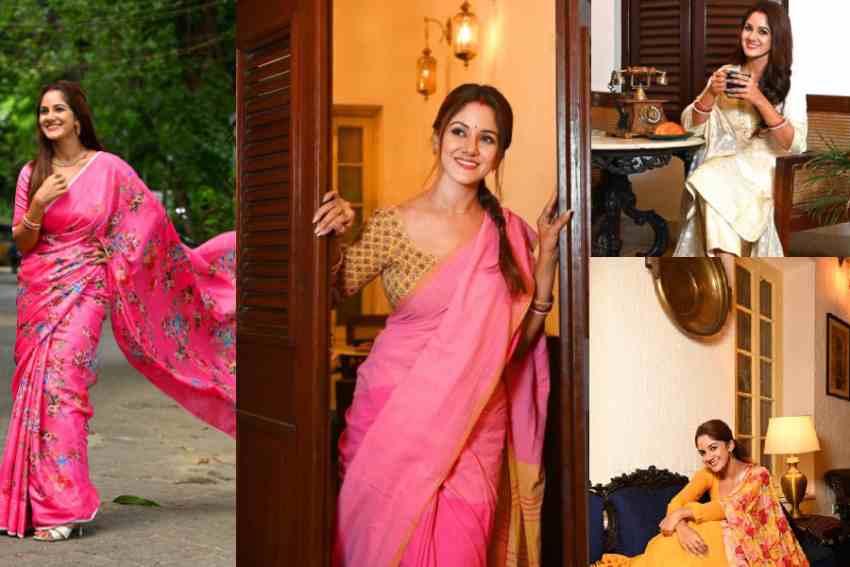
Trina Saha's majestic shots from the photoshoot
Ten years in television is no ordinary milestone. When you look back at your journey, what feels most transformative about the woman and actor you have become?
First of all, I was not an actor at all. I had never done modelling, never done theatre, never even explored anything remotely connected to performance. I genuinely did not know how I would look in front of the camera. I had no understanding of framing, expressions, shots — nothing. Today, when I look back, I feel grateful that I have at least learnt the craft. I now know how to face the camera, how to give a shot, how to understand a scene emotionally. These 10 years have been like an education for me... learning something at every stage. Every project taught me something new. Every mistake taught me something important. This industry shaped me from scratch.
The shoot revisits five of your most iconic characters. Was there one that felt unexpectedly emotional or different to step back into?
Honestly, every character has been deeply personal to me. Every serial becomes your baby after a point. You live with these people and these emotions for years sometimes — you cannot simply detach yourself from them. But yes, Koler Bou remains extremely close to my heart. Tepi’s hairstyle became a conversation at that time. She was this completely uneducated village girl who knew almost nothing, who loved food, who behaved innocently and foolishly in many situations. There was something so pure and vulnerable about her. Playing her became an emotional experience for me.
At the same time, Khoka Babu can never be separated from my journey because it was my very first serial. I still remember the floral saris from that show — they became so popular then. Revisiting that look immediately took me back to those early days. And then there is Khorkuto. That project came after a long gap and after Covid. It was my first project after that phase, and the love it received was overwhelming. Gungun became part of almost every household conversation. Even today people talk about her with so much affection. So, wearing those costumes again during the shoot made me very emotional and nostalgic. It felt like revisiting different chapters of my own life.
How has your relationship with your on-screen personas evolved over the years? Do you still carry parts of them with you?
Completely. You carry them with you whether you realise it or not. Especially in television, where you spend such an enormous amount of time living as that character. I think every role I have played has had something emotionally relatable about it. For example, in Khoka Babu, I was completely inexperienced. I had never acted before. Playing Tori — this spoiled, privileged girl who slowly changes because of love and relationships — was difficult for me then. But audiences connected with her transformation because people understand emotional change.
Then in Koler Bou, I played Tamasha, a robot daughter-in-law. I did not even know how to imagine a robot emotionally or physically. So, that role demanded an entirely different approach.
What I have realised is that every character contains some fragment of me. Somewhere, there is a quality, a vulnerability, a habit or emotion that overlaps with Trina. In fact, we learn from our characters too. Most lead characters are written very positively. They represent emotional ideals people long for. Real life is rarely that perfect. These stories are often heightened and idealistic, but we still want to believe in them. Somewhere, even we as actors start carrying a little of that hope within ourselves forever.
How have you managed to keep your performances feeling fresh across diverse roles?
For me, every character has needed to feel completely different — not just emotionally, but visually and physically too. I always tried to create a distinct look, body language and energy for every role. Otherwise, audiences begin seeing only the actor and not the character. Also, after finishing a project, it takes time to emotionally come out of that world. I remember it took me a very long time to move on from Tori in Khoka Babu. Even after starting new projects, that shadow stayed with me. I think Khorkuto helped me finally break away from that hangover a little. Then Parashuram— Ajker Nayok helped further.
A huge amount of credit goes to my producers, directors and channel because they believed I could play such different women. They trusted me with characters that had completely different emotional textures and personalities. And I have to mention Snehasish Chakraborty. Any conversation about my career would remain incomplete without him. He is one of the main reasons I am in this industry today. All these people became family to me. Every time they gave me something new to attempt, they also gave me confidence. They taught me patiently. I owe a great deal to them.
Which of your roles challenged you the most in terms of physical or emotional transformation?
Khoka Babu, without question. That project completely transformed me. One day I was a non-actor holding a script, and suddenly I was expected to perform in front of the camera. I did not even know how to deliver dialogue properly. Everyone around me in that serial was so experienced — Kushal da (Chakraborty), Mousumi di (Saha), Debjani di (Chatterjee), Rupsha di (Chakraborty). I was the newcomer who knew absolutely nothing. But that project became my foundation course in acting. I still remember my Bengali was very weak initially. It has improved tremendously now, and Snehasish da deserves enormous credit for that. I also had a stammering issue in the beginning, while my character required very fast dialogue delivery. That became another major challenge. Snehasish da, Star — all of them became my school. From language to camera presence to dialogue delivery, they shaped every aspect of my growth as an actor.
In revisiting these looks, did you notice any patterns in the kinds of characters you were drawn to? Or the ones audiences connect with most?
Audiences connect most strongly with characters they can recognise from real life. At the same time, audiences also enjoy characters they can fantasise about. I feel fortunate because I got the opportunity to play both extremes.
The industry has evolved significantly in the last 10 years. What changes have you witnessed first-hand?
The industry has changed enormously. Earlier, spending 20 hours on set with your work family was normal. Now schedules are relatively more structured — 14-hour shifts feel manageable by comparison. People have become far more professional. But sometimes I do feel a little warmth has disappeared. Earlier, there was perhaps more emotional closeness on sets. Today things function more professionally and efficiently. Still, for me personally, every project continues to feel like home because I have spent more time with these people than I have at my own home. Especially with Star where I have worked for almost 10 years.
Beyond the screen, how has this decade shaped you personally?
This industry shaped me entirely as a person. The biggest lesson television teaches you is that the show must go on. No matter what happens in your life, work continues. Television made me mentally strong, emotionally strong and physically strong in ways I never imagined possible. This profession demands resilience from you constantly. I grew up in a very protected and loving environment. I never knew I had this kind of endurance within me. But this industry revealed that strength to me. So despite all the exhaustion and emotional pressure, I remain deeply thankful.
How has the definition of success changed for you over the past decade?
For me, success has always been personal and made up of small milestones. During my first project, I bought my own car. That felt huge to me. Then after another project came another milestone. Maybe something for my family, maybe something for myself. These small achievements matter deeply to me because they represent growth. I think success is also about making the people around you proud. My school teachers, my principal — even today they feel so happy for me. As long as you continue wanting more from life, continue dreaming and feeling ambitious, you remain alive creatively.
Hair: Vishal Adak
Makeup: Kaju Guha
Jewellery: Gahane
Venue and hospitality courtesy: Bunaphile Roasters, Southern Avenue