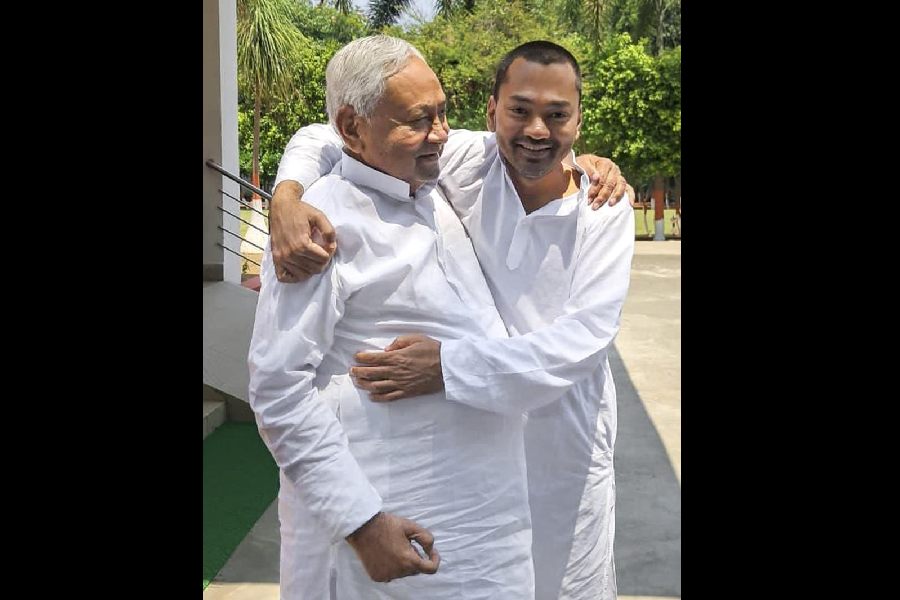
Nishant Kumar, son of former chief minister Nitish Kumar, joined the Samrat Choudhary government as health minister on Thursday, perpetuating Bihar’s long tradition of dynastic politics that his father had staunchly opposed.
Nishant, 50, has never contested an election and formally joined his father’s party, the Janata Dal United, only last month. He is being increasingly projected as Nitish Kumar’s political heir despite holding no organisational post in the party.
He was sworn in with 31 others — drawn proportionally from all five NDA constituents based on their Assembly numbers — during the first cabinet expansion involving the new Bihar government.
Of the 32 new ministers, 15 are from the BJP, 13 from the JDU, 2 from the Lok Janshakti Party (Ram Vilas) of Chirag Paswan and 1 each from the Hindustani Awam Morcha Secular (HAMS) and the Rashtriya Lok Morcha (RLM).
The ruling NDA turned the swearing-in ceremony into a political show of strength with Prime Minister Narendra Modi, Union home minister Amit Shah and several other senior alliance leaders present.
Modi held a brief road show in Patna ahead of the event, seeking to underline the BJP’s dominance of the country’s eastern states after recent elections.
Nitish, now a Rajya Sabha member, was on the dais when Nishant took the oath of office after touching his father’s feet and seeking his blessings.
Deepak Prakash, son of RLM chief Upendra Kushwaha, too was inducted into the ministry despite never having contested an election. He had served in the previous Nitish government as well, although his inclusion had faced stiff resistance from within his own party.
Nitish Mishra (BJP) and Santosh Manjhi (HAMS) — sons of former chief ministers Jagannath Mishra (late Congress leader) and HAMS chief Jitan Ram Manjhi — too were sworn in as ministers.
Beginning with RJD supreme leader Lalu Prasad’s son Tejashwi Yadav, the rise of the new dynasts adds a fresh chapter to Bihar’s entrenched tradition of family-led parties.
Union minister Chirag Paswan, son of the late Dalit leader Ram Vilas Paswan, is another prominent political heir from the state. Chirag was on the dais to watch two ministers from his party sworn in.
Modi has repeatedly attacked dynastic politics, describing family-controlled parties as a threat to democracy and constantly urging voters to reject them.
The BJP, however, maintained silence over the induction of Nishant and Deepak, saying it was the allies’ prerogative to decide which of their members to nominate for ministry berths. Nitish Mishra, however, is a dynast from the BJP itself, as are many others in the party.
Nitish Kumar has throughout his political career opposed dynastic politics as uncompromisingly as corruption, and steadfastly criticised Lalu Prasad for installing his wife Rabri Devi as chief minister and later promoting his sons’ political careers.
Nishant, an engineering graduate, had long resisted calls to join active politics. He eventually relented amid mounting pressure from senior JDU leaders and workers after Nitish decided to step down as chief minister and move to the Rajya Sabha.
His family too impressed on him the importance of gaining administrative experience, party insiders said. The JDU was keen to see him as deputy chief minister in the Samrat government but Nishant declined, saying he wanted to focus on strengthening the party organisation.
The Bihar cabinet now has 35 ministers — Samrat and two deputy chief ministers from the JDU had been sworn in earlier — picked carefully to maintain a caste balance.
Upper castes and the extremely backward castes — the alliance’s core social support base — have an equal representation of nine ministers each. The lone Muslim face in the new government is Zama Khan from the JDU.