 |
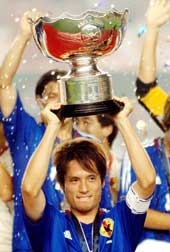
| Japan captain Tsuneyasu Miyamoto with the trophy in Beijing on Saturday. (AP) |
Beijing, Aug 7 (Reuters): Holders Japan overcame bitter rivals China 3-1 in a highly-charged final to win the Asian Cup for the third time on Saturday.
Chinese fans vented their fury at the final whistle after Japan scored twice in a controversial second half.
Koji Nakata had given Japan a 2-1 lead in the 65th minute with a hotly-disputed goal, the midfielder bundling in a Shunsuke Nakamura corner, though replays seemed to suggest that he had used his hand.
Keiji Tamada added a fine solo goal in injury time to give the scoreline a flattering look for Japan after a tension-filled match laced with political and historical overtones. Japan also won the Asian Cup in 1992 and 2000.
Japan coach Zico praised his team for battling through the intimidation factor. “From the start of the tournament all the fans have supported our opponents and it was worse today with 60,000 fans for China,” said the Brazilian.
“It was important to keep calm in an atmosphere like this,” he said.
“Nobody thought we would win before the tournament but we have kept faith in ourselves and made it to the top.”
A furious Chinese coach Arie Haan refused to collect his runner-up medal in protest over the officiating of Kuwaiti referee Saad Kameel.
“The first goal was from a free kick to Japan that should have gone to us, the second was handball and the third was after a foul on Sun Jihai,” fumed the Dutchman. “I didn’t feel ready to take the medal. I don’t know who scored those goals — how can you win when this happens?”
Japan weathered an early storm from China before taking a 22nd-minute lead against the run of play following a questionable foul on Nakamura by defender Wei Xin.
Nakamura whipped in a dangerous free kick and Takashi Fukunishi headed in from close range after a knockdown from Takayuki Suzuki to silence a hostile crowd of 65,000.
However, China struck back in the 37th minute, midfielder Li Ming sweeping home a superb left-foot shot from 25 metres after good work from Yan Song.
China, craving for their first-ever major title in 20 years, showed more determination, but the Japanese side was superior in skill.
The defending champions, playing with a compact 3-5-2 formation, pushed hard to threaten China’s defence constantly. But China’s counter attack looked more dangerous.
Evergreen striker Hao Haidong, who had his injured head bandaged, nearly made it 2-1 in the 45th minute when he missed a pass from midfielder Zhao Junzhe near the goalline.
At half time, both sides were tied 1-1. In the second half though, Japan appeared more determined.
Japan have been booed relentlessly at the Asian Cup and they were subjected to similar treatment, with their national anthem drowned out by a cacophony of booing before kickoff. Japanese players were jeered as they celebrated but more than 6,000 security staff — including riot police, armed troops and SWAT teams — were called on to prevent any violence.
Fans run riot
Meanwhile, even though the match went on smoothly, hundreds of Chinese soccer fans clashed with riot police outside the stadium on Saturday night, throwing bottles and shouting obscenities.
The crowd burned Japanese flags and called for boycotts of Japanese goods after the defending champions’ 3-1 win. Tens of thousands of Chinese fans converged on the Workers’ Stadium before the match. They booed Japan so loudly that they drowned out the Japanese national anthem.
About 2,000 Japanese fans sat separated from their Chinese counterparts by several rows of plainclothes security officials to prevent trouble.
The final whistle was greeted by jeers, obscenities and paper missiles from the Chinese crowd. Hundreds of fans massed outside the stadium’s north gate where they threw bottles and shouted abuse.
Before the match, small groups of Chinese chanted anti-Japanese slogans and flashed politically charged banners outside the stadium, but none were on display inside.
One banner, reflecting China’s desire to beat Japan, read “Take the blade to the devil’s head and put our head in its place”.