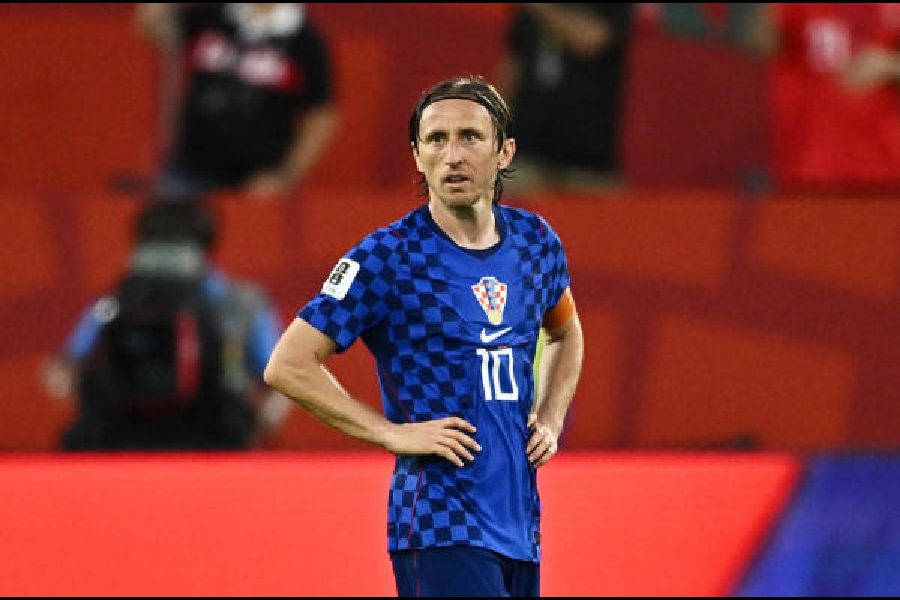
Luka Modric flapped his arms in exasperation as the Norwegian referee ruled out Josko Gvardiol’s late equaliser against Portugal for offside in the Round of 32 clash in Toronto on Thursday. At 40, the Croatia midfielder knew his fifth and final World Cup was over as Portugal edged past 2-1 after a dramatic end to the game.
Cristiano Ronaldo had opened the scoring from the penalty spot — his first-ever goal in a World Cup knockout match — but it was a VAR intervention late on, chalking off Croatia’s leveller and denying them a shot at extra-time, that left Modric visibly distraught in a thrilling finale.
When the whistle blew, Ronaldo rushed straight to his old club teammate’s side — a warm embrace between two men who spent six trophy-laden years together at Real Madrid beamed across the world before a single Portugal player found the words to console the midfield maestro. Modric, now with AC Milan, later revealed that the Portuguese superstar had comforted him and sung his praises.
Modric leaves the stage with a runner-up medal from 2018, a Golden Ball, a third-place finish in 2022, and a Ballon d’Or won eight years ago that briefly broke the Messi-Ronaldo duopoly. But more than the medals, he leaves behind the most enduring image of a small, war-scarred nation that built itself anew after Yugoslavia’s collapse.
Short in stature, pragmatic by instinct, and blessed with a footballing brain that read the game a beat ahead of everyone else, Modric pulled the strings from midfield for a country that once shocked the world with its 1998 semi-final run. That golden generation — Zvonimir Boban, Davor Suker, Robert Prosinecki, Igor Stimac — first announced itself at the 1987 World Youth Championship in Chile, forged in the Yugoslav system but rooted unmistakably in Croatian identity even as they conquered Europe’s biggest clubs.
Modric represents something different: a nation moving on from the horrors of war, from the trauma of the split. That doesn’t make him any less Croatian — if anything, it deepens it. He belongs to Croatia and to the world in equal measure, and that duality is precisely what a new generation, one that never lived through the violence of the 80s and 90s, wants in its hero.
Where the class of ’98 carried the weight of representing a wounded nation, Modric carries something lighter — a sign of a society that has healed enough to simply produce a footballer, not a symbol of survival.
“He led Croatia until the very end,” said coach Zlatko Dalic after Thursday’s match. Ronaldo, typically guarded with his praise, had none of that reserve for his old teammate: “I played with him for so many years, we are nearly the same age. He’s a legend of football because he still plays very well and high quality.”
The pair dominated the world stage together at Real Madrid, winning four Champions League trophies as teammates.
What set Modric apart was his willingness to change games for his country in ways he never did for his club. At Real Madrid, he was theeternal No. 10, pairing with Toni Kroos in a partnershipas enduring as Xavi and Iniesta’s at Barcelona. For Croatia, he dropped deeper,snuffing out danger before it reached goal.
That’s what undid Brazil in the 2022 quarter-finals, and it’s what he did again on Thursday — retreating further as Portugal seized control after the break, covering ground, calming young teammates, keeping Croatia’s shape intact. Even after Portugal equalised through a Ronaldo penalty after Ivan Perisic had given Croatia the lead, Modric kept demanding the ball rather than fading from view.
He leaves behind a blueprint for midfielders like Martin Baturina and Petar Sucic, who grew up watching a captain prove that technical class and tactical intelligence could outlast physical decline.
When Jose Mourinho signed him for Real Madrid in 2012, Modric was mocked as the worst buy. Six Champions League titles later at theBernabeu — the first in 2014, the last a decade on — Mourinho’s old prediction that “this signing will be hailed as the best ever” readsless like bravado than prophecy. Even as his legs slowed and the starts turned into substitute appearances, thebrain never dimmed: that outrageous outstep pass to Rodrygo in the 2022 Champions League quarter-final remains one of the great assists in its history. His muscle was always in his mind.
Croatia’s exit closes a chapter that stretches back to Yugoslavia itself — this is the last World Cup featuring anyone from that lost generation. In four years, Croatia will look like a different country. Modric leaves it in a place he alone built the road to.