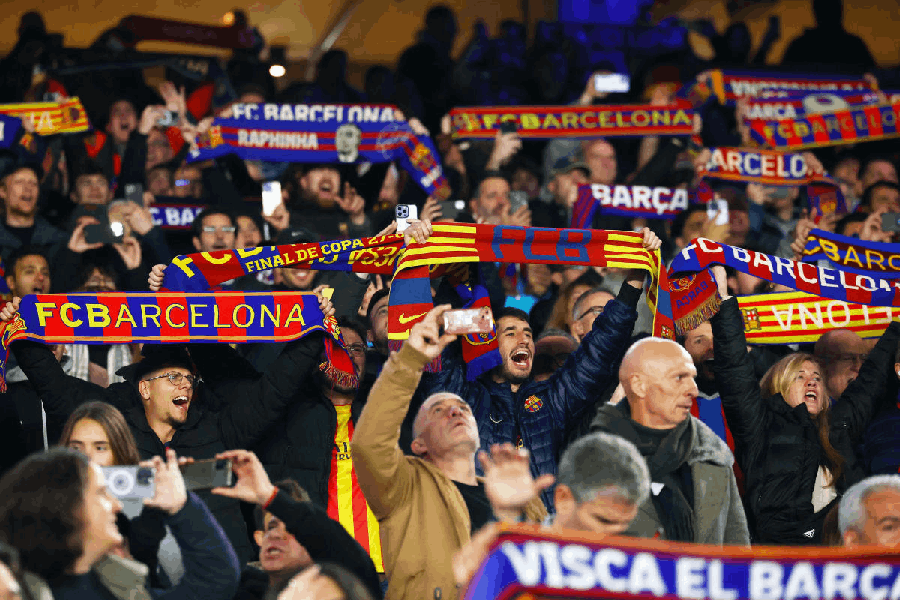
FC Barcelona’s long-standing reputation as a serial record-breaker on the pitch now sits uneasily alongside another, far less flattering distinction off it: the Catalan club is the most indebted team in global football history.
According to details reported by The New York Times, Barcelona’s total liabilities have ballooned to about €2.5 billion, a figure confirmed by the club’s treasurer.
The burden is roughly double that of arch-rival Real Madrid and reflects a mix of financial mismanagement, aggressive spending and an ambitious but delayed redevelopment of the Camp Nou.
The bulk of the debt, around €1.5 billion, comes from long-term financing raised for the stadium refurbishment. The remaining liabilities stem from the club’s determination to stay competitive by recruiting elite talent despite mounting losses.
Club president Joan Laporta, who returned to office in 2021, once said Barcelona was “technically bankrupt” in 2022.
Barcelona’s financial strain is complicated by its unique ownership model. Like Real Madrid, the club is owned by its members, or socios, who pay an annual subscription of over €200.
Around 150,000 members elect the leadership every five years, with the next presidential vote expected in the first half of this year.
Laporta is seeking re-election on a platform that relies heavily on spending to revive sporting and financial fortunes.
That strategy has involved costly player signings and a major revamp of the Camp Nou, now known as the Spotify Camp Nou.
The stadium project, arranged with financing from Goldman Sachs, was meant to be completed before the current season. Instead, Barcelona spent months playing home matches in smaller venues, including one with a capacity of just 6,000.
Although the team returned to the stadium in November, attendance remains capped at under half of its 105,000 capacity until construction is finished.
To fund its operations, Barcelona has also sold future revenues. As reported by NYT, the club sold 25 per cent of its domestic television rights for 25 years to Sixth Street for €667 million, a deal that could see around €1 billion redirected to the investment firm if current values hold.
Another agreement linked to a digital platform is now the subject of litigation and has been written down in value. Without these asset sales, the club noted in its accounts, it would have lost almost €1 billion over five seasons through 2025.
On the field, Laporta’s gamble has delivered results. Barcelona have won two La Liga titles since his return, reached the Champions League semifinals last season and sit top of the table near the halfway stage of the current campaign.
But financial stability remains elusive. Spanish league spending rules, which tie player expenditure to revenues, have limited Barcelona’s activity and led to disputes over player registrations.
“The extremely rigid rulebook prevented us from getting into more debt,” Marc Duch, a tax adviser and longtime member, told NYT.
The club’s sponsorship choices have also drawn scrutiny. A deal with a little-known cryptocurrency start-up announced in November sparked fan backlash, prompting the club to distance itself from the firm’s token, and reports this week suggested the agreement had been dropped.
Barcelona has also faced criticism from human rights groups after signing a four-year sponsorship deal with the Democratic Republic of Congo’s Ministry of Sports and Leisure, reported to be worth about €10 million a year, under which the DRC became the club’s training kit sponsor and a global empowerment partner, while the club’s 2024 telecommunications tie-up with a little-known UAE-based firm also drew scrutiny.
European football’s governing body fined Barcelona millions of euros last July over accounting practices, a penalty that Laporta said could have been far harsher.
The club has also changed auditors several times in recent years. Víctor Font, who plans to challenge Laporta in the upcoming election, said, “Institutionally and socially, the club faces very serious problems. However bad the situation Laporta inherited might have been, the time for excuses is long over.”
Despite the debt, Barcelona remains a powerful revenue generator, bringing in about €1 billion annually. The stadium financing structure defers the largest repayments until 2033, at an average interest rate of more than 5 per cent, higher than the rate Real Madrid secured for its own stadium renovation.
Barcelona expects the refurbished arena to generate €350 million per year, more than double its previous stadium income, though much of that will be absorbed by debt servicing.
At the same time, the league is pressing the club to reduce a wage bill that swelled during the era of Lionel Messi.
These financial constraints are now shaping Barcelona’s decisions in the January transfer window, which opened this week in Spain.
According to a report by Spanish outlet SPORT, the club’s limited depth in defence, exacerbated by Andreas Christensen’s injury, has highlighted the difficulty of reinforcing the squad mid-season.
With an inflated wage bill and continued economic pressure, Barcelona have two options. One is to invoke La Liga rules that allow clubs to use up to 80 per cent of an injured player’s salary to register a replacement.
This would offer only a temporary fix, as the new signing would still need to be registered again in the summer, requiring further room in the wage structure.
The second option would involve offloading a high-earning player, with SPORT reporting that attention has turned to captain Marc-André ter Stegen.
The German goalkeeper is reportedly not part of coach Hansi Flick’s plans and has been linked with Girona, though only a loan move appears feasible, and only if Barcelona subsidise his wages.
But Ter Stegen has shown no desire to leave, leaving the Christensen injury provision as the most realistic path for January reinforcements.
Beyond the transfer window, broader questions loom over Barcelona’s future. Real Madrid president Florentino Pérez has announced that members will vote this year on selling a portion of the club’s equity, fuelling speculation that Barcelona could one day consider a similar move.
For some socios, that would strike at the heart of the club’s identity. “In my opinion that would mean the end of this FC Barcelona,” Duch said, “for the simple reason that it wouldn’t be ours anymore.”
Barcelona, for now, insists it has no plans to sell a stake, even as sporting ambition and financial reality continue to collide.