
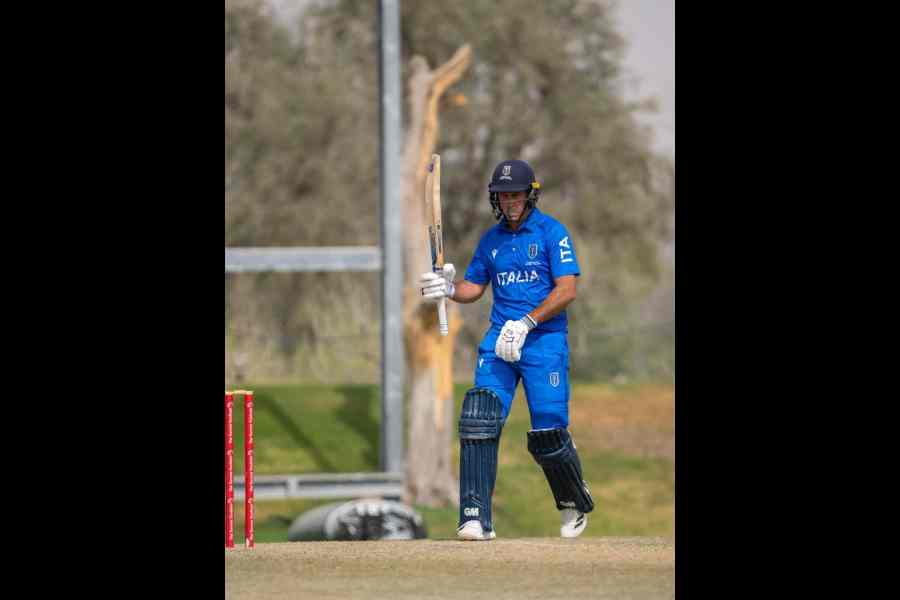
The world knows Christian Vieri as a top-notch goal-scorer. But what many do not know is the fact that Vieri used to bat left-handed, idolising former Australia captain Allan Border.
In the run-up to the T20 World Cup, Team Italy, known as a footballing powerhouse — tennis too, thanks to Jannik Sinner — may seem to be a misfit on cricket’s big stage. But Vieri’s love for cricket can be cited as an example to highlight the fact that cricket is not alien to Italians.
The backdrop to Vieri’s story is that the former centre forward, who represented clubs like Juventus, AC Milan and Inter, spent his growing-up years — till he was 14 — in Sydney, the Australian city which has produced modern-day cricket stars like Steve Smith, David Warner, Pat Cummins and Mitchell Starc.
The current Italian cricket team’s players share similar stories which somehow
connect them to the game. Their World Cup-bound squad features hardly anyone born in Italy.
Off-spinner Ben Manenti and his younger brother Harry, a medium-pacer all-rounder, were born in Australia and play there, while right-handed batter Marcus Campopiano is based in England.
The Durban-born Wayne Madsen, replacing former Australia Test batsman Joe Burns as captain last December, is a key member of Derbyshire, as his 17,067 first-class runs suggest. Madsen and former South Africa international JJ Smuts aside, the Manenti brothers and Campopiano are quite conscious of their Italian heritage.
“The Italian heritage is not lost on these players, and they consistently speak Italian with the home-based ones. They regularly speak of their parents, grandparents, aunts and uncles who made that move (to settle in Australia and elsewhere) from small towns and villages across Italy after World War II,” former Ireland batting all-rounder Kevin O’Brien, currently Italy’s batting-cum-assistant coach, emphasised.
Wearing many hats
Quite a few of these Italy cricketers have done or are doing many other things in life than just playing the bat-and-ball game.
Skipper Madsen had represented South Africa in the 2006 Hockey World Cup in Germany and at the Melbourne Commonwealth Games that year.
Campopiano works as an assistant strength and conditioning coach at Surrey, while Phagwara-born Jaspreet Singh, who bowls medium pace, drives Uber in England from Monday to Friday, finding time out for cricket on Saturdays and Sundays.
Sri Lankan-origin Crishan Kalugamage, also a former track-and-field athlete who has trained with Lamont Marcell Jacobs, Italy’s 100m gold medallist at the Tokyo Olympics, is a pizzaiolo (pizza maker) at a restaurant. “I actually had to give up a couple of jobs for cricket,” Crishan, who stays at Lucca, 350km from Rome, recalled.
“I play for the Rome Cricket Club. I work during the week and travel to Rome on Saturday evenings or Sunday mornings for matches, then return home the same evening. I usually practise after work.”
Visibility counts
In a country where football continues to be miles ahead in popularity, cricket is not televised much, while the grounds there have astro-turf pitches. “Football will always be huge in Italy, that’s just the reality. But it doesn’t mean cricket can’t grow,” Madsen, with 253 first-class appearances so far, explained.
“Popularity isn’t just about broadcast numbers. Participation at club level is growing, especially in communities that love sport and with younger players getting involved through schools and local clubs.
“When people see Italy competing on a global stage, it sparks interest and belief. That visibility really matters.”