 |
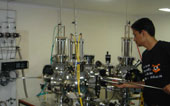
| Tech savvy: Inside IIT Bombay’s nanoelectronics laboratory where the iSens biochip was born |
Electrical engineer Ramagopal Rao has shrunk an entire cardiac diagnostic laboratory into a matchbox-sized silicon chip. His laboratory has no technicians, no test-tubes, no microscopes — just a tiny ‘biochip’ that provides an instant picture of the health of the heart.
The chip, developed by marrying advances in silicon technology, materials and biomedical sciences, can trace key chemicals released into the blood immediately after a heart attack, in just about 10 minutes.
This, claim Prof Rao and his colleagues at the Indian Institute of Technology Bombay is several times faster than other conventional methods and thus can be life saving for many cardiac patients, whose numbers are swelling by leaps and bounds in India. Besides, it helps them save money too; the reliable results given by the novel technique help doctors take quick decisions. What is more, as a result, unnecessary and expensive bypass surgery can be avoided.
While all those susceptible to heart-related problems can benefit, it is the poor who may gain most from this cutting edge IIT work. For it will dramatically trim their diagnostic bills.
The latest estimates by the World Health Organization (WHO) and other bodies monitoring trends in cardiovascular diseases say India is soon to be crowned as the global capital of heart-related ailments. By 2010, India will account for nearly 60 per cent of all heart disease cases in the world, WHO says. Today, globally seven million people die of heart diseases.
More worrying is the fact that the majority of those affected will be poor people. Doctors and medical researchers are now beginning to notice that the poor are also equally vulnerable to heart attacks, once known as the malady of the rich and upwardly mobile who are seemingly more stressed, consume food rich in fat and calories and lead sedentary lifestyles. Says Dr Harsh Vardhan, head of the cardiology division at the state-run Ram Manohar Lohia Hospital in New Delhi , “The number of cardiac patients from lower and middle income groups who visit our hospital has gone up substantially in the last several years.”
 |
The iSens chip
A heart attack is actually the death of the heart muscle cells owing to a lack of oxygen. The cells require oxygen for their metabolic functions. Oxygen is supplied to them by the coronary arteries. If sufficient oxygen is not supplied to the heart muscle cells, the cells die.
Experts fear that the economic burden caused by the mounting cardiovascular epidemic in the country on the poor will be enormous. A majority of them will not be able to afford treatment even if it is heavily subsidised.
Accurate and timely diagnosis, however, can avert a large number of cases from progressing to full-blown heart failures.
It is this concern that prompted several researchers at IIT, Mumbai, to put their heads together. The researchers, drawn from fields as diverse as materials science to mechanical engineering to biomedical technology, thought of an innovative product: the iSens biochip.
There are standard criteria to diagnose a heart attack.
Typically, patients should have a characteristic chest pain lasting more than 20 minutes. Secondly, electrocardiograms should record abnormal electrical activity of the heart. The third and most reliable method of tracing a heart attack is to look for certain chemicals released into the blood after the onset of the attack. These include a variant of the enzyme creatine kinase, called CKMB, and two proteins, troponin and myoglobin.
Currently, detection and quantification of these biomarkers is not only expensive but also takes a few hours and the intervening period at times can be fatal for patients.
The iSense chip offers a better and cheaper way to trace these signatures of heart attacks in the blood. At the heart of the biochip are ultra-small sensors made of silicon or a speciality polymer, whose length and breadth are less than a millimetre. The chip is 40 to 50 nanometres thick (one nanometre is one billionth of a metre). The chip, together with the sensors, is built using semiconductor lithographic techniques. This particular chip requires three different sensors as there are three biomarkers. Each of these sensors is coated with materials that bind specifically to the particular biomarker it is looking out for, says Prof Rao, a professor at the IIT’s electrical engineering department.
Professor Soumyo Mukherjee of the institute’s School of Biosciences and Engineering explains that when a drop of purified blood serum drawn from the patient is placed on the cartridge containing the chip, it freely flows to the sensors through microfluid channels etched on the chip. If the biomarkers are present in the blood serum, they bind to the respective sensors. Within 10 minutes the results are available to the pathologist.
How do they develop these materials that bind to the biomarkers? “What we need to do is just mimic nature. Suppose one needs a material to bind troponin. What is required is to extract troponin from human blood and inject it into another mammal, say, a dog or a mouse,” says Prof Mukherjee. These animals’ immune system identifies human troponin as a foreign matter and thereby produces antibodies against them. Such antibodies will bind to the human troponin molecules in order to nullify their impact (what scientists call immobilisation). As these antibodies are always produced in excess, they can be isolated from the animal and purified. The purified biochemical is coated on the sensor meant to detect and measure troponin using proprietary coating techniques developed by the IIT scientists. These antibodies are so specific to human troponin that they will seek and bind only troponin molecules to them. Such immobilisation and coating techniques were developed by Prof Mukherjee’s postgraduate students.
Nano-scale technology
Aiding the IIT scientists in their work is a new centre of nanotechnology set up at a cost of Rs 50 crore by the Union Ministry of Information and Communication Technology. Another IIT researcher, Dr Prasanna Gandhi, chipped in with his expertise in nano-scale cantilever technology. Cantilevers are microscopic, flexible beams resembling a row of diving boards. The sensors hang out like diving boards. When minute quantities of the purified blood serum is passed through the chip, each of the sensors sticks to its corresponding biomarker. The presence of the biomarkers can be read using a laser beam or similar sophisticated methods already available in the market.
“What one needs to remember is that these sensors are extremely light in weight and sensitive. A few molecules of the biomarker are more than enough to produce the desired results,” says Prof Rao. For instance, the mass of a few biomarker molecules attached to the sensor will make the latter bend enough to give a reliable reading. Instead of mass, the scientists say they can use other parameters as well, such as the strain produced by the binding of the molecules, the charge (atomic) present on the surface of sensor and so on.
What are the system’s advantages? “Once proven, such microelectronic mechanical systems (or micromachines for short) can give very robust results,” says Dr Gandhi. They can also cut the cost of diagnosis, adds Prof Rao. For instance, according to a spokesman of the New Delhi-based Lal Pathlabs, which runs a chain of pathological labs in the capital and in several other cities, the blood tests for these cardiac markers can cost between Rs 4,000 and Rs 5,000. The IIT researchers are confident that their lab-on-chip technique whose prototype is being readied can cut the cost to sub-Rs 100 levels, if widely used. A major reason for such drastic reduction in costs is that the volume of reagents (antibodies) required for running the tests will be in microlitres whereas conventional testing procedures will require millilitres of these expensive chemicals, says Prof Rao. More importantly, using the new method the results can be obtained almost instantaneously, says Prof Mukherjee.
According to the IIT scientists, they have hunted down the markers well; their job now is to hunt for partners from industry. “The next stage is technology development. Scientists alone can’t do this. We need partners who understand the market well, so that the product can be designed, packaged and marketed accordingly,” says Prof Mukherjee.
Practising cardiologists say that the market potential for such innovative products is very good in India. Any medical technology that is innovative and indigenous is welcome, provided it’s proven and cost effective, says Dr Vardhan. Prof K Venugopal, head of cardiology at the Kozhikode Medical College in Kerala, feels that more such home-grown diagnostic tools are required. He also thinks that the near-realtime diagnosis of biomarkers, particularly of a certain type of troponins that serve as a pre-cursor to heart attacks, may even give doctors enough time to initiate preventive measures.