
Pic: JOANNE H. LEE/SANTA CLARA UNIVERSITY
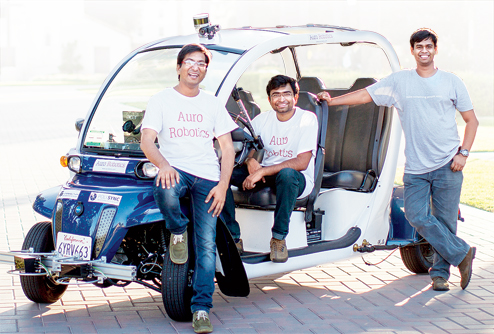
Since August 21, some students and staff at California's Santa Clara University (SCU) have been zipping around the campus on a strange vehicle that looks like a golf cart. A closer look reveals the vehicle has no drivers. It's being operated by an on-board computer, aided by a wide range of sensors and a sophisticated navigation system.
The palm tree-lined university campus at SCU is the beta test ground for an autonomous shuttle system being developed by Auro Robotics, a Silicon Valley start-up run by a group of Indian engineers.
While the much hyped prototype of self-driving cars by Google - being tested just a few miles away on the roads of Mountain View, California -has been hitting the headlines, the innovators of the Auro vehicle are unfazed. They believe they are ready to shake up everyday transport with their modest shuttles.
The brains behind the driverless shuttle system are three engineers trained at the Indian Institute of Technology, Kharagpur (IIT-Kgp) - Nalin Gupta, Srinivas Reddy and Jit Ray Chowdhury.
"We created the car inspired by a project on affordable driverless vehicles at IIT-Kgp," says Ray Chowdhury, chief technology officer at Auro Robotics. "The test run at SCU has been going on for the past few months to check how users interact with the vehicle. We also want to show that the self-driven shuttle can work as a viable mode of transport in university campuses, theme parks, resorts, industrial campuses, and retirement communities," he adds. Right now the maximum speed of the vehicle is a mere 20 km per hour. "But in the long run, the vehicle will pick up speed," he says.
While Google and automobile makers have been testing their faster self- driven vehicles on public roads, Auro Robotics has a modest goal of getting their slower and less flashy shuttles tested on university campuses. "We have got permission to test drive our vehicles in three university campuses. Since SCU is close to our headquarters at Sunnyvale in the Bay Area, we chose this campus for the initial tests," says Ray Chowdhury.
The free-of-traffic campus allows the innovators to observe and adjust its service easily. Since SCU is a private institution, the trial runs do not require government approval. The innovators also get inspiration from the university's "technology-forward mindset". Godfrey Mungal, dean of the School of Engineering at the university, says in a press release, "This is a unique way to bring Silicon Valley to their [students'] doorstep and expand their education beyond the classroom."
Through the pilot programme, Auro engineers are learning whether the vehicle works in the "shuttle bus" mode (a fixed route with a number of predetermined stops) or in the "on demand mode" (just like one summons an Ola or Uber cab).
So far the test has been going well. Unlike most other experimental driverless vehicles, the Auro car is adept in sensing pedestrian movement and can weave through a crowded street seamlessly. The vehicle performed excellently while negotiating through people attending a Sunday service at the campus church. "Most self driven vehicles stop abruptly when they sense too many pedestrians on the wayside, say, a chatting group of people. Our vehicle is smart enough to measure the speed and direction of people and assess whether they are on the move. If the pedestrians are moving, it adjusts the route and speed accordingly," says Ray Chowdhury. Being a small vehicle with a small turning radius, it can navigate twisted roads as well.
The electric vehicle uses a perfect combination of computer vision and GPS tracking. It uses a wide range of sensors, such as laser scanners, radars, cameras and a GPS system to create a 360-degree view of its environment. It can navigate and see ahead clearly, as the embedded navigation software can analyse 200 metres ahead while moving forward.
The Auro vehicle's seamless movement can be traced to its humble origin in the mining engineering lab of IIT-Kgp. The Autonomous Ground Vehicle (AGV) team, led by Prof. Debashish Chakravarty, associate professor in the department, designed Eklavya, a self-driven vehicle. It participated in the Intelligent Ground Vehicle Competition at Oakland University in Michigan, and topped the 56 teams from all over the world.
Says Chakravarty, "We created the Team AGV with 30 undergraduate and postgraduate students from different departments, specialising in computer science, mechanical, electronics, electrical, mining engineering and also mathematics, in 2006. Nalin, Srinivas and Jit joined the team in 2008-2009."
The idea here was to send bots or self-driven vehicles to explore mines before humans step in. Data collected from the bots can help create accurate maps and also sense dangerous environmental cues (such as toxic fumes) well in advance. Says Chakravarty, "The lack of accurate maps of underground mines frequently causes mine accidents. Hazardous operating conditions and difficulty in access make robotic exploration and mapping mitigate disasters."
While working on this project, Team Auro Robotics was inspired to develop an inexpensive self-driving car that can help prevent car crashes, congestion and fuel waste across the world - mostly caused by the inefficiency or errors of human drivers. "I am happy that they are using the knowhow and have dared to create their own company," says Chakravarty.
That a autonomous vehicle can help the disabled was also envisaged by the budding techies on the IIT campus. Says Reddy, "I have a love for robotics (since I was a student) and had been nurturing a dream to start a company." Adds Gupta, the CEO, Auro Robotics, "Our immediate goal is to redefine the way transportation happens on campuses. The autonomous vehicle technology can disrupt the age old shuttle transportation business."