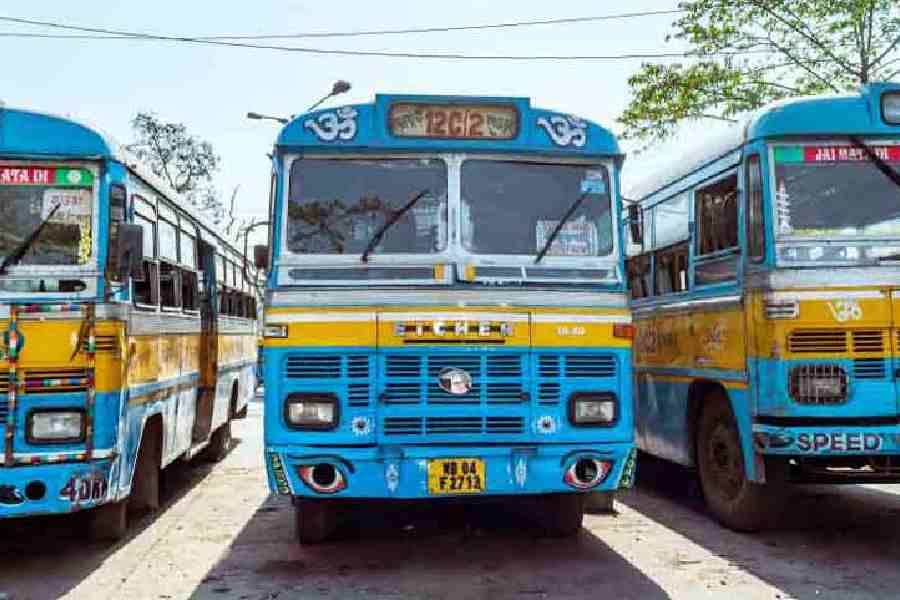
The blue and yellow private bus is seldom seen as an identification marker of Calcutta as is the tram and the yellow taxi. Yet it is this bus which is central to Calcutta’s public transport, travelling the distance between localities carrying crowds of people, used most by those who do not travel by private cars or taxis. So the bus will be honoured at an annual event called the “The City as a Museum” organised by an art company, with installations in buses placed at different points in the city. While the focus on this form of transport is to be lauded, it is necessary to look deeper into the condition of Calcutta’s buses beyond the sentimental and artistic approach. In a discussion arranged by two associations and attended by representatives from the government, academic institutions, development organisations and by transport operators, it was found that the city’s fleet of 6,000 buses had dropped to under 2,000. Financial uncertainty and poor returns on investment had led to this crisis. The result has been an unacceptable prolonging of waiting time at bus stops and a diversion of passengers towards autos and two-wheelers. Even then, buses carry the most passengers although crowding has increased.
A number of correctives were suggested at the discussion, including a doubling of the bus fleet, electrification of buses, a rationalisation of routes, and universal accessibility with arrangements for the disabled. The buses’ connectivity between neighbourhoods should increase too. All changes should be made with the needs of the operators and passengers in mind. This means that the problem that has caused the crisis — financial problems — should be addressed immediately and with care. Electrification and attracting passengers away from autos and two-wheelers would reduce emissions and make public transport more environment-friendly. But the issue is larger. The role of buses should be seen in the context of the emerging transport system in the city as a whole. Connectivity at the lowest price possible would evolve with a rationalisation of the whole system, from the metro and suburban trains to the ferry and the auto. Real-time tracking — a suggestion at the discussion — can be used not just for buses but all fixed-route transport. Unsafe practices associated with buses, including the spectre of rash driving that snuffs out lives frequently, must be addressed. Only then can the growing population be matched fruitfully with advancing technology.