“A person will die just furnishing proof of their existence through documents; in death,
we will have to furnish documents too.”
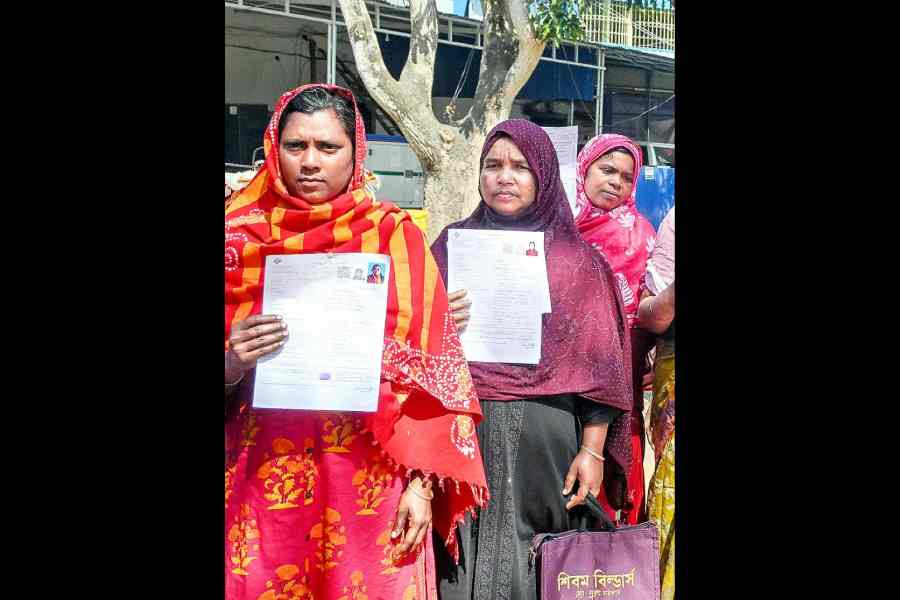
This is what an exasperated Hindu woman we met in the slums of Titagarh, West Bengal, had to say about the onerous demands of the Special Intensive Revision of the electoral rolls. Her daughters’ names had been struck off the rolls and she was now scrambling to assemble documents to ‘prove’ their existence. In a quiet village in Taki constituency along the Bangladesh border, an elderly Muslim man’s children had suffered the same fate. He was running in circles after the algorithm had rejected their birth certificates. In another case, mismatched spellings between father and son had caused the algorithm to declare these electors ‘deleted’. These mismatches were ‘logical’ discrepancies. The Hindu woman was vocal in articulating her frustration. The Muslims we met were anxious: anger was a luxury they could not afford. There was just a quiet desperation to find their way back on the lists; to be made visible and deemed legitimate citizens by the State. It is in these differentiated experiences between Hindus and Muslims that the real story of the SIR and its consequences are to be found.
The election is over. The verdict is in and West Bengal, along with Tamil Nadu and Kerala, is ushering in a new government. But the dark cloud of the SIR will continue to loom large. Did the SIR with its deletions and active disenfranchisement of over 27 lakh voters propel the Bharatiya Janata Party to power in West Bengal? This is the question that is dominating the political debate.
To understand the full effects — and dangers — of the SIR, we must look beyond electoral math. Its real impact and its most enduring consequence lie in the countless stories of State harassment: the endless chase for documents to ‘prove’ one’s identity; the callousness of algorithmic decisions; and the sharply differentiated ways in which this burden of proving identity are experienced across religious lines — differences that were unmistakable in the voices we heard during our travels. Taken together, these accounts reveal that the West Bengal SIR is a case study in how long-established, routine bureaucratic procedures — verifying documents, cleaning up ‘lists’ — can be weaponised and folded into a dangerous political project of exclusion.
Understanding the modalities of this co-option is essential to grasp the full measure of the SIR and its implications for democratic processes.
The business of ordering society into simplified, legible categories, as James C. Scott argued in his seminal work, Seeing Like a State, is central to how the modern State exercises power. Bureaucracy governs by translating the messy reality of human life into data, standardised documents and, increasingly in the 21st century, algorithms. These categories do more than just organise society; they engineer it.
In India, this drive for legibility has morphed into an administrative obsession with identifying the ‘eligible’ and the ‘ineligible’. Bureaucratic norms cohere around the narrow idea that ‘good governance’ is about weeding out the ‘ineligible’. On the surface, this is a legitimate impulse. Corruption, elite capture are all good reasons to worry about who is and isn’t eligible for government programmes and welfare benefits. But the process of determining eligibility has become a profound exercise of State power. The Indian State has exercised this power by ‘seeing’ the citizen as a suspicious actor. The irony is stark: the State issues the very documents — job cards, ration cards, Aadhaar, and bank cards — that it subsequently refuses to trust. Instead of facilitating access to public services and welfare, once citizens obtain these documents, the State occupies itself with ‘authenticating’ its own paperwork, shifting the entire burden of proof onto the citizen.
Digitisation has given this suspicious State a new tool — the algorithm. As Rajendra Narayanan and the LibTech team have meticulously documented, a single-digit error in a bank account number or a minor spelling mismatch in a database (usually the consequence of the State’s own incompetence) can instantly transform a rightful beneficiary into a ‘doubtful’ or ‘ineligible’ subject. The State takes no responsibility for these errors, leaving it to citizens to run from pillar to post, physical documents in their clasp, to clamber back onto the database. The costs are inevitably borne by the poorest. In 21st-century India, citizens’ capacity to lay claim to their socio-economic rights is shaped entirely by their ability to navigate the algorithm.
When tasked with implementing the SIR, the State inevitably deployed its algorithm as the gate-keeper. ‘Logical discrepancies’ (a category of voters flagged by the software to identify data mismatches in documents supplied by voters) were treated as routine verification procedures in which citizens were summoned to present documents and fix errors. In the end, the process led to disenfranchising over 27 lakh voters and harassing countless others. In several other states, Kerala most notably, the data mismatches caught by the algorithm were resolved with relatively little burden on citizens. But in West Bengal, the State’s penchant for placing the evidentiary burden of proof on citizens was effectively weaponised. The Supreme Court never asked why the EC placed this onerous burden of proof on citizens. Perhaps it was convenient not to. When the need to ‘prove’ oneself is baked into every routine encounter with the State, the impulse to question the process withers even when that process is used to strip away the most fundamental rights of citizenship.
Finally, and most insidiously, once suspicion is legitimised, it becomes easy to co-opt bureaucratic procedures into the service of an exclusionary political project. The ghuspetiya (infiltrator) narrative gets a great deal of credibility when the State reserves for itself the power of demanding documents and authenticating them at the whim of an algorithm. The ghuspetiya can easily procure documents; therefore, everyone must be ‘verified’. But ‘verification’ takes on a different meaning once the grammar of the ghuspetiya is normalised. For Muslims, verification through the SIR is an existential necessity, a means of protecting their rights and legitimate claim to citizenship. For Hindus, it is justified as a necessary inconvenience to weed out the ghuspetiya. The indignities they suffered through the SIR were no different to the routine harassment for documents they experience in their daily encounters with the State. The roots of communal polarisation were thus entrenched. The SIR is thus not just about deletions but about how bureaucratic modes have been used to categorise one class of citizens as ‘doubtful’ in the eyes of the majority.
The true danger of the SIR lies in this systematic Othering of fellow citizens. It must be recognised for what it is — a tool through which the seeds of deep exclusion are sown using routine bureaucratic practices that in the eyes of the majority citizens carry within them a veneer of legitimacy. If unchecked, its consequences on our social fabric will be irreversible.
Yamini Aiyar is senior visiting fellow, Brown University