|
|

Identity, national or individual, depends on difference born of, and borne along by, language. When Barack Obama says in his Cairo speech that “Islam is a part of America”, he is speaking a home truth as ancient as the hills. The West has fashioned itself against its cultural and racial Other and, in this process, Islam has perhaps been the Enemy Number One. The polarization of the Christian and the Muslim worlds may have become entrenched after the 9/11 terror attacks, but history was at work from the very beginnings of Western civilization.
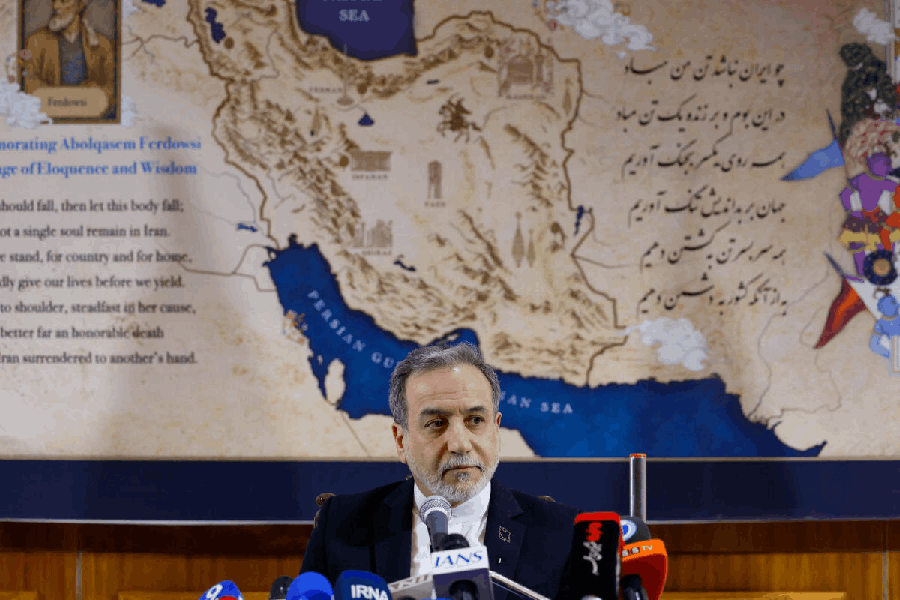
A few years back I went to watch 300, the film adaptation of Frank Miller’s graphic novel. The story is set in ancient Greece during the Persian War. Three hundred Spartans fall to the mighty Persians, and become heroes. Leonidas, the Spartan warlord, becomes Christ-like in his martyred patriotism. But Xerxes, his Persian opponent, is shown to be unnatural, unmanly and ungodly. He is the proverbial tyrant sprung to life straight out of the fairy tales the West has spun about the wild, exotic Orient. Miller’s period piece is firmly planted in a politics that the Iranian intelligentsia found crudely racist. But I was put more in mind of Iraq. That the Spartans are Americans in costume needs no telling. The Spartans are doers while the Athenians are talkers, and the Persians become marauding Muslims.
Another scene from the same story was told by Aeschylus, whose The Persians was performed in the fifth century BC in commemoration of Athens’s victory. Aeschylus had fought in the Persian War and did his best to capture the exoticism of this enemy from the East. The occasion was religious as well as political, and the spectacle held its audience captive with the persuasive power of theatre and poetry. Rhetoric has always been pressed to the service of politics. The fortunes of statecraft depended upon the difficult art of public speaking, and Greece had now to make the best use of oratory to rise above bickering city states and make a united front against a new kind of national enemy. The newness of this cultural difference expressed itself in racial, but not racist, terms.
The racism came with the crusades, which began in quarrels within Christendom, covered up as a holy war against Islam. As not only Muslims but also Jews and homosexuals began to be persecuted, the legacy of the battle for Jerusalem became a global culture of minority-bashing as well as disquiet in the Middle East. But the alien has its attractions too. The crusades opened the doors of trade, in ideas and in chattels. The West could not have done otherwise than define itself as different from its rival powers. The danger is not in difference itself, but in difference sliding into disrespect and discord. Miller’s film and Obama’s speech are two different voices of America. Which is saner is for us to decide. “Words alone,” says Obama, “cannot meet the needs of…people.” The way we speak and listen could well make a difference to the shape of things to come.