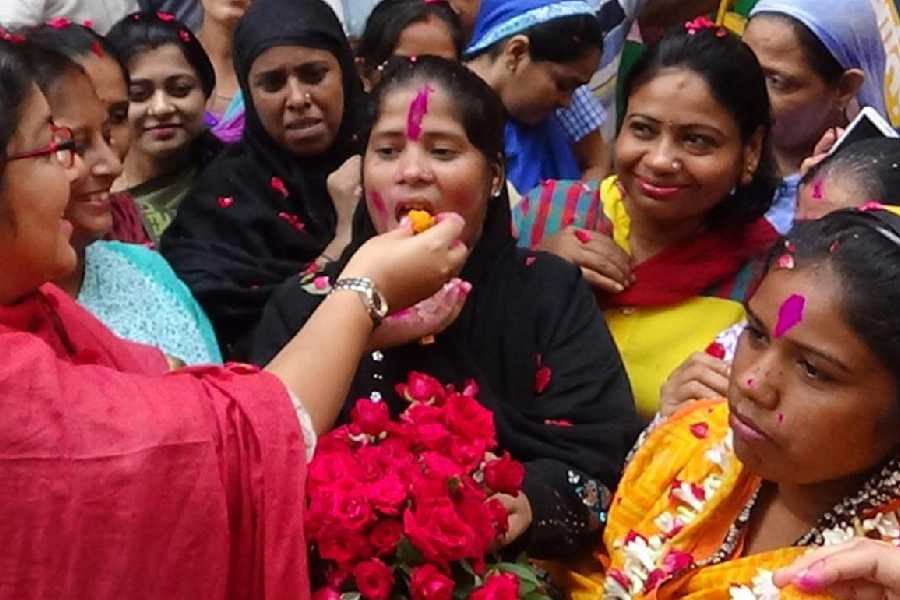
The efforts by the Bharatiya Janata Party to reach out to a section of rashtravadi Muslims in West Bengal are an intriguing move. This tactical repositioning of the party’s attitude towards Muslims might be interpreted as a political paradox. After all, the alleged infiltration of Bangladeshi citizens into West Bengal has been one of the central electoral themes for the party. BJP leaders have also invoked Muslim appeasement as a template to criticise the ruling Trinamool Congress. The outreach programme for Muslims, in this sense, seems to disrupt the established party line.
But there is another and perhaps more persuasive way to make sense of this phenomenon. The Muslim outreach initiative may also be construed as a practical strategy for the BJP to create a winnable configuration in those constituencies in the state where the Muslim vote can play a decisive role. This is exactly what a senior, state-level BJP leader argued recently. Such a practical approach goes well with the idea of winnability which has been the guiding principle of the BJP’s electoral management.
It is almost impossible to predict the electoral relevance of the BJP’s Muslim outreach at this stage. Yet this interesting development encourages us to ask a much deeper and highly unexplored question of our political life: is there any connection between Muslim political identity and the challenges posed by federal democracy? This question does not merely concern the presence of Muslims in different states, their
voting behaviour, and the ever-changing attitude of political parties towards them; it is also about the actual functioning of democracy in a strictly federal sense.
The Muslim political identity has a unique federal connection. The seminal work of the historian, Nazima Parveen, on the politics of space tells us that the debate on Pakistan in the 1940s revolved around two different sets of arguments. M.A. Jinnah and the Muslim League demanded that the future federal system should be based on a weak Centre and strong and autonomous provinces schema to carve out Muslim-majority areas for Pakistan. The Congress and Jawaharlal Nehru, on the other hand, were in favour of a strong Centre and relatively weaker states arrangement to achieve planning-based economic development for the entire country. The actual partition of India along religious lines resolved this contentious debate in an entirely different manner. The Muslim majority provinces — Punjab in the west and Bengal in the east — were eventually demarcated to create two independent states, Pakistan and India.
This historical background is important to make sense of the idea of federal democracy in the postcolonial Indian context. The Indian Constitution recognises democracy and federalism as decisive and desirable principles of governance. Democracy is supposed to legitimise the intrinsic unity of the Indian people as a political community while federalism seeks to celebrate India’s regional diversity. A federal democracy, in this sense, is a normative principle to realise the goal of ‘unity in diversity’.
This constitutional framework found concrete political meanings after the reorganisation of states on linguistic lines in the mid-1950s. It led to an interesting political development. Linguistic identity emerged as a template to articulate regional and even religious political demands and aspirations. Hindu-Muslim antagonism, for example, translated into the Hindi-Urdu controversy in Uttar Pradesh. The Punjabi Suba movement led to the formation of Punjab as a Sikh-dominated, Punjabi-speaking linguistic state. And the debate on Kashmir’s special status continued to revolve around its religious demography.
Federal democracy, in other words, produced a new vocabulary of politics. It is now possible for political players to invoke religious symbols as inseparable markers of linguistic identity. This helps them nurture a very specific form of identity politics without being accused of communalism and/or separatism.
Muslim identity politics is a good example to illustrate this point. The demographic profile of Muslims in India is very interesting. After Partition, Kashmir was the only state where Muslims were in the majority (though it was a Kashmiri-speaking state in technical terms). On the other hand, there was sizeable Muslim presence in at least 12 states. These Muslim communities were spatially dispersed and culturally diversified. The formation of linguistic states further strengthened this regional Muslim heterogeneity. In this situation, it was important for the political elite to mobilise Muslims both as a national minority as well as state-level social group without destabilising the available vocabulary of federal democracy. For instance, the North Indian Muslim elite identified Urdu as the most important symbol of Muslim identity in the early decades after Independence. ‘Protection of Urdu’ was thus presented as the ultimate guarantee to protect Muslim identity at the national level. The political class dominated by the Congress also gave a kind of legitimacy to this Urdu-centric Muslim political discourse. State-level Muslim issues, however, remained the guiding force in the non-Urdu speaking regions, particularly in states like Kerala and Tamil Nadu. Urdu was merely seen as a Muslim symbol in these states.
Two important, yet paradoxical, developments of the 1990s — the acceptance of religion as a legitimate political category and the rise of coalition politics — redefined the functioning of federal democracy in a significant manner. The Babri Masjid-Ram Mandir debate became the focal point of political discussions to talk about Hindu-Muslim conflict. Five religious communities — Muslim, Christian, Sikh, Buddhist, and Jain — were also declared ‘national minorities’. Language-centric religious politics became highly irrelevant in this context.
Coalition politics, on the other hand, empowered the regional parties to
carve out a space for themselves at the national level. However, regional diversity survived merely as a practical need to create dominant coalitions such as the UPA and the NDA. The structural configurations of these coalitions did not allow regional players to pose any challenge to the standardised religion-centric national politics.
The outcome was obvious. The highly-diversified socio-economic universe of Muslim communities at the state level could not become a political issue at all. On the contrary, a dominant discourse of Muslimness, which envisaged India’s Muslims as an undifferentiated, homogeneous, and unified political community, got consolidated. The rise of Hindutva-driven nationalism in the last few years has further intensified this process.
The BJP’s Muslim outreach programme in West Bengal is a good example to not only make sense of the contemporary manifestations of federal democracy but also demonstrate how state-level substantive Muslimness is interpreted through the prism of the dominant discourse of Muslimness. This means that the linguistic identity
of Bengali Muslims can only become politically relevant if it is defined in rashtravadi terms.
Hilal Ahmed is Professor, CSDS, New Delhi