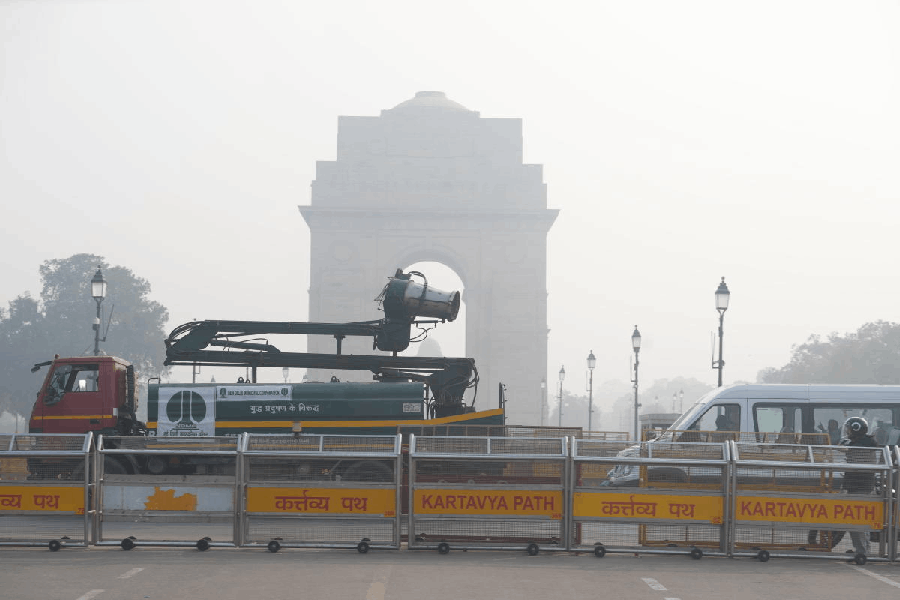
In late October, Delhi’s authorities, grappling with dangerously high air pollution levels, undertook a cloud seeding trial to induce artificial rain and wash away the toxic haze choking the city. While the initiative demonstrated a willingness to deploy technology against smog, a closer look at scientific evidence and expert
opinion suggests that this strategy is a high-cost, temporary palliative that
risks distracting public attention from sustained emission controls.
Cloud seeding is a weather modification technique designed to increase precipitation from clouds. The process involves introducing tiny particles, known as seeding agents, into clouds suitable for rain but which haven’t precipitated yet. The most common seeding agent is silver iodide. The chemical can be released by aircraft flying through the clouds or by ground-based generators that allow the particles to be carried upward by air currents.
Delhi’s cloud seeding trials in October involved flying aircraft equipped with flares that released seeding agents over cloud formations across several districts. The goal was to trigger rainfall to wash away particulate matter (PM2.5 and PM10). Despite the careful planning and execution, the trials failed to produce rain. Meteorologists pointed to a critical factor: the atmosphere lacked sufficient moisture. Effective seeding generally requires a particular type of cloud, the Nimbostratus, with at least 50% moisture content, but Delhi’s clouds had only about 15-20% moisture during the trials.
The most significant constraint facing the cloud seeding initiative is Delhi’s winter climate. The winter air is typically too dry, often lacking the moisture and saturation levels needed for viable seeding. Viable meteorological ‘windows’ for seeding — when the necessary cloud depth, moisture, and temperature coincide — are exceedingly rare. In essence, attempts to trigger rain often chase precipitation that would have occurred naturally.
Even when heavy rainfall occurs naturally, air quality improvements are demonstrably short-lived. Pollutant concentrations typically rebound to pre-event levels within one to five days because the root causes — persistent emissions from vehicular traffic, industry, construction, and agricultural burning — remain active.
The cost of cloud seeding further challenges its viability as a pollution management strategy. Each trial sortie is budgeted at a significant cost (around Rs 55 lakh per run) with a total project cost of Rs 3.21 crore. When weighed against the minimal, short-lived benefits — small, temporary reductions in particulate matter, and often no measurable rainfall — the cost-benefit analysis skews heavily against it. Instead, structural, year-round initiatives that target emission sources directly, such
as enhancing public transport infrastructure, strict enforcement of construction dust control as well as subsidising and mandating mechanised crop residue management across the NCR, would yield better results.
Cloud seeding’s proponents argue that the quantity of seeding agents is too minute to pose a risk. But the long-term ecological consequences of repeated, widespread use of this practice remain poorly understood. Artificially altering weather in one area may also have unintended consequences elsewhere, potentially altering local microclimates or creating ‘rain shadows’ that reduce precipitation in downwind areas.
Perhaps the greatest policy risk posed by cloud seeding is the creation of a ‘silver bullet’ narrative. Measures like artificial rain and smog towers, while generating immediate political and media visibility, foster an illusion that the crisis can be solved with a quick technological fix. This narrative detracts from the difficult, cross-jurisdictional, and continuous work required to control emissions at their source.
The cloud seeding trial may provide valuable scientific data on atmospheric conditions over Delhi but it cannot be recommended as a reliable or sustainable strategy for managing the city’s winter AQI.
Riddhi Datta is Assistant Professor in Barasat Government College