Those seeking religious or spiritual instruction may need a guru, who teaches and even orders them toward what he considers the correct path. The shishya is asked to follow the guru implicitly and even blindly. However, those who wish to become scholars would be ill-advised to look for a guru. Critical enquiry and original research require one to have a certain independence of mind, to adopt or discard theories and methods according to one’s own intellectual interests, not at the bidding of someone else, even if he be more powerful or (especially) more famous.
Tragically, this important difference between the spiritual search and the scholarly quest is largely lost sight of in India. The academic culture of our country is irredeemably feudal, with those who are older and of higher status almost feeling obliged to act as gurus, demanding obedience and getting reverence in return. This intellectual feudalism exists among the sciences and the humanities, and within the latter, amongst all ideological shades. Marxism is in theory opposed to social hierarchies, but in practice Marxist professors in Calcutta have been no less hierarchical towards their junior colleagues than professors of a conservative Hindu orientation in Varanasi.
While young scholars must not be in search of a single guru, when starting out they may yet benefit from interacting with scholars who are older than themselves. These more experienced hands can provide, to the beginning researcher, clues, orientations, and, above all, critical feedback. They can be guides, advisers, even (temporarily) mentors, but gurus, never. While listening attentively to what their elders have to say, ultimately it is for the individual scholar to decide which specific research problem to engage with, and in what particular ways.
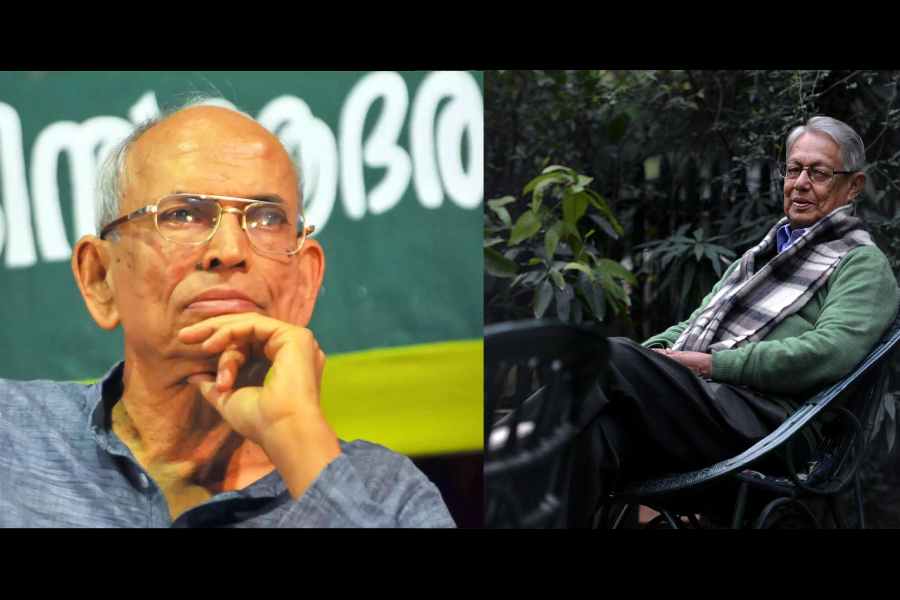
These reflections on intellectual practice are prompted by the deaths, in quick succession, of the two older scholars who most influenced me when I was myself young. These are the ecologist, Madhav Gadgil, who died in Pune on January 7, aged eighty-three, and the sociologist, André Béteille (picture, right), who died in Delhi on February 3, aged ninety-one. I first met Gadgil in 1982, when I was twenty-four and he forty. I first met Béteille in 1988, when I had just turned thirty and he was in his mid-fifties. Despite the difference in our ages (large in one case, very substantial in the other), I struck up a friendship with each almost immediately, this continuing almost until their deaths. While we occasionally talked about our respective families, for the most part my conversations with Professors Gadgil and Béteille were about society, politics, culture, history, ecology, India, and the world.
At first sight, there is much that, biographically speaking, separates Madhav Gadgil and André Béteille. Gadgil was a scientist, whereas Béteille was not. Gadgil was raised in Pune speaking Marathi long before he came to learn English. Although Béteille’s father was French, he identified more with his mother’s side of the family, which was Bengali. He grew up in Chandannagar and was educated largely in Calcutta, speaking English at school and college and Bengali in the street with his friends. Béteille took his doctoral degree in India, whereas Gadgil did so in the United States of America. Gadgil spent the bulk of his professional career in Bengaluru, while Béteille did so in Delhi. Finally, Gadgil and Béteille never met, and largely knew of one another through their mutual friend, this writer.
And yet, looking at their careers in the round, I think I can see striking similarities. In what follows, I shall identify ten features that, in terms of their intellectual orientation and scholarly practice, brought Madhav Gadgil and André Béteille together.
First, both were genuinely interdisciplinary in their approach to scholarship. Béteille was a sociologist who interacted with historians, economists, and legal scholars, Gadgil an ecologist who reached out across the science/humanities divide to conduct collaborative research with anthropologists and historians;
Second, in their work, both brought together theory as well as empirical research. Interestingly, though, Béteille was trained as an ethnographer but later turned to comparative sociology, whereas Gadgil began with a more theoretical approach to ecology before conducting field studies on the diversity of human interactions with nature;
Third, both had a deep commitment to teaching, and to institution-building. Each spent more than thirty years in a single institution, Béteille identifying closely with Delhi University (and its Department of Sociology in particular), Gadgil having a visible attachment to the Indian Institute of Science (and its Centre for Ecological Sciences in particular);
Fourth, each actively engaged with a wider public beyond the academy. Both published academic books and research papers that set intellectual trends, yet both also wrote often for newspapers, making accessible to their fellow citizens the fruits of their scholarship. Notably, though, neither saw himself as an activist or even as an activist-intellectual. They restricted their public interventions to domains in which they had done research themselves;
Fifth, both had their intellectual worlds enlarged by moving outside their native province quite early in their career. Because Béteille worked in Delhi and not Calcutta, and Gadgil in Bengaluru and not Pune, they had a wider field of vision than that of Indian intellectuals who spend their lives largely in their home states. Béteille’s most intensive fieldwork was in Tamil Nadu, and Gadgil’s in Karnataka and Kerala — that is to say, in states other than their own. Nonetheless, neither lost touch with their native heath. Gadgil wrote for the Marathi press and spent his last years in his hometown, while Béteille translated into English a classic Bengali text by his teacher, Nirmal Kumar Bose, while also writing quite a few articles for this newspaper;
Sixth, both were curious about the world outside India, keen to engage with scholars of all nationalities and to read their work closely. They were thus conspicuously pan-Indian as well as capaciously internationalist in their intellectual interests;
Seventh, despite the complete absence of parochialism in their mental make-up, both chose to live and work in India and contribute to its intellectual life. Gadgil left a job at Harvard University to come back to his homeland, whereas Béteille declined offers of Professorships at Cambridge University and the University of California, choosing to stay on in Delhi;
Eighth, while both were patriots, neither ever sought to exhibit his love for India in demonstrative ways. It was expressed in how they lived and how they acted, by treating all students and colleagues alike, regardless of their caste, class, gender, or religion, while continuing themselves to contribute steadily to Indian intellectual life;
Ninth, their patriotism did not involve a blind, unthinking devotion to all that their country did or stood for. Both would have agreed with the statement of the Irish scholar, Benedict Anderson, that “no one can be a true nationalist who is incapable of feeling ashamed if her [or his] state or government commits crimes, including crimes against their fellow citizens.” Both Béteille and Gadgil felt a sense of shame at the pervasive inequalities in Indian society, and sought, in their academic as well as popular writing, to draw attention to them;
Finally, unlike so many of their fellow Professors, neither Béteille nor Gadgil wanted to be gurus, with a circle of adoring chelas around them. Both understood that while older scholars can provide the benefit of their accumulated wisdom and experience, they can in turn get something from the zest and intellectual risk-taking that are more usually present in younger scholars. This was of a piece with their liberalism, with the fact that in both political and intellectual terms they were not rigid or doctrinaire, not wedded to any particular ideology while pursuing an open-minded approach to understanding India and the world.
In a gurukul, shakha, or party school, the novice or fresh recruit is instructed, ordered, talked down to, in a word, indoctrinated. Scholarly research, on the other hand, proceeds through reciprocal learning, through exchange and dialogue among people of different disciplines, theoretical orientations, research styles, social backgrounds, national affiliations, and — not least — generations. I learnt these lessons first from Madhav Gadgil and André Béteille, and have had them repeatedly underlined for me in recent years, when I have myself benefited so much from younger scholars and writers who come looking for guidance and end up teaching me a good many things too.
ramachandraguha@yahoo.in