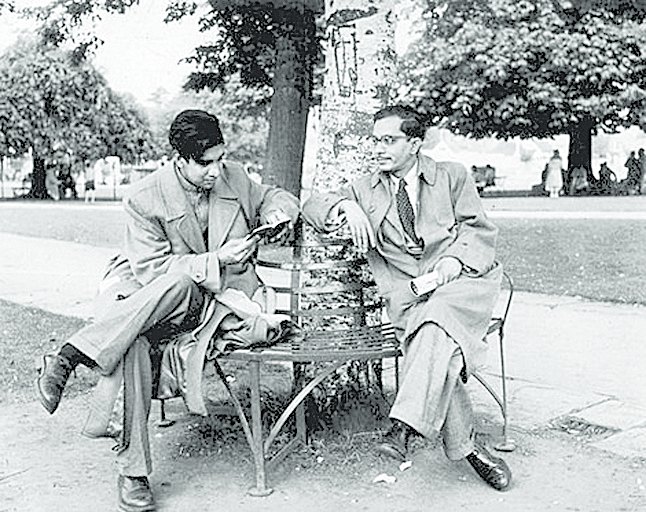

Kamakshiprasad Chattopadhyay (1917-1976), the elder brother of the philosopher, Debiprasad Chattopadhyay, was a poet, fiction-writer, translator and photographer. He was part of the group of modernist Bengali poets who had tried to move out Tagore's shadow by composing verses on subjects considered unpoetic, in a ragged style that was aimed at disrupting the sweetness of Tagore's lyricism. Chattopadhyay's photographs of his compeers - the poets, Bishnu Dey, Sudhindranath Dutta, Samar Sen, among others - preserve the suaveness of a generation of Bengali intellectuals who were, in certain ways, more English than Bengali, even when they were wearing dhuti and punjabi.
In the photographs, Bishnu Dey is found in a pensive mood, smoking a pipe; bespectacled Manik Bandopadhyay, dressed, surprisingly, in a suit rather than the dhuti-punjabi he is commonly seen in, smiles shyly; the famously handsome poet, Sudhin Dutta, is seen in profile in the photograph that usually accompanies his anthologies; Subhamoy Ghosh and Samar Sen, both clad in trench coats, are seen on a park bench beneath a tree [picture]. Such photographs, which are on show in Boi-Chitra gallery from August 3, will thrill aficionados of Bengali literature and lovers of a lost time.
Chattopadhyay's photographs had been lying forgotten for 75 years till the writer and editor, Pulak Chanda, retrieved them with the help of Kamakshiprasad's wife, Rekha Chattopadhyay. The exhibition consists of photographs taken between 1938 and 1962. Rekha features prominently in several of them. In one of the photographs, she stands with an open umbrella against a blue sky dotted with sailing clouds - the picture seems to be a photographic counterpart to Monet's painting, Woman with a Parasol. Rekha also provides a delightful introduction to Kamakshiprasad's works in the exhibition brochure.
Her writing style - sparkling, anecdotal and unencumbered by any sentimental excess - would immediately transport one back to the world of Leela Majumdar and the Rays. She talks, among other things, about how "Kamakshi" used different kinds of filters and lenses to click prize-winning photographs with his Rolleiflex camera. A "soft effect" was created by draping the lens with a piece of white muslin. Rekha Chattopadhyay describes how Kamakshiprasad had made a nice portrait of hers using this trick. One of the photographs in the exhibition was of a demure Rekha with downcast eyes seen in diffused light; but it is not certain whether this is the picture that had so pleased her. Detailed captions would have helped viewers connect the photographs to their stories, where they exist. The exhibition also needs an introduction to Kamakshiprasad in English, which would enable it to speak to a wider audience. The absence is all the more disappointing since Rekha Chattopadhyay's neat Bengali could have been easily rendered into English; such a translation would have allowed people not only to understand Kamakshiprasad's oeuvre better but also to appreciate Rekha's flair.
The lack of captions de-contextualizes the mine-workers, who are seen walking with coal-laden wicker baskets on their heads, unloading the coal into trucks, or squinting at the sun. One comes to know from Rekha that Kamakshiprasad used to work for the DVC and would go photographing in places like Maithon, Tilaiya, Kodarma and Panchet. When Khrushchev and Bulganin had visited India, Nehru had taken them on a tour of the DVC dams. Kamakshiprasad had photographed the occasion and presented Nehru and Khrushchev-Bulganin with an album each. The leaders had reportedly loved the present.
Kamakshiprasad had been the editor of the popular children's magazine of the Forties, Rangmashal. He had also lent his photographs to that other children's monthly, Ramdhanu. Some of these are seen at the exhibition. Full of large-eyed, happy children - of the kind made famous by Millais, whose painting of the cherubic child looking up at a bubble became better known as the advertisement for Pears soap - these photographs make one nostalgic for a time when Bengali children could enrich their imagination with stories and essays from a wide range of magazines.
It is apt that the revamped Boi-Chitra Sabhaghar should open with an exhibition of Kamakshiprasad's photographs. Both belong to the history of photography as practised by Bengalis at a time when photography was still a fledgling art. The Boi-Chitra Sabhaghar on College Street is housed in the studio of the photographer, Charu Guha (1884-1957), who cocked a snook at the sahib photographers of colonial Calcutta by running a swadeshi studio, complete with electrical lighting, which was the first of its kind in the city.
Guha's ancient camera mounted on a tripod is still there at the studio, as are such accessories as a full-length mirror and the prized generator. Guha had been one of those enthusiasts who had helped transform photography from an art of the affluent to an art of the people. The privileged and the underprivileged alike must have visited the studio in the hope of getting immortalized in photographs. Guha assured them with his promise, "If you have beauty, I will take it./ If you have none, I will make it."