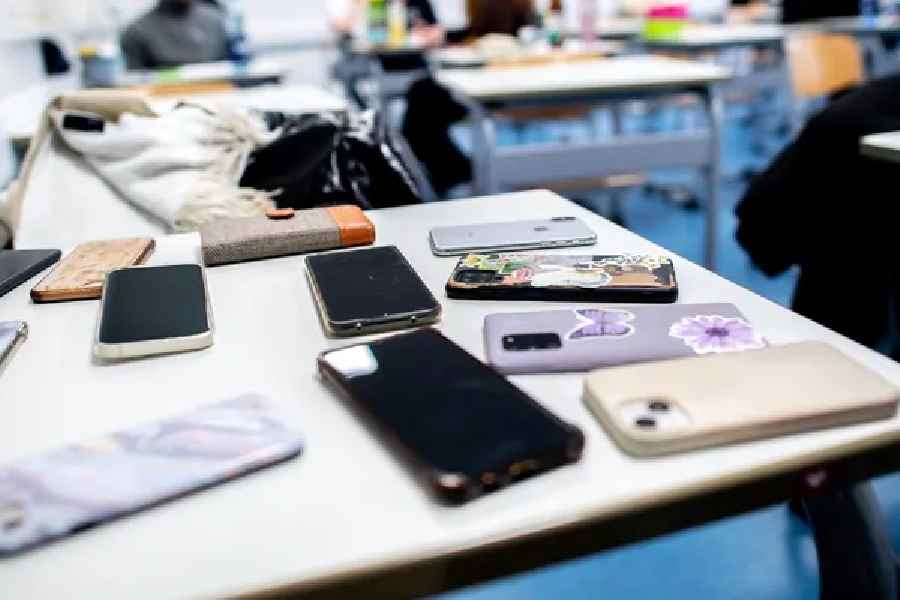
To log in or not to log in, that is no longer the question. Gen Alpha, raised in homes where voice assistants like Alexa answer before adults do, is showing signs of turning away from technology. This is the first cohort born entirely into the age of the smartphone, social media and algorithmic feeds. Yet reports show that members of Gen Alpha routinely prefer dumb phones, printed newspapers, CDs and vinyl records, not as curiosities but as a way of life. For instance, research by the music manufacturing agency, Key Production, found that 46% of those born after 2010 say that they are listening to CDs and vinyl instead of Spotify. While school phone bans across the world have accelerated the shift, the impulse to ‘disconnect’ seems to run deeper. What is striking — hopeful? — about this generation is not its ignorance of technology but its indifference to its glamour.
The explanation is partly economic in nature. Desire thrives on scarcity. For millennials, the early internet felt expansive and new. For Gen Z, social media carried novelty and status. For Gen Alpha, digital connectivity is infrastructure. It is present at school, at home, in transport and in leisure. The result is that technology has lost some of its aura. A smartphone is now just an appliance while so-called retro objects have acquired distinction. A printed newspaper cannot be refreshed; a CD does not adjust itself to the whims of an algorithm. The attraction for Gen Alpha for a lived experience that is liberated from the dull rhythm of technology, survey by an American firm shows, may lie precisely in these boundaries. These older formats demand choice and attention, which gives Gen Alpha a sense of agency. This shift has social consequences too. Technology’s unprecedented connectivity fostered an epidemic of loneliness, especially among adolescents. Millennials and older Gen Z grew up learning to ape the performative dimensions of companionship — a poor substitute for organic human connections — for social media platforms, thereby transforming ordinary life into content, confusing attention with affection. Has Gen Alpha had enough of such performance? Pew Research Center data from 2024 show that 48% of Gen Alpha say that social media has a “mostly negative” effect on people their age, up from 32% in 2022. This growing scepticism suggests that young people are not interested in inheriting adult anxieties.
The retreat, revealingly, includes a wariness regarding Artificial Intelligence even though it has embedded itself quickly into education, entertainment and communication and is used widely by Gen Alpha. Survey by the media brand, Fast Company, notes that 70% of young people now question their job security due to AI, and 65% believe a college degree alone will not shield them from disruption caused by AI. In response, 53% are considering skilled trades and 47% are leaning towards people-centred professions such as healthcare or education. This is a pragmatic generation, rightfully anxious about being replaced by algorithms.
What does this recalibration mean for the future? Younger generations appear increasingly willing to treat technology as a tool rather than an identity. A generation raised saturated in technology may prove less impressed by innovation for its own sake and more attentive to its consequences. If that instinct takes hold, the future may be decidedly retro.