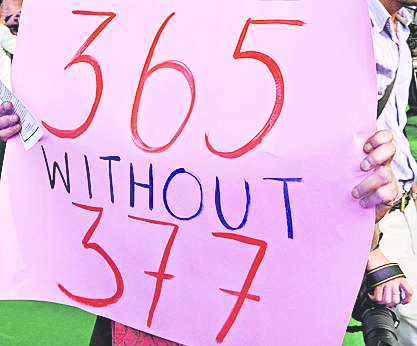

India's recent vote against the benefits accorded to same-sex spouses of United Nations employees brought back bitter memories of December, 2013. Back then, the Supreme Court had overturned a previous verdict that decriminalized consensual sexual activity between two adults of the same sex, by "reading down" Section 377 of the Indian Penal Code. This law is often used as a tool for policing men who have sex with men in public places. The bringing back of the law was a jolt to the gay rights movement and the preventive health work done among men who have sex with men. In upholding the constitutional validity of the law, the court seems to have moved through a labyrinth of complex legal arguments spread over a 98-page report, which makes a number of disturbing observations.
While agreeing on the judicial right to review constitutionality, it observed that the legislature, which is "undisputedly the representative body of the people of India", has chosen to keep the law intact, in spite of the Law Commission's recommendation to the contrary. In a country where legislative changes are inextricable from careful electoral calculations, the judiciary's faith in Parliament is heartening, in spite of Parliament's failure to ensure, say, a just representation of women.
The judiciary's take on the use of Section 377 is more revealing. All reported cases under this law have been non-consensual and coercive. So, the courts were justified in locating culpability and bringing justice to the victims. However, since the bench could not earmark a tentative list of acts that would constitute sexual intercourse "against the order of nature", it decided that the law would be applicable to all cases irrespective of age and consent. While leaving room for judicial interpretation, the court decided to add a caveat: the law was only meant to punish a specific form of sexual behaviour and not an identity. This distinction between identity and behaviour is problematic since legal validation of one involves the acknowledgement of the other. In India, there are men who have sex with men while being reluctant to associate themselves with a particular identity category. Criminalizing their behaviour automatically criminalizes them. The court is also wary of the argument that the law hinders HIV prevention work: data showing a high HIV rate among men who have sex with men are not convincing since there is no direct evidence to make this link. Asking for evidence of discrimination on the basis of the abuse of this law is the same as asking for evidence of how objectification of the female body in popular culture fosters violence against women. While the connection is not a simple one, discriminatory laws nurture an environment of negativity, of mistrust and hostility towards men who have sex with men and who are often thought to be the vectors of a deadly and communicable disease.
What is more ominous is the precondition laid upon the enjoyment of fundamental rights. According to the court, the previous verdict had overlooked the fact that a miniscule fraction of the country is the sexual minority. This is, at best, a majoritarian logic that spells doom for every other kind of minority. The very idea of the individual's right opposes this logic. The "greatest happiness of the greatest number" logic cannot be "the measure of right and wrong" in a democracy that purports to be inclusive. Even as conservatives gleefully point out that the court has upheld public morality, quaint changes are already under way that have limited the reach of the court. In 2014, the same court held that numerical proportion was not an a priori determinant to the enjoyment of fundamental rights and that Section 377, seemingly gender-neutral, was more discriminatory towards certain communities.
Law, therefore, has a curious double bind. A law that is meant to subject a person of a particular orientation to certain licit ways of social conduct also opens up a space for sustained criticism and identity politics. Once notions of equality, fairness and justice are out of the closet, it is hard to put them back in. They might unwittingly contribute to the shaping of a counter-public that will start questioning the institutionalized powers that attempt to discipline and punish them.