 |
The world loves icons; ‘elder statesmen’, revolutionary leaders, movie and television stars, sports heroes, leading composers, musicians, artists — all qualify for distilled attention of various kinds. Biographies — empathetic, critical, carping — keep them alive in the literate universe. However, re-telling lives of iconic figures is never easy; most often, the hagiographic mode is the usual, though not always acceptable, way out. In the present world, for wider transmission of iconic status, the visual, be it a garish multi-coloured poster, a calendar image or a classy studio portrait, a quick shot taken by a digital camera, a mobile phone or even a fuzzy, out of focus grab from a television image, is taken for granted. Iconic images, as Robert Hariman and John Louis Lucaites point out in No Captions Needed, “come to represent large swaths of historical experience, and they acquire their own histories of appropriation and commentary”. They become “visual commonplaces”, soon operating “like the stock figures in memorial statuary, ceremonial oratory, and other representational practices that have been used to construct a community’s sense of the past”. The authors were clearly thinking of the image in history; its role in the present construction of the iconic figure, too, is unrivalled, the creators of this visual data bank often the much maligned paparazzi. The paparazzi and the icon share an unmistakeable synergy, an almost cannibalistic fervour characterizing the response of one to the other.
Often, the icon welcomes and seeks out her/his image creation by the photographer; here willing collaboration, not a predator-victim atmosphere, dominates the elaborate mise-en-scene; choice of clothes, accoutrements and backdrops are debated and chosen with care. For Che (Ernesto) Guevara, the Havana was often a favourite ‘prop’. Long after his death in 1967, the photographic visual and film have been used in re-presentations of the action-packed life of this poster boy of 20th-century revolution.
There was enough in his life and tragic death to merit not only hundreds of photographs and documentary footage but also more than one film. He was born into an upper-middle-class Argentinean family. The Motorcycle Diaries is regarded as a classic coming-of-age story in which, in 1952, Che, then a 23-year-old medical student, and his friend, Alberto Granado, a 29-year-old biochemist, set out to explore South America “on the back of a sputtering single cylinder”. Nine months and 8,000 kilometres down the line, Guevara was convinced that his future lay in working for the poor and for a united Latin America.
Che Guevara’s ascent in Cuba’s revolutionary movement was rapid and the Argentinean became a Cuban in 1959, soon after the three-year-old guerrilla war had succeeded in overthrowing the dictator, Fulgencio Batista. Now second only to Fidel Castro, Che’s public phase had begun: a phase that was invariably represented visually with the unimaginative photographs that often characterize the public face of world leaders — shaking hands, smiling absent-mindedly at the myriad cameras or even hugging and kissing, if that was what the local culture demanded. There was also Alberto Korda’s now-iconic photograph of the Guerrillero Heroico (Heroic Guerrilla) looking into the middle distance with “character, firmness, stoicism, and resoluteness” (Korda) in his eyes.
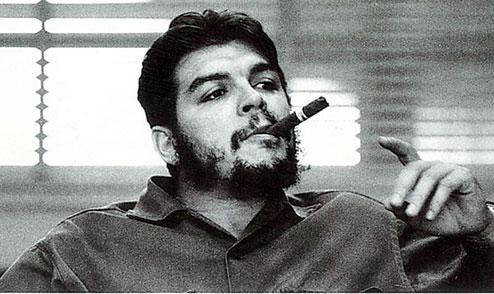
It is not that other visuals are not available from Che’s ‘official’ phase: there is the brilliant 1963 series by photographer, Rene Burri, who compares his subject to a restless, caged animal. Burri’s many images — reproduced in Hans-Michael Koetzle’s Photo Icons — capture the spirit of the ruggedly handsome man, puffing furiously at his cigar. The scene was Che’s office in the ministry of industry in Havana where Burri and the well-known journalist, Laura Berquist, had been given time for an interview-cum-photo session. According to Koetzle, as Burri disliked flashbulbs, he used the natural light of a sunny January afternoon. He brought with him two Leicas and a Nikon fitted with 35, 50 and 85-mm lenses. Three hours later, he had used six rolls of film. At times, Burri wished that he could have opened the Venetian blinds a bit — but Che’s response was a gruff negative. Was he afraid or was he irritated with a question from his forceful interlocutor? As he spoke, he was ‘captured’ in a number of sequences, some more suggestive and expressive than others. Che was in uniform, his hair somewhat short and his beard longer than in other photographs, and, as in this image, the Havana and swirls of cigar smoke carefully placed. He was at the peak of his power at the time — and this is evident in Guevara’s self-assurance before the camera. This was even though Che was clearly uncomfortable behind a desk, as armed struggle was his métier.
After he criticized the Soviet Union publicly in 1966, it was time for Che to go underground. Following a brief stint with the rebels in Congo he emerged in Bolivia. Official propaganda and some Che mythologists believe that, in October 1967, he was hunted down and killed in a battle between army troops and guerrillas in the jungles of Bolivia. He was actually executed against a school wall. Alone. His body was discovered 30 years later, minus hands. In De Handen van Che Guevara — The Hands of Che Guevara (2006) — by the Dutch film-maker, Peter De Kock, the audience is treated to a fascinating pastiche of interviews, film footage, stills — and some re-enactment —aimed at finding out what happened to Che’s hands after his death. De Kock visits the school building where Che was held hostage on the night of October 8, 1967. The camera moves slowly, suggestively around the desolate space more than once, focusing on the corner where the hero of a million hearts crouched as the soldier, Mario Teran, took aim. There is a telling on-screen silence — and then the room once more... After his death, his hands were chopped off and preserved in formaldehyde and though ostensibly the film is about the search for these body parts, it is nothing short of a life of this amazing man. Ernesto, the daring motorcyclist, caring doctor, lover and finally Castro’s confidant are presented through carefully chosen visuals, some of which came from his father’s home films.
And then there was Oscar-winning director Steven Soderbergh’s (Sex, Lies and Videotapes, Erin Brockovich) two-part four hours plus portrait Che Part 1: The Argentine and Che Part 2: Guerrilla, that premiered at Cannes in 2008 with the Puerto Rican actor, Benecio Del Toro as Che. Del Toro won the best actor award at the festival. To be sure, the actor — born ironically in the year of Che’s death — was daunted by the task of representing a man who he had grown up knowing to be ‘a bad guy’. It was only after he had seen a photograph of him did he realize that he had a ‘really warm smile’. Then began his journey of discovery. In defence of his prolixity, Soderbergh said that he wanted to bring out the many facets of the man, something that required quiet footage and meaningful shots. Some critics have found the two films simplistic, hagiographic, skimming over the surface. Others have found him in the South American superman- mode, uncomplicated and at times even pious and boring. Such criticisms only confirm the vulnerability of celebrity status — and the power of the visual in re-creating and even perhaps misrepresenting a life. But then it is for an audience to judge whether its icon has been ‘correctly’ portrayed — that is, if one accepts there is any such thing as an ‘objective’ understanding of another’s life.