
In 1972, Associated Press released a photograph that showed a group of Vietnamese children fleeing a napalm attack by American troops, with an unclad nine-year-old Kim Phuc in the middle of the frame. The girl had torn off her flaming clothes to avoid being burnt. This photograph acted as a tipping point and public opinion in the United States of America against the continued involvement of its troops in the Southeast Asian nation was further antagonized. The Terror of War, as the photograph came to be known, could be considered the denouement in a long narrative of news reports and images that pilloried the US for its aggression in Vietnam. Investigative reporting by the likes of Homer Bigart and Seymour Hersh had by then made it apparent to the average American that the raison d'être for the US to venture into Indochina was not to save "democracy". Rather, the cold strategic calculations of the Cold War informed its choice.
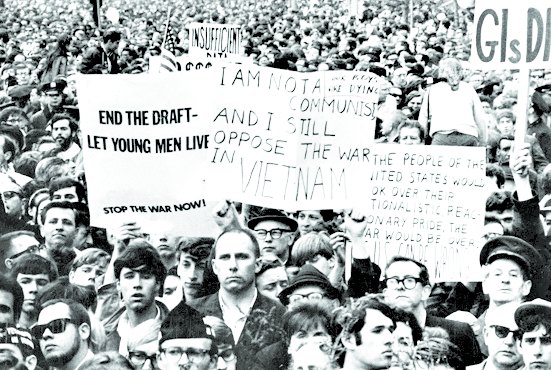
Extensive coverage given by American media to the excesses committed by the US army, combined with domestic issues like the civil rights movement, played a catalytic role in making Americans critical of the government. This is made clearly evident by the number of people participating in the anti-war demonstrations across the US - through much of the 1960s and beyond, till the time Washington was compelled to pull out of Vietnam. In the first 'March on Washington' rally organized in the spring of 1965, there were about 25,000 demonstrators. The next, held in 1969, saw a massive crowd of more than 5,00,000 - the largest in the history of the US till then.
The jarring images tumbling out from the My Lai massacre in 1969 or the Pentagon papers exposé by the New York Times in 1971 had convinced conscientious Americans that they must pour out into the streets to demonstrate their objection to the intransigence displayed by their State.
Besides the media, the support extended by academics, sportspersons and celebrities helped in legitimizing the protests. In 1967, Muhammad Ali refused the draft induction into the Vietnam War and was threatened with imprisonment. Ali's refusal enthused scores of young men who publicly burned their draft cards.
The anti-war demonstrations marked a new phase of activism in the US. Middle-class stay-at-home moms turned up at rallies to denounce war: making 'Vietnam' that rare moment in history when one could berate the policies of his country and yet not be labelled 'unpatriotic' or, worse, a 'traitor'. The State no longer seemed infallible or its goals unquestionable.
The spirit kindled by Vietnam spread far and wide. Across the world, millions since the heyday of the Vietnam War have taken to the streets to march for peace. The demonstrations against the First Gulf War in 1991 illustrate the point. The protesters were not enemy nationals, but professors, factory workers and students who drew inspiration from the legacy of the anti-war demonstrations conducted during the Vietnam War, and believed that they too could pile pressure on the administration and engender a course correction. They didn't meet much of a success; but in no way did it diminish their efforts.
It is, however, worth noting that even as Vietnam has gone on to acquire cult status, the gains made from the anti-war demonstrations during the 1960s and the early 1970s have suffered setbacks with the advent of the new millennium. The 'War on Terror' following 9/11 has scarred various communities and nations and yet there has not been a significant protest movement. Whatever little there was could not operate in the polarized climate created by George W. Bush's "You're either with us, or against us" sermon.
People and the media, and not just in America, should recall the Vietnam days. Opposition from its own people, in part, forced a superpower to retreat. It also sent across a message of solidarity: all Americans do not condone the violence that the US government perpetrated on Vietnam. In a world that is witnessing increasing acts of violence, whether in justification of national security or for protecting the interests and honour of religion, it is very important for citizens to stand up against acts of violence. "Bring 'em Home" - the memorable song by Pete Seeger - is as relevant today as it was then.