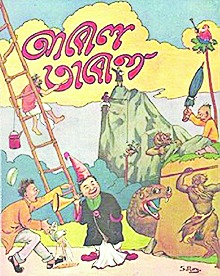

THE RAYS BEFORE SATYAJIT: CREATIVITY AND MODERNITY IN COLONIAL INDIA By Chandak Sengoopta, Oxford, Rs 995
Chandak Sengoopta's new book, The Rays before Satyajit, is a classic example of how a painstakingly researched and empirically rich work can become a rather misguided effort to understand Bengal's social history from the viewpoint of a single family. The methodology of taking a single event, one particular family or an individual, or even a small episode in history as the entry point for the exploration of a wider socio-cultural context is probably a favoured approach among historians. However, this gesturing towards the larger from the vantage point of the smaller is not always helpful. What often happens, as it does with this book, is that the exceptionality of one event, one 'eccentric' individual or a family is mistakenly read as being suggestive of certain sweeping historical trends.
The stellar ensemble in this book comprises a motley of immensely gifted individuals of a Brahmo family of colonial Calcutta - the Rays. The principal characters include Upendrakishore Raychaudhuri, a musical genius, who, instead of pursuing a conventional career in law or medicine, spent his life in developing the elusive technology of half-tone photography; his father-in-law, the formidable Dwarakanath Ganguli, who, in spite of coming from an orthodox Brahmin family, chose to throw his weight behind gender reforms and the cause of the indentured labourers of Assam and lastly, Upendrakishore's eldest son, Sukumar Ray, a polymath artist, who is best known for his delectable nonsense verses.
In many ways, the story of the Rays was indeed a unique one. Unlike Europe,where industrialization had created a new bourgeois class that derived its income from non-agrarian enterprise, the Bengali middle class had to depend largely on some form of land ownership. Colonialism did spawn a numerically small English-educated class that sought its fortune outside the domain of agriculture. But even to them, most of the avenues of real material transformation were closed. The British neither encouraged industrial entrepreneurship nor allowed Indians to occupy the top echelons of bureaucracy. This resulted in the creation of a sycophantic, socially conservative and unenterprising class of keranis, who could hardly bring meaningful social change. This peculiar material predicament had a profound impact on their cultural and moral universe. By the end of the 19th century, the critical exercise of self-questioning in some areas of gender relations and conjugality had given way to rigid social conservatism and status quoism.
The Rays rejected both, the world of the landed gentry and of the petty bourgeois, drawing instead their material sustenance from the creative enterprise of publishing. Socially, they denounced the Hindu faith and embraced the Upanishadic ideal of one god, espoused by the Brahmos. Culturally, their experience of modernity was routed through social reforms including the advocacy of women's emancipation and campaigning for legal changes in marriage laws. Children, along with women, were very much at the heart of their creative endeavours. Sukumar's eccentric Pagla Dashu or the lyrical nonsense of Abol Tabol, while being immensely entertaining and humorous, also contained thinly veiled allusions to oppressive colonial rule, obsequious Bengali gentlefolk, and the stifling nature of disciplined and time-bound salaried life.
What could have been a rigorous analytical exercise of exploring the roots of this progressive, cosmopolitan family turns out to be a rather anodyne, celebratory account of their achievements. Even when the author probes the limitations of their creative impulses, he chooses not to dwell on them. By treating the case of the Rays as a liberal exception in an otherwise conservative world, and then suggesting that their 'eccentricity' was part of an alternative intellectual trend in the 'Bengal Renaissance', Sengoopta sets up a false liberal-conservative dichotomy of colonial modernity. A closer look at the Brahmo project would reveal that when it came to certain ideas regarding women, Muslims or even British rule, the Brahmos shared many concerns similar to their conservative counterparts.
For instance, the Brahmo curriculum was designed to subject women to patriarchal authority. It was geared towards manufacturing an educated but subservient wife, who would have none of the uncouthness of the traditional woman and yet would remain fully docile. Women were deemed to be the guardian angels of the inner, spiritual domain of the colonized society, which was meant to be free from the corrupting influence of colonialism. This puritanical approach towards women, I would argue, colours many of the Satyajit Ray's female characters, who, in spite of their psychological complexities, are depicted as morally incorruptible. The failure to imagine an independent feminist agency was not the only limitation. For some Brahmos, such as Dwarakanath for instance, an uncritical acceptance of the divine providence of British rule went hand in hand with an equally unquestioning acceptance of the tyranny of the Muslim rule.
The book may be a worthy prologue to the moral and creative universe of Satyajit, but by arguing that the 'creative eccentricity' of one particular family was reflective of the larger multidimensionality of colonial modernity, Sengoopta ignores the insidious ways in which apparently incompatible interest groups collaborated and colluded when it came to the question of social power and minority rights.