|
|

Although Neera Yadav left the civil service before joining the Bharatiya Janata Party, her political ordination confirms that the last bastion of stability in India may be crumbling amidst the electoral frenzy. If the bureaucracy collapses, it could mean the end of seven per cent growth amidst global recession and of the national yearning for an international leadership role.
Walter Lippmann, the American columnist, once lamented that “the breakdown in the constitutional order of things is the cause of the precipitate and catastrophic decline of Western Society.” That “decline” — if such it can be called — was only relative to the peak from which the great European empires once commanded mankind. As Europe declined, for economic, not moral or systemic, reasons, the United States of America took over its imperial mantle. What Lippmann called “breakdown”, we would regard as a slight erosion, so slight as to be barely noticeable. In comparison with much of Asia, India included, even a financially faltering West is an oasis of order and rectitude.
Political stability is not always a sine qua non of effective administration. France after World War II might easily have succumbed to Lippmann’s “precipitate and catastrophic decline” because its governments were formed and fell as swiftly as they used to in Bihar. But France did not collapse because an inherently strong civil service provided continuity. That resilience must be contrasted with the politicization, collusion and corruption that officials like Neera Yadav, Runu Ghosh (picture) and Gautam Goswami — to take only three recent instances of notoriety — represent.
A few unprincipled civil servants might have made hay during World War II but Independence presented the first major challenge to bureaucratic integrity. Asok Mitra of the Indian Civil Service described the dilemma in an article titled “Two Men on the Spot”. We know who won that contest long before the Emergency made collusion between bureaucrats and politicians the norm. Those who surrendered all authority to the extra-constitutional centre of power represented by the late Sanjay Gandhi gave another demonstration of supineness when the Shah Commission set a witch-hunting precedent that two vengeful prime ministers eagerly took up. Kishan Chand, ICS, an Oxford graduate in Modern Greats, and lieutenant-governor of Delhi, jumped into a well. Others were content to sink into paralysed inaction.
Not many senior civil servants enjoy Neera Yadav’s distinction. Though married to a Yadav police officer who showed the way by quitting the Indian Police Service to become a BJP member of the legislative assembly, she was born a Tyagi, reportedly with important Brahmin connections in Ghaziabad. The description that she is a “resourceful” person must be the understatement of the year. The Uttar Pradesh state Indian Administrative Service association sacked her as its chairman and voted her the second most corrupt bureaucrat. A former chief secretary of Uttar Pradesh and CEO and chairman of the Noida authority, she faced a CBI inquiry over plot allotment when she chose voluntary retirement. The special gifts that made her infamous will now be at the BJP’s disposal if they were not already so, for such alliances do not blossom overnight.
India can live with its bought-and-sold politicians. It cannot live (and certainly cannot achieve the height to which it aspires) with a ramshackle administration under bureaucratic mercenaries at the beck and call of unscrupulous politicians. As the special CBI judge, V.K. Maheshwari, said when sentencing Sukh Ram, the former Union communications minister, to jail for criminally amassing vast assets, “If public servants are corrupt, the whole structure of the society would get upset and government policies, howsoever beneficial it [sic] may be, would be adversely affected.” In other words, a venal politician (“a menace to the society”) infects the entire system. Maheshwari called political corruption “the worst form as its consequences are far-reaching”.
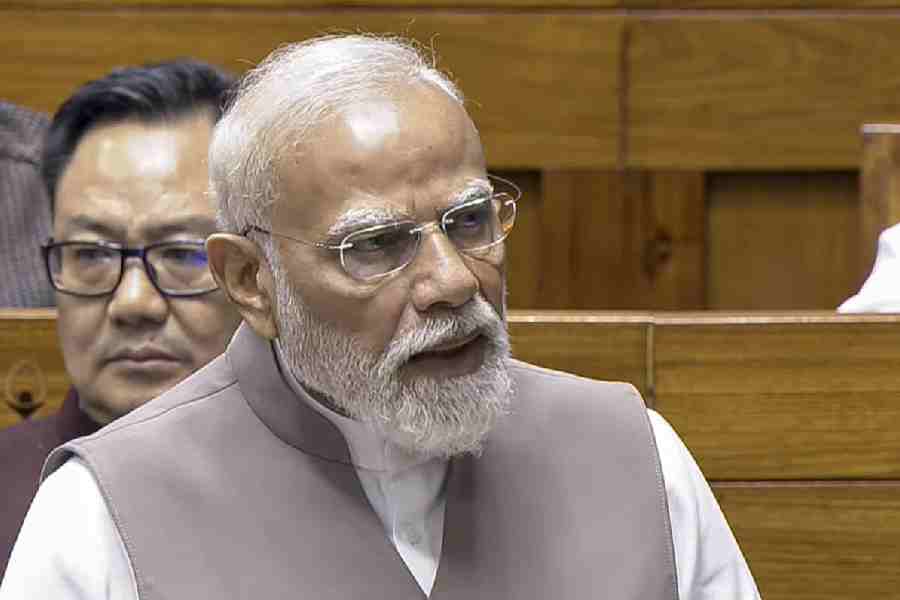
India is not — not yet — Chad or Kyrgyzstan which lead the list of corrupt States in influence peddling, bribery and scandalous business dealings. Nor can any politician here compare with Zimbabwe’s Robert Mugabe who is accused of stealing over seven million dollars in foreign aid meant for medicines. One does not have to recall Italy’s Silvio Berlusconi, who is involved in an investigation regarding the payment of more than $500,000 from undisclosed funds to the husband of an Olympic minister in Britain to realize that India is especially blessed with a prime minister of impeccable integrity.
But one swallow does not a summer make. The difficulty of keeping the system clean is highlighted by Transparency International’s admission that even Japan and Canada have below-par enforcement standards vis-à-vis accepted G7 guidelines for bribes from foreign businesses. Transparency International found only one prosecution in each country against more than 40 in Germany, 19 in France and 16 in Switzerland. No one in India batted an eyelid when the Americans complained that Rajiv Gandhi’s officials demanded commission payments on the computers on which he had set his heart.
Maheshwari was taking an idealistic view in describing political leaders as role models and asking rhetorically how we can expect honesty and virtue from the public if politicians are corrupt. It’s much more a sin of commission. A legislator who pays Rs 10 crore for nomination from a parliamentary constituency or spends hugely on his campaign must recover his outlay. As the young and idealistic Atal Bihari Vajpayee lamented, every legislator starts his career with the lie of false election-spending returns. Even a politician who is known for his genuinely austere lifestyle needs a great deal of his money to ensure continued rank and file support and prevent followers from defecting. Many dignitaries may choose not to know what is done for them or in their name, but done they are. And they cannot be done save through the administration at the politician’s command.
The few cases of bent bureaucrats that come to light are the tip of the iceberg. Such exposure can be attributed to several causes — the failure of political protection, an especially diligent judiciary, envious colleagues or a crime of such magnitude that it could no longer be hushed up. Lesser crimes like avaricious palms all the way up in courts and government offices pass unnoticed. The papers regularly report bribery demands by the police and even hospitals. Political mendacity no longer makes news. In Sukh Ram’s case, the CBI’s chargesheet claimed that Runu Ghosh “in her capacity as director (in the department of telecommunications), and in conspiracy with Sukh Ram and with the owner of the Hyderabad-based firm, Advance Radio Masts Limited, had caused pecuniary advantage to herself”. She was convicted and sentenced along with the minister in 2002 and dismissed in 2003 when she was general manager (finance) in Ahmedabad. Her appeal is pending.
Another illustrative case is that of the late Gautam Goswami, of the IAS and winner of Time magazine's Young Asian Achiever Award. He shot into the limelight in 2004 when, as district magistrate of Patna, he asked L.K. Advani to leave the dais midway through an election meeting for canvassing beyond the prescribed time limit set by the Election Commission. Goswami also earned laurels for collecting and distributing funds for victims of the 2004 Bihar floods. But less than a year later, he was accused of involvement in defalcating the money he had helped to raise along with Lalu Prasad’s brother-in-law, Anirudh Prasad Yadav alias Sadhu Yadav, and 27 others. If a brilliant and charismatic officer’s fall was due to politicians, so, perhaps, was his rescue. Goswami was reinstated on health grounds not long before his untimely death.
The steel frame became the bamboo frame. Now, as much because of politicians’ interference as because of bureaucrats’ inclinations, it’s in danger of becoming a rusty, twisted tangle of wires and rotting string. If that is permitted to happen, India will, indeed, sink to a sub-Saharan level with no prospect of ever realizing the dreams that keep it going.