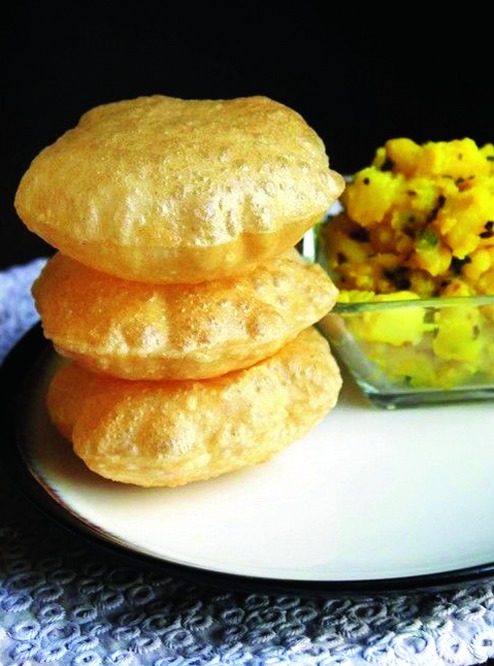

The first thing you eat and drink in the morning is hugely important. The beverage and food provides fuel to a body that has, usually, not ingested anything for a good few hours. The quality and quantity, the taste and the 'rightness' of the first meal also go a long way towards shaping the start of your day and possibly the whole day itself. Furthermore, that first intake also fits in with a whole cluster of morning rituals that define who you are, ethnically, culturally, socially and class-wise. Or, horror of horrors, it doesn't actually gel with your usual habits and needs, creating its own misregistration between you and the day. Or, then again, the change of morning alimentation could provide a delicious challenge to an intrepid, unprejudiced and curious traveller.
In my family of three, breakfast didn't actually exist. My parents would drink tea in the morning ( desi style, CTC, milk and sugar), while listening to the radio and reading the newspaper. Watching them, I used to think the crackling pages were actually their morning nashta, though they would also snack on some non-oily, non-spicy chevdo and some biscuits. The real meal would only come in the shape of an early lunch around 11 am. They could afford to stick to this very Gujju routine because my father ran his own business and my mother taught in a college where she never had early classes. On the other hand, I had to be given fodder before school and so strategies were developed, involving fruits, Bournvita, Ovaltine, Cadbury's Hot Chocolate and toast. My Madrasi friend who lived down the road came to school having quaffed lovely home-made idli, vada and dosai, which I thought was hugely unfair. At some point, eggs and I were introduced to each other by my mother, but outside our strictly vegetarian home. By and by, I discovered the illicit, taboo-joy of meat, which meant bacon or sausages along with the eggs.
There was an epiphanic moment at age 15, on the first day of my first trip to the West. Travelling with my father on a strict budget, we found ourselves in a small hotel in Paris, confronting the all-important free breakfast that came with the price of the room. I sipped on magical hot chocolate, the likes of which I'd never tasted before, and simultaneously discovered this flaky, buttery, airy thing called a croissant and the French jams that go with it. At that age I knew a tiny bit about French painting and sculpture but this breakfast was the first time I encountered Gallic culture viscerally, haptically, through touch, smell and taste, and I was left flabbergasted - no wonder they painted so brilliantly after such a breakfast.
Later, I came across the comment of the great film-maker, Jean Renoir: "the quality of the day's shooting depends on the taste of the first cup of coffee in the morning." By this time I'd graduated through my first encounter with the French petit déjeuner and had had close dealings with all sorts of different breakfasts. There was the ghastly 'dead omelette' and banana at boarding school, variations on the same theme on the Indian railways, and, in contrast, the winter joys of stuffed paranthas, achar and dahi in roadside dhabas in north India. Filming in rural Bengal, you realized that 'breakfast' was as alien a concept here as in a middle-class Gujju household, often consisting of lal chaa accompanied by chirey or dry muri with green chillies and mustard oil. Travelling in Rajasthan, the tea came with dry rotis and pickles. South India was a heaven of different kinds of home-made dosai, upmas and utthapams. In Maharashtra, the sweet Gujju tea was tweaked just that little bit with spices that made it undrinkable for someone like me, but the pohey were a revelation. In various parts of the country, people with a little bit of money were also able to bombard their stomachs, first thing in the morning, with deep fried samosas, filluries and bhajiyas.
Upon travelling, all sorts of categorizations would attack the mind that was just waking up. Breakfasts were cold or hot, heavy or light, centred around sweet tastes or savoury, expansively vegetarian, with a small non-veg presence or a truckload of meat with some tiny vegetable alibis on the side; there were summer breakfasts in hot countries and then summer ones in cold countries; winter breakfasts in the tropics and winter breakfasts with icicles hanging from the window. The one hugely unhealthy thing that became a constant for far too many of us was the coupling of a cup of tea or coffee with a cigarette; this would be first thing we would touch in the morning before space was created, biologically and mentally, for any solid food. At some point in a wintry Paris very different from the one I first visited, working on finishing the post-production of a film, I was introduced to the 'French working man's breakfast', which added a shot or two of cognac to the already formidable coffee and cigarette combination.
In contrast to the gut-scouring sparseness of this lunacy were the examples of extreme morning excess. At a certain young age in America, it seemed to me and my pals a fun idea to put away a stack of pancakes, two kinds of egg, sausages, bacon and hash browns plus coffee and juice, all in one eating frenzy in some diner. Across the Atlantic, the 'Full English' was no less bruising: eggs, mushrooms, grilled tomatoes, all the aforementioned pig variations plus black pudding (for those who don't know: a delicious, dark biscuit of dried beef blood). As a change from this, one thankfully came across one standard Middle Eastern breakfast which consisted of olives, hummus, various other pastes, roasted and raw vegetables, salad and pita bread.
Speaking of a 'Full English', I recently found myself watching a documentary titled Secrets of the Royal Kitchen, where one got to see two kinds of breakfast being made in the British royal kitchens. One was a 'normal' breakfast for Her Maj, elaborately eviscerated discs of brioche were lightly fried to make cages for poached eggs, which were then served with sausages. The other was a reconstruction of the wedding brekker made for the union of Charles and Diana in 1981, a meal eaten by the royals and a hundred and twenty of their closest friends. Starring on the menu were quenelles of brill with a lobster sauce and a breast of chicken stuffed with a lamb mousse, coated with brioche breadcrumbs, a minted cream sauce and samphire. Somewhere else in the film it says Queen Elizabeth never travels without crates and crates of her own English bottled water. No matter where in the world, the royal tea is always made with this same water. Watching this food porn I felt no twitch of lust for all the expensive, elaborate food that was being made and displayed. One of the things that put me off was when they said no garlic at all was allowed into the royal kitchens.
As one grows older the realization hits the gut: eating some things in the morning makes you happy while eating other things, no matter how delicious, can destroy your day; if you eat healthily most of the time you can indulge occasionally; a croissant is a confection of genius but it is essentially a very small, fluffy lachha parantha that's been rolled up; muesli, fruits and raw nuts are not just a fad; garlic is one of the healthiest things you can eat raw in the morning. Another realization also lands, perhaps only partly true, but I'll venture it anyway: you can mess with a person's eating habits for lunch and dinner far more easily than you can with their breakfast. Just as the first language you learn, your mother tongue, is said to be stored in a different part of the brain from all the subsequent languages you pick up, I suspect the construction and taste of one's basic breakfast is also stored in a special place. This is perhaps why I find myself craving a sada dosa or a plate of luchi-alu while looking at artisanal brioche being carved into twee little medallions.