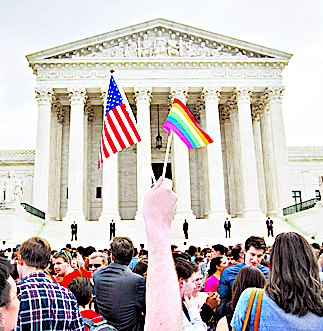

It is being hailed as the gay rights movement's equivalent of the landmark 1954 judgment of Chief Justice Earl Warren - one that led to the desegregation of schools in the United States of America. Last month, a Supreme Court bench decided that the right to marry was a fundamental one and cannot be denied to same-sex couples. As the news spread, hundreds of activists gathered in and around the court plaza waving rainbow flags and shouting the slogan, "Love has won". Such a conclusion to decades-long activism and litigation seems obvious. However, the issue of marriage is not just about the legitimacy of love and its logical culmination in a socially and legally sanctified ritual. It is a vexed question that draws upon interconnected concerns of religious sensibilities, constitutional rights and federal politics. Such associations are not always apparent, even to those who are in the thick of minority-rights movements.
For the past couple of years, the issue of marriage has been in the forefront of US politics. It has evoked strong reactions across the liberal Democratic and conservative Republican divide. The sexual minorities of the country look up to their Democratic leaders as those who stand up for their rights. However one only has to remove the veneer of democratic magnanimity to understand the liberal deceit. Consider Barack Obama's wishy-washy position on the issue. In 2008, he publicly declared marriage to be an institution between a man and a woman, but rushed to shower praises on the recent verdict of the court. Some political analysts claim that Obama preferred to keep his mouth shut while running for presidency, as surveys showed that an overwhelming majority of African-Americans considered homosexuality to be a taboo subject. If there is any truth in such a claim, then it points to a rather disturbing trend in US politics. It means that political leaders are not really serious about gay rights. Minority rights are convenient signposts that can be used by political parties according to the dictates of realpolitik.
There are other concerns as well. The right to marry is inextricably linked to the right to exercise religious freedom. Can a same-sex couple compel, say, a pastor to conduct their wedding without substantially encroaching upon his liberty to deny them? Several states have passed the Religious Freedom Restoration Act that ostensibly promises all US citizens the right to exercise religious freedom. Critics believe that this is nothing but a veiled way of undercutting some of the privileges afforded to sexual minorities. It gives pastors, wedding planners, florists and others the freedom to deny services to sexual minorities. What seems to be a constitutionally valid right for one is the loss of freedom for another. This curious paradox between rights and liberties is at the heart of the gay rights debate and there seems to be no way out of the legal quagmire.
The court's decision also invites us to consider the very objective of identity politics. The decision to grant conjugal rights to all is based on the cherished democratic principle of equality before law. And yet when we give the State the right to recognize or derecognize certain social relations, don't we automatically lose the right to organize our social life creatively according to our own free choice? Societies across the world have a range of templates for conjugal relations. And not all societies privilege marriage over other forms of intimacy. And yet, when the court declares that, "No union is more profound than marriage, for it embodies the highest ideals of love, fidelity, devotion, sacrifice and family", it automatically privileges one form of relationship over others. This privileging of marriage - rather a particularly heteronormative, patriarchal form of it - is then the ultimate betrayal of the sexual politics that sought to transform radically, if not entirely do away with, the institution.
While there is no denying the fact the court's decision is an act of unquestionable good, the eternal sceptic in me cannot help but see the glass as half empty. The right to marry cannot be the be-all and end-all of gay identity politics. A sustained critique of such an understanding of the queer movement is needed so that its radical edge is not lost altogether.