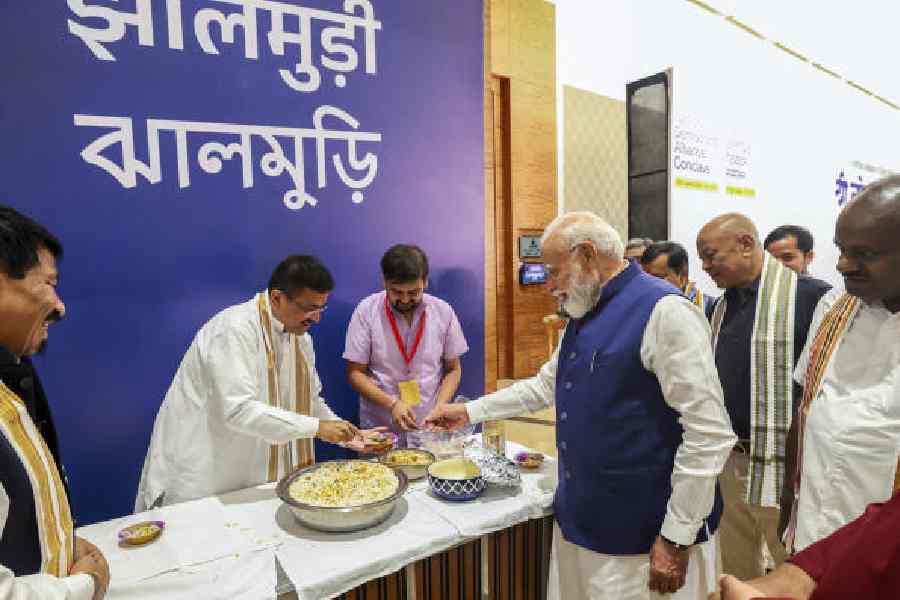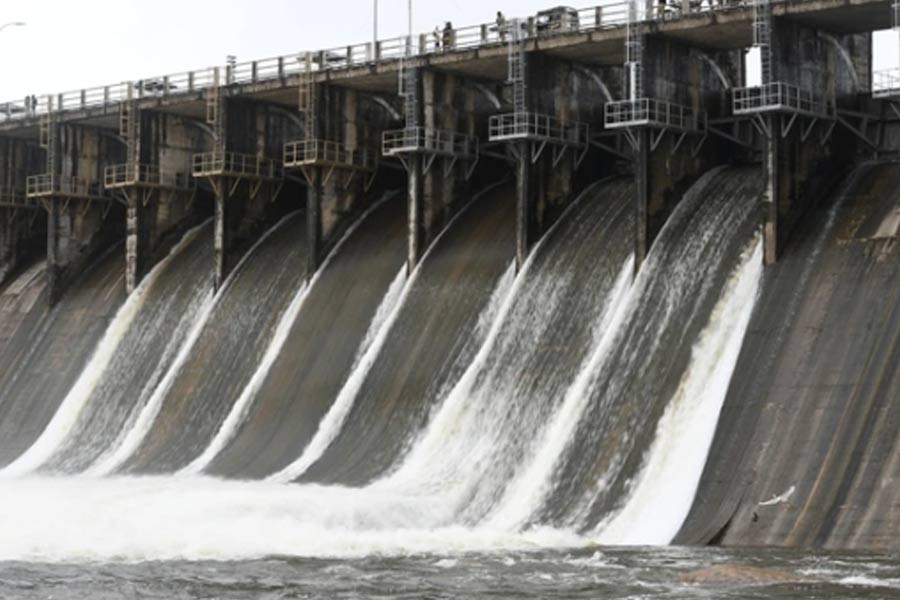
India and the Netherlands elevated their diplomatic ties to a formal Strategic Partnership in May 2026, adopting a five-year roadmap. The partnership spans cooperation in trade, semiconductors, clean energy, and water management. During his recent trip to the Netherlands, the Indian prime minister visited the Afsluitdijk, which was built between 1927 and 1932 by sealing off the Zuiderzee and creating the IJsselmeer, a freshwater lake of about 1,100 km² in area.
Possibly inspired by the Afsluitdijk, Anil Kane proposed the Kalpasar Project in the 1980s, a lake that fulfils all wishes. The government of Gujarat envisages the creation of the largest coastal freshwater reservoir in the world by constructing a 60.13 km-long dam across the Gulf of Khambhat between Paniadara village of Bharuch district on the eastern side and Bhavnagar on the western side. If constructed, the reservoir will store about 8,000 million cubic meters of surface water from various contributing rivers — Sabarmati, Mahi, Dhadhar, Narmada, and the various rivers of Saurashtra. The prime minister’s visit to the Afsluitdijk is significant because although IJsselmeer and the Kalpasar may seem similar, there are fundamental differences.
The Zuiderzee was a relatively shallow, low-energy inland sea connected to the North Sea, while the Gulf of Khambhat exhibits the highest tidal range in India, reaching up to 11-12 metres. The gulf’s funnel-shaped topography amplifies tidal movements. Semi-diurnal tide amplification is about threefold from mouth to head, resulting in strong currents. Moreover, the Arabian Sea has exhibited an increasingly severe pattern of cyclonic storms due to the rise in sea surface temperature. Between 1982 and 2019, a 52% increase in the frequency of cyclonic storms, an 80% increase in their duration, and an increase in intensity of about 20% in the pre-monsoon period make Gujarat and the west coast increasingly vulnerable. The Dutch Zuiderzee closure faces no such tropical storm threat. A Gulf of Khambhat cyclone-tide compound event is a hazard that Dutch engineers, however skilled, have never had to design for.
For all mega projects, climate non-stationarity is a challenge. For Kalpasar, it is existential. The project is being designed for a 60+ year operational lifetime, during which every major physical variable it depends on will shift. Arabian Sea surface temperatures will continue rising, driving more intense cyclones toward Gujarat’s coast. Sea level rise will add a permanent new baseline to all surge and flood calculations: already, 785 km — roughly 46% — of Gujarat’s coastline is rated at high to very high risk from anticipated sea level rise, and approximately 15% is classified as very high vulnerability, concentrated precisely in the zone the proposed dam traverses. Monsoon patterns will shift, altering the river inflows on which the reservoir’s utility depends. The sediment dynamics of the Gulf — already poorly understood — will also be transformed by the structure itself, with uncertain consequences for the dam’s foundations and the region’s ecology.
While the water needs of Gujarat are real and pressing, the risk profile of the Kalpasar Project is extraordinary. A single structure, at Rs 85,000-90,000 crore, sited in one of India’s tidally extreme coastal zones, with a lifespan that runs deep into a period of accelerating climate uncertainty — if it fails, structurally, hydrologically, or ecologically, there is no recovery.
None of this is an argument against ambition. Gujarat’s water security challenge is genuine, and the India-Netherlands partnership offers real promise — Dutch expertise in adaptive delta management, storm-surge modelling, and climate-resilient hydraulic engineering is among the best in the world. The way forward is to harness that expertise fully, completing the geotechnical and hydrological studies, applying rigorous probabilistic climate stress-testing to the dam design, and exploring whether phased or modular alternatives might deliver water security with lower catastrophic risk. Optimism about what the two nations can achieve together is warranted. Rushing to construction before the science is settled would squander it.
Anamitra Danda is an environmentalist. Views are personal