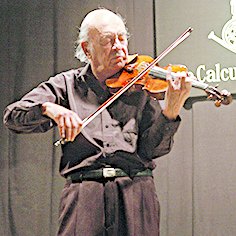

It is not often that a violin maestro in the class of Jack Glatzer performs in Calcutta, which is why it was shameful that his solo violin concert at the Calcutta School of Music on February 21 was so poorly publicized. People would have gladly flocked to Glatzer's recital, if only they knew about it. Instead, seats went abegging in the Sandre Hall.
Nothing, however, could take away from the stellar performance. It was a treat to listen to Glatzer's lecture-recital. He began with three caprices by Pietro Locatelli, who was a precursor of Niccolo Paganini in displaying the violin's virtuosity. The first caprice he played signified a battle; Glatzer demonstrated the use of the 'flying staccato', a type of bow stroke. This was followed by what he called "the hunt caprice", conjuring visions of hunters, and even an effect of shooting, made by dropping the bow and letting it ricochet off the strings. Harmonic Labyrinth is a simple melody repeated in so many different ways harmonically that it is tough to memorize. It was charming in its use of the bariolage.
Glatzer then moved onto Partita No. 3 in E Major by J.S. Bach, one of the composer's six works for solo violin that have probably never been surpassed. The prelude goes back to "the music of the people" - fiddle music. After the prelude came the Loure, a slow, French courtly dance. The Gavotte en Rondeau, as Glatzer said, reminded one of the rustic scenes depicted in the works of the great Flemish painter, Bruegel. The two Menuets were next; they were followed by the Bourrée, the wildest movement - one could almost see people stepping on each other's toes - and the very light Giga.
Glatzer then played Eugene Ysaye's Sonata No. 2 for Solo Violin. Ysaye was obsessed with Bach's music, and quoted directly from Partita No. 3 in E Major in the prelude, entitled Obsession. The performance was particularly enchanting in Glatzer's rendition of the theme of the Dies Irae, an example of church music in the early Middle Ages. The lovely Malinconia, signifying melancholy, was mostly played contrapuntally, using two strings. Then was the Dance of the Shades, in the theme-and-variations pattern (the theme was a reference to the Dies Irae). In the Dance of the Furies, Glatzer played right on the ponticello, making a scratchy sound symbolizing the diabolic nature of the Furies.
Glatzer's most awaited performances, however, were a number of caprices by Paganini, perhaps the greatest violinist who ever lived. His astonishing skill made people say that he had sold his soul to the devil, who inspired him to play. The 13th caprice is supposedly the devil's laughter; it is a hugely complicated work. Glatzer said that a close look at the bow arm in the middle section would show why Heinrich Heine swore he could see the devil's hand on Paganini's arm. The 15th caprice was a poignant melody repeated in delicate arabesques; the 9th symbolized a hunt. It was followed by one of Paganini's most beautiful caprices - the 21st, titled Amoroso.
The 16th caprice was interesting in its confusion of vertical and horizontal bow movements. Glatzer finished with the 24th caprice in A minor, probably the greatest of the caprices, made up of short, almost piquant, variations. In it, Paganini summarized his entire technique for future generations of violinists. In playing it, Glatzer painted a picture of Paganini's melancholic, restless, romantic soul.