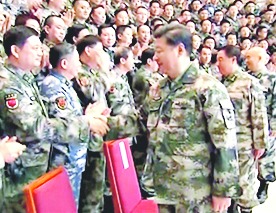

The Chinese president, Xi Jinping, will now be known as commander-in-chief of the military's joint operations command centre. The title, bestowed on a fatigues-clad Xi by the State media towards the end of April, is largely a symbolic reaffirmation of his existing authority over the People's Liberation Army. Xi is attempting to consolidate his control over China's institutions and the title is primarily to reinforce the image of Xi as the man in charge. While previous Chinese presidents had delegated operational decision-making to the PLA, Xi wants to have operational powers as well.
On his visit to the joint battle command centre of China's Central Military Commission, Xi urged officers to build a command system that was "capable of winning wars." According to Xinhua, the State news agency, he said, "The current situation requires battle command to be highly strategic, coordinated, timely, professional and accurate." He also said that "All must be done with the ultimate goal of improving battle command capacities and measured by the standards of being able to fight and win wars."
This move is part of Xi's massive reorganization of the PLA, transforming it from a collection of distinct regional units that operated with a degree of autonomy to a more streamlined, top-down organization. The Chinese leader is also actively purging the military's officer corps, arresting dozens on charges of corruption and firing others for incompetence, while cutting some 300,000 troops from the army's bloated ranks.
This unprecedented reorganization of the PLA is a rolling process that will continue over the next few years, with 2020 set as the target date for all the changes to be in place. This is the most sweeping and fundamental reorganization of the PLA since the 1950s, when Russia helped Beijing create a post-civil-war military largely modelled on the Soviet system. The current reorganization is likely to strengthen the hold of the Communist Party of China over the military and is aimed at enhancing the professionalism of the force. There still remain many unanswered questions about the future trajectory of the new Chinese reform program, including what it means for the top-heavy leadership structure, and what role the reserves and the country's civilian militias will play in national defence and in projecting Chinese power abroad. But what remains certain is that the Chinese military of the near-future will be very different from the Chinese military of the recent past. And this is, predictably, causing consternation in the region and beyond.
While China has taken the issue of military reform by the horns, India continues to be lackadaisical about the defence structure. Appropriate institutional frameworks that enable a nation to effectively leverage its capabilities - diplomatic, military and economic - in the service of its strategic interests still do not exist in India. Though many in the government have lamented at the paucity of long-term strategic thinking in India, nothing substantive has been done by successive administrations to stimulate such thinking.
The National Security Council still does not work as it ideally should. The headquarters of the three services need to be effectively integrated with the ministry of defence. The post of chief of defence staff is the need of the hour for single-point military advice to the government. The fact that successive Indian governments have failed to produce a national security strategy is both a consequence of institutional decay as well as a cause of the inability of the armed forces to plan their force structures and acquisitions adequately to meet future challenges.
Yet, the Indian politico-bureaucratic establishment is not the only guilty party here as the Indian armed forces also have a lot to answer for. Their top leadership has shied away from making tough choices about reducing manpower strength; about adjusting the inter-service budgetary balance; and about restructuring the nation's professional military education system. No military anywhere in the world gets all the resources from its government that it deems adequate but an effective military organization should be able to optimize the use of whatever is at its disposal.
Resources alone, however, will not make the Indian armed forces the envy of its adversaries. It is the policy direction set by the military leadership and the quality of training imparted to its manpower that will make the difference. The debate on the wide-ranging changes that India's defence set-up needs should have been initiated long back by the armed forces themselves.
The questions that need to be debated and answered include: does India have a 21st-century military in terms of doctrine and force structure? Have the doctrines and force structures evolved in line with the equipment that the nation is spending its resources on? Do India's command and control processes reflect the changing strategic and operational requirements? Does the Indian military have the capacity to initiate military actions on very short notice and actually conduct military operations that result in something other than a stalemate, something that India might have wanted to do during Operation Parakram in 2001-02 but could not? Have the Indian armed forces got the balance between capital and labour right?
The armed forces will have to find a way to strike a balance between growing manpower shortage and the easing of budgetary constraints. The services have no option but to modernize their human resources policy - recruitment, retention, promotions, exit et al that will make a huge difference to the satisfaction levels of the rank and file.
It is disappointing to see the service headquarters continuing to resist greater integration. Inter-services rivalry also continues to be as vicious as in the past. The government, meanwhile, can always point to the malaise within the armed forces as an excuse for not undertaking any meaningful defence reform on its own. India, for example, finds itself in a peculiar position of having a strategic forces command but no CDS, partly because of the differences among the three services.The debate has got stuck on the issue of the CDS whereas the nation needs to be thinking seriously about integrated theatre commands, allowing the three services to share their resources and enabling a reduction of manpower at various levels. Today's military challenges cannot be tackled without a real integration up to the command level.