
WHEN BREATH BECOMES AIR By Paul Kalanithi, The Bodley Head, Rs 599
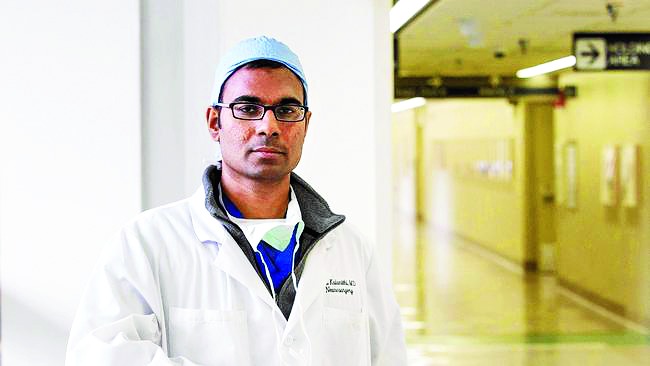
If the unexamined life is not worth living, then, perhaps, it is also not easy to put one's own life under moral examination. Very few of us have the detachment, the objectivity and the clairvoyance that are required for assessing our own lives. And it does not help if, additionally, one is racing against time - fighting a terminal illness and knowing all too well that in the end, death might still catch up. When Breath Becomes Air is the remarkable memoir of Paul Kalanithi (picture), an Indian-American neurosurgical resident at Stanford. It chronicles his journey from a young medical student, trying to figure out the complex interconnectedness of "biology, morality, literature and philosophy", to a neurosurgical resident, working on immensely challenging and frequently life-changing brain surgeries, and finally to a stage-four lung cancer patient, confronting issues of mortality and morbidity between sessions of cancer drugs and chemotherapy. And yet, in the end, one cannot help but be amazed at the clarity and the shimmering prose style with which he confronts and tackles questions of life and death.
Instead of giving his readers a sentimental account of a cancer victim, Kalanithi comes up with a thoroughly engaging book, laced with self-effacing humour and a writing style that is poetic and yet rigorously scientific in temperament. He creates drama, uses words with sparseness and precision, and couches serious philosophical questions in real-life stories (a part of the crispness also comes from what must have been a cautious editing exercise undertaken by Random House, since Kalanithi left much of his manuscript unfinished). Starting his book straight with the detection of his ailment and then turning back to his healthy years, he intertwines two lives - one of an ambitious young man at the cusp of achieving great things and the other of an end-stage cancer patient, whose "future" had "evaporated" at the flip of a CT scan image. The reader cannot help but feel for a man who has put his life on hold for years and from whom the chance of delayed gratification was cruelly snatched away, just when he was getting ready for it.
In the throes of death, Kalanithi takes us on a journey through his healthy years. In an almost Heideggerian manner, Kalanithi links the questions of 'being' and 'becoming' to those of 'temporality'. For him, following the detection of his illness, his sense of the self gets attached to his experience of time. Since time is finite and since this finitude is mainly felt in terms of the temporality of his life, living then becomes an exercise in grasping this finitude better. For Kalanithi, as it was for Heidegger, human life is really about "being-towards-death" or, in other words, "stretching one's life onto the horizon of one's death". While Kalanithi tries to make sense of this ephemerality, we get a glimpse of a life that was, a life that is and a life that could have been.
Time for Kalanithi seems to fly in the operation room. His day usually begins at 6 a.m. and lasts until the final operation is performed, sutures are in place and wounds are healed. For neurosurgeons, the sense of time depends on how fast they are in the OR. Neurosurgery requires an almost superhuman quality of technical precision, along with breakneck speed. Anything can go wrong if an operation takes too long: anaesthesia can wear out, nerves can be damaged, muscles can break, kidneys can fail. If a neurosurgeon takes too long, assistants will invariably take digs at him: "Looks like we've got a plastic surgeon on our hands!" or "I get your strategy: by the time you finish sewing the top half of the wound, the bottom will have healed on its own! Half the work - very smart!" The intense focus and concentration make "the arms of the clock seem arbitrarily placed. Two hours [can] feel like a minute". Once the final stitches are placed the sense of clock time dawns once again.
Six years of his residency pass and Kalanithi develops a host of symptoms, all of which point towards metastatic lung cancer. Clinical investigation follows and he is put under powerful drugs and eventually under chemo. His body weakens, his energy flags and he retires from the hospital to convalesce. Recuperating at home, his sense of time alters. With little to do except for rest, time now seems to stretch for eternity. During residency, time may have flown but in the hurly-burly of the OR, it never seemed meaningless. There were always new challenges, new patients and new complications. In the vacuous dullness of his home, hours, days and weeks have little meaning. A full day's plan includes forcing in powerful meds, waiting for the doctor's next appointment and, if lucky, a visit from a friend.
With time, his sense of identity also distorts. In a moment of supreme irony, he remarks that the conjugation of the verb, "to be" - 'have been', 'am' or 'will be' - seems confusing. "Which [is] correct?" he asks, "I am a neurosurgeon," "I was a neurosurgeon," "I had been a neurosurgeon before and will be again?" Given his altered state of being, these questions seem redundant. The past is lost forever. The future seems uncertain. It is only the present and its painful awareness that appear to be eternal.
And yet, in his darkest hours, he finds joy and succour. Just nine months before Kalanithi dies, his daughter, Cady, is born. Once again, his sense of time and that of the precariousness of the self change. But now, time is like a "double-edged sword". His most profound desire that Cady grows fast enough to have some recollection of him is at odds with his physical state that brings him a tad closer to death each day. Kalanithi ends his memoir with an aching realization: when Cady grows up, she might have no recollection of her father. Nonetheless, he takes comfort in the fact that we, as readers, would know that it was Cady who had filled the days of a dying man with "a sated joy, a joy unknown to [him] in all [his] prior years".
The season changes and just as the saucer magnolias come to bloom, Kalanithi's body starts resisting the third-line drugs. On a quiet Sunday morning, as the church bells toll and the neighbourhood prepares for Mass, he develops a high fever and by evening starts gasping for breath. But even on deathbed, he rejects the choice of being intubated. He refuses to slip into delirium, losing his organs one by one and then his mind and eventually his body. Instead, he removes his breathing support and waits for death. The story of his final days is recounted by Lucy, "his wife and a witness" to his suffering, in the epilogue of the book, as Kalanithi knew that he would never be able to finish it.
It is not very often that one comes across a book that has the power to shake one to one's deepest core. I cannot recall any other reading experience with such vividness: I can still remember turning each page, the smell of the paper, the welling up of tears in my eyes. Why do I feel this strange kinship with a man whom I did not know of even a few weeks before reading this book? Is it just my humane instincts that kick in or is that this book, in an insidious way, has made me confront my own fears: not of cancer per se, but of a consciously felt death. Will I be able to embrace death with dignity? Will I have a meaningful life? Will I find my little desires fulfilled before my last breath?
It is one thing to philosophize about death but to prepare for it with patience and without bitterness is quite another. Kalanithi does the latter not only in words but also in action. When Breath Becomes Air is a monumental testimony of the relentless striving of a man to embrace death while not forgetting to live.