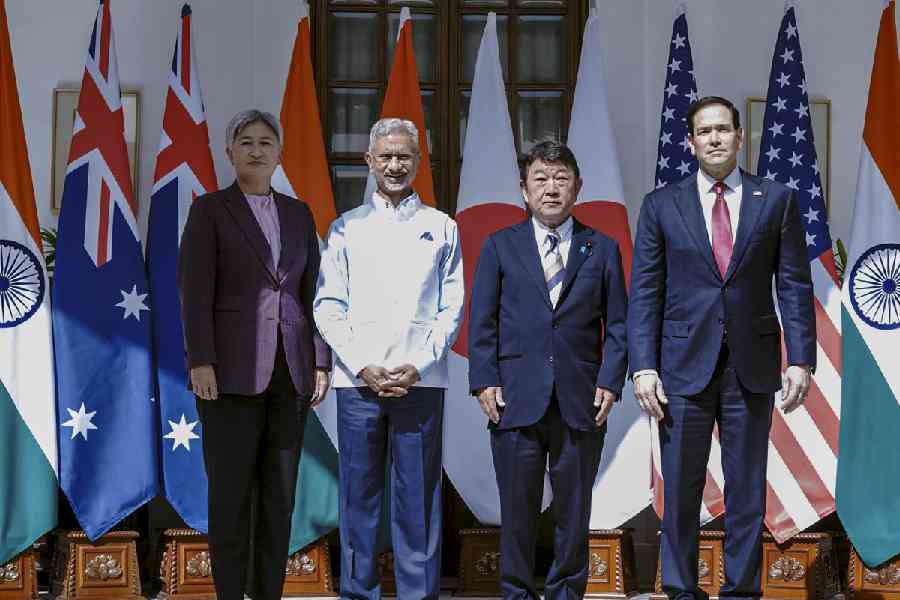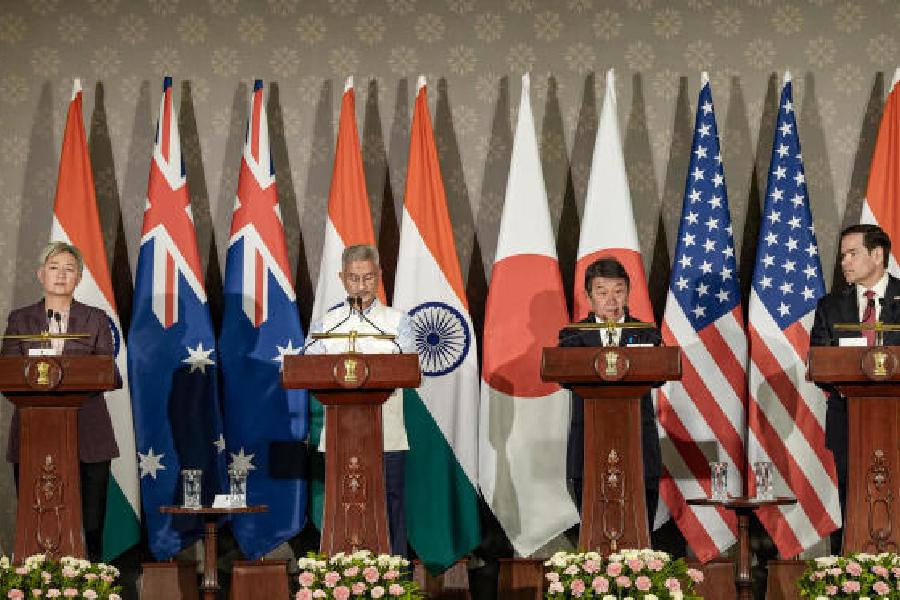
For several months now, questions have lingered and grown over the future of the Quad, the grouping consisting of India, the United States of America, Japan and Australia. On Tuesday, the foreign ministers of the four democracies helped give the Quad a new lease of life, underscoring that the prophecies of its demise have been premature. But their meeting in New Delhi did not put to rest larger concerns about its relevance in a world where the ideas that were supposed to be the glue keeping it together no longer appear to matter to its most powerful member. On the surface, the meeting threw up multiple outcomes. The deal they struck on sharing technology and know-how to develop critical minerals supply chains could help them reduce their dependence on China. Their firm assertion on keeping the East China Sea and the South China Sea open, their plans to collaborate on building a port, and their continued efforts to provide humanitarian assistance to vulnerable countries in the region are welcome.
Boilerplate statements condemning terrorism are unsurprising. But whether on combating extremism or on upholding international law and freedom of navigation, statements of intent by the Quad sounded hollow given the actions of the US. The joint statement issued by the foreign ministers opposes the closure of critical waterways. But what of the US naval blockade of Iran in the Strait of Hormuz? The statement condemns unilateral attacks aimed at changing the status quo. What about the unprovoked US-Israel war on Iran that has plunged the entire world into an economic crisis? The ministers spoke of sticking to international law. What of America's abduction of sovereign leaders and the assassination of others in blatant violation of the UN Charter? The statement talks of ensuring the free flow of goods. What does this mean when the US under President Donald Trump seeks to wage a global trade war using tariffs? The foreign ministers condemned the Pahalgam terror attack. How does that square with Mr Trump describing Pakistan's army chief as his favourite field marshal? More fundamentally, what does the Quad's unstated but definite aim of countering China's aggression in the Indo-Pacific mean when Mr Trump is wooing China, seeking to cut bilateral deals? These are existential questions for the Quad as well as for the idea of a democratic front against authoritarianism in the Indo-Pacific. Do its members, especially the US, have convincing responses?