|
|
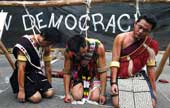
| Dappu Ramesh and Gadar at a Naxal rally in Hyderabad, September 30 |

Last week, a group of nearly 50 rebels stormed Dumri village in Koderma district?s Satgawah block and mowed down four villagers. One of them was a retired government teacher. His fault: he had been trying to mobilize the villagers against the Naxalites. A people?s resistance wave has been sweeping through the villages of Giridih and Koderma districts ? considered a hotbed of rebel activity. The attack dealt a crushing blow to the fledgling movement.
For the past fortnight, over 20 primary and middle-level schools in Dhanbad?s Topchanchi and Baghmara blocks have been witnessing zero attendance, following rumours that Naxalite outfits are demanding 10 children from each school. Earlier this month, over 500 rebels looted Coal India?s arms depot in Hazaribagh?s Ramgarh sub-division and made away with more than 1,000 detonators and gunpowder.
These incidents, though unrelated, have a common thread. They point to the rejuvenation and re-consolidation of the underground forces after a relatively long period of inactivity.
At a time when the governments of the strife-torn states in the east and the central plateau region ? namely Andhra Pradesh, Chhattisgarh, Madhya Pradesh, Bihar, West Bengal and, to some extent, Maharashtra ? are making overtures to the rebels for peace, Jharkhand remains curiously insulated.
A couple of months ago, the chief minister, Arjun Munda, sent feelers to the Maoist Communist Centre and People?s War to come to the negotiating table. While PW responded positively, MCC gave the offer a thumbs down. They thought it pointless to hold talks with the Munda government as the assembly polls were barely a few months away and a dialogue would be meaningful only with the new dispensation. The MCC?s rejection apparently put off the PW and cast the chief minister in poor light. Since then, Munda stopped pursuing peace with the extremists.
However, a section of government and police officials in Ranchi feels that Munda should have hung on to the peace process despite the initial hiccups. Unlike Andhra Pradesh and Madhya Pradesh, the state does not have a consistent policy on extremism ? be it trial, surrender or rehabilitation. Hence, it is difficult to convince the ?misguided youth?? inherently suspicious by nature ? to return to the mainstream. The last time an ?elaborate surrender ceremony? was staged in Giridih after the creation of Jharkhand, the promised rehabilitation package proved elusive. The handful who surrendered were either hunted down by their comrades-turned-foes or returned to life in the shadows. A former primary school teacher in Koderma, a rebel sympathizer, who was coaxed into giving up arms, has not yet received his salary since he re-joined school. The bureaucracy cites delay in necessary paperwork, but the teacher perceives lack of will on the part of the state to deal with the problem.
At a meeting of the chief ministers of the Naxalism-affected states in Hyderabad on September 21, the Union home minister, Shivraj Patil, urged the states to initiate talks with rebels ?even if they do not surrender arms.? In consonance with Patil?s stand, the Y. Rajshekhar Reddy government in Andhra Pradesh extended the olive branch to the People?s War Group. He sent word through the outfit?s emissary, Varavara Rao, for an October rendezvous. As a prelude, the PWG and its radical allies staged a mammoth public rally in Hyderabad on September 30 to bring the outfit?s ideology and demands to the masses after 14 years.
But any attempt at peace has its pitfalls. The last time when a truce of sorts was declared between the government and the rebels, the PWG used the opportunity to regroup and strike back. However, the Andhra government and the Centre feel that it is still worth taking a chance.
As if on cue, the West Bengal government, which had adopted a hard line on red militancy, has also made peace gestures though the chief minister, Buddhadeb Bhattacharjee, insists that any talks should be minus arms ? a pre-condition that the PW is unwilling to buy. Bihar is grumbling, but mulling talks all the same. Chhattisgarh, perhaps the worst-affected state in terms of socio-economic loss, and Orissa are also open to negotiation and vigorous development in the backward districts.
So that leaves Jharkhand. Munda is on the offensive. He has wrangled Rs 10 crore from the Centre to enhance police infrastructure and combat power. Besides, an additional 77 lakh is in the pipeline to arm the homeguards so that they can act as a resistance force at the local level. Part of the Rs 10-crore bounty will also be used for launching more rural welfare schemes in the sensitive region. But after the scrapping of the Prevention of Terrorism Act, there is no law to try the arrested rebels. Munda had rustled up a draft crime control act, but must have dropped the idea with an eye to the assembly poll.
Insiders say a number of National Democratic Alliance leaders? especially those in Palamau, Chhatra, Garhwa, Giridih and Hazaribagh ? use the rebel base to buy votes. Any anti-terror legislation at this juncture could blow up on the NDA?s face. Moreover, Munda is still smarting from the repeal of the Pota and wants a debate on it in parliament. One can well imagine that the Pota alternative? Unlawful Activities Prevention Act? will be of little impact in the state. Political considerations will overshadow any anti-terror endeavour in Jharkhand.
Under the circumstances, the naxalites have the advantage. Jharkhand is perhaps the only state where the Naxalites can use the government?s hostility to their advantage. One cannot ignore the fact that the NDA has been the avowed ?class-enemy? of the ultra-left groups.
The United Progressive Alliance is playing it safe. It has a four-pronged strategy to counter extremism, but it does not want to get involved in an interim truce ? which has been categorically stated as a state subject.
Munda would rather go down in Jharkhand?s history as a warrior rather than a ?Congress? stooge. The rebels never had it so good.