
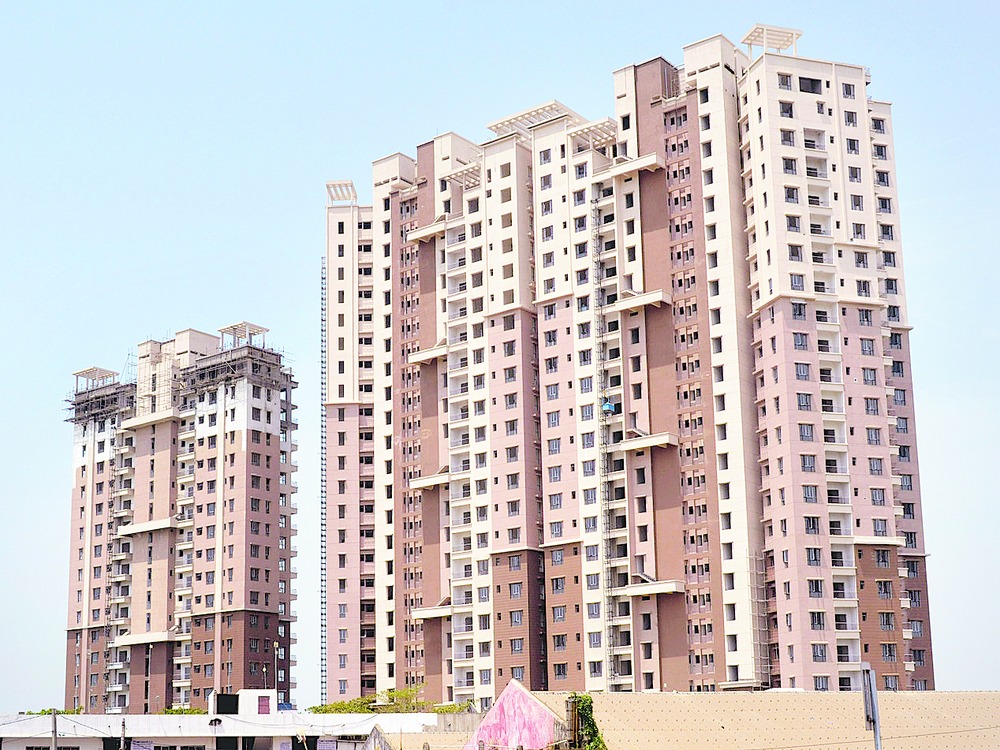

Bhubaneswar, Feb. 5: If you are planning to buy your dream house or apartment, be prepared to shell out more.
The January 13 notification of the development authority to implement the transferable development right (TDR) rules by the end of this financial year is giving sleepless nights to real-estate developers, landowners and buyers here.
The proposed rules of the housing and urban development department, which it had notified on December 28 last year, envisage that landowners here would get a TDR certificate instead of monetary compensation if their land is taken up for any development work.
Using the TDR certificate, land losers can buy land within the jurisdiction of the Bhubaneswar Development Authority (BDA). They can also sell the certificate to other interested buyers or real-estate developers. The TDR certificate will have an initial validity of five years from the date of issue. The certificate can be extended by another five years.
Residents here are worried that the implementation of the new TDR rules would further push up the prices of flats and apartments. According to experts, the TDR system combined with the floor area ratio (FAR), under the existing rule, is set to create drastic imbalance in the property value.
The floor area ratio is the total covered area of the floors divided by total plot area of a particular land. At present, the authorities have reduced the base FAR to 1.2 from the earlier 1.5-2.75.
This means, once the new rules are implemented a building with a total floor area of 12,000sqft can be constructed on a plot size of 10,000sqft.
"Reduction of base FAR to 1.2 as a standard will create a permanent problem for individual homemakers to fulfil their space requirement. As they are not making any commercial construction, they would be forced to buy TDR to achieve their previous allowed FAR," said president of the Association for Real Estate Developers, Umesh Patnaik.
The FAR in Pune is 1.5 to 2.5, in Gurgaon it is 2-4.5 and in Hyderabad the rule stipulates a permissible limits of 2.5 to 4.
Patnaik said that the new policy might bring down land prices at some distant places of the state, but in a city like Bhubaneswar the flat or home costs will shoot up by 30 to 40 per cent.
One of the salient features of the proposed rules is that land losers can also use the TDR value to increase height of the house beyond the permissible FAR.
As TDR benefits are transferable, the reduction in FAR will make real-estate developers seek out land losers with such certificates to gain additional building height.
However, real-estate developers will have to buy the TDRs at market value.
The additional expenses incurred by the builder in procuring TDRs to achieve the permissible FAR limit beyond base 1.2 will automatically be transferred to the constructed property.
This, Patnaik says, will lead to an escalation in the prices of flats and apartments.
"The reduction in existing FAR, and the ultimate investment by the developer to buy TDR from the open market to fulfil its entitled space requirement will push the price of flats northward," said Patnaik. Notably, the going land price in Bhubaneswar is Rs 3,500 per sqft, which may rise up to Rs 5,000 per sqft if the rules come into effect.
In the present situation, a real-estate developer will have to get the TDRs at market valuation for construction of multi-storeyed apartments beyond the base FAR of 1.2.
If the new rules are all set to make real-estate costlier, those getting TDRs will have a few other issues to tackle.
Though the TDRs have a shelf life of 10 years, the proposed rules are silent on the fate of the certificates if one fails to use it within the prescribed period.
Moreover, in case of loss of the certificate, the owner will have to pay one per cent of the total property value to get a duplicate copy from the authority. Earlier in the case of a patta, one had to pay just Rs 100 to obtain a duplicate copy.
What is also baffling residents here is whether a land loser can use the TDR certificate as a mortgage document in banks.
Another component of the rule is that the TDR certificate will be issued in the name of only one person even if the property has multiple holders.
"I have found no benefit in this rule for the common people. The question is, why would I pay one per cent of my total property value to get a duplicate TDR certificate. Also if the property is in the name of seven of my family members, how would the authority issue a single certificate and in whose name," asked Dhananjay Rath, a resident of Satya Nagar.