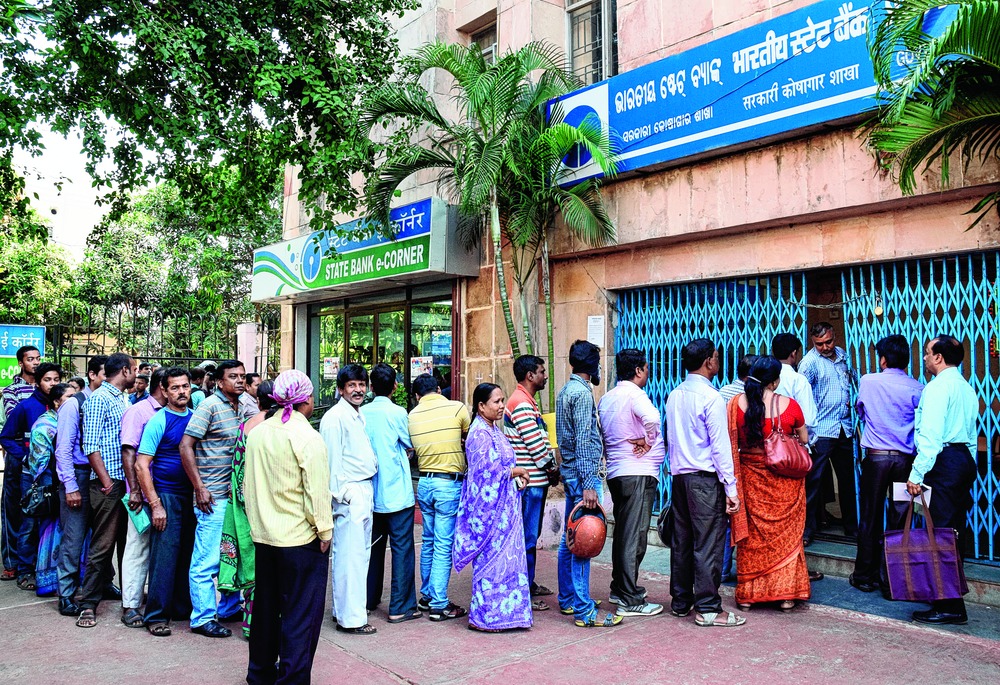

Bhubaneswar, Nov. 30: Banks and the state government have their hands full tomorrow as they get ready to handle the first salary day rush post-demonetisation.
The state government, however, doesn't see much problem with salary disbursement to its 4.5 lakh employees and 3 lakh-odd pensioners and said it was for the banks to handle the rush.
"All the employees and pensioners have bank accounts. Their salary or pension is credited to their accounts through bank transfer. It's almost a cashless transaction," said a senior officer of the state finance department.
"It's up to the banks to ensure availability of adequate cash for withdrawal," he added.
The banks, on their part, claimed their plans to manage the first-day rush for withdrawal would work.
Chief manager of SBI state secretariat branch P.K. Behera said: "We have taken all measures for availability of adequate cash at the ATMs. We have packed the ATMs with Rs 2,000, Rs 500 and Rs 100 notes."
Senior manager of UCO Bank secretariat branch Gyana Ranjan Mohanty said: "We have enough Rs 2,000 notes. We have requested RBI for adequate Rs 100 notes for the ATM withdrawal and for the counter disbursal."
As the banks work out their mechanism to handle the rush and meet the cash demand of the people, the common man is still trying to work out a way to beat the currency crunch.
Rajendra Mohan, 32, an airline employee and resident of Patia, looks forward to the first of the month eagerly. However, the first of December this year is different.
For the first time in his eight years as working professional, Rajendra, will have to make several compromises this time. "I give half of my salary to my wife for managing household expenses. But with a cap on withdrawal limit post demonetisation, I plan to give her Rs 6,000, which is much less than I used to give her in other months," he said.
Rajendra earns around Rs 40,000 a month and lives in a rented accommodation at Patia. The rent of the house is Rs 12,000. "Paying rent has emerged as the biggest headache as the house owner will not accept cheques and has made it clear that he will accept it only if it is in denominations of Rs 100 and the new Rs 500 notes," he said.
Paying the household help is also a challenge.
"The housemaid takes Rs 3,000 every month and will not accept cheque or bank transfer. Cashless transaction does not work in these matters," he said, adding he would have to stand in queue at the bank for two days to be able to withdraw Rs 24,000. "I cannot afford to do it because of work," he said.
Mahendra Swain, 38, a steel firm employee and resident of Rasulgarh said for the first time in his 12-year-long career, he was apprehensive of what was in store for him tomorrow when he would have to stand in queue to withdraw a part of his salary. "I will receive my salary tomorrow. Every month, I withdraw Rs 25,000 from the ATM for meeting household expenses. However, that will not be possible this month. I am bracing myself for long queues at the bank. Withdrawing Rs 2,000 after waiting for 15-20 minutes at an ATM does not make sense," he said.
Swain said he uses his debit card for making purchases and is not averse to cashless transactions. "However, cashless transaction has its limits. Its limit ends at the nearby grocery store and the milkman. Buying items from a supermarket is costlier and adds to the overall monthly household budget," he added.
Swain said salaried people would feel the pinch of demonetisation as despite their salaries being credited, they would be bound by restrictions on withdrawal.
Those who are retired are also apprehensive of standing in queue at banks to withdraw their pension. It is customary for some pensioners to visit the bank on the first or second of every month to withdraw pension.
"Although I am retired and have no professional commitments, standing in queue at the bank to withdraw pension amount is not a cakewalk anymore," said Mani Behera, 72, retired state government employee and resident of Jharpada.
He said that since he had already deposited whatever old currency he had with the bank, procuring medicines would be a tough task.