 |
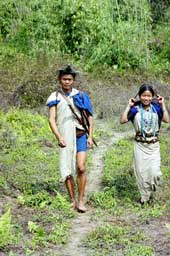
| ‘The life of a tribal, till the last couple of decades, had been intricately linked to the forest’ |
Conservation of forest and environment is neither the exclusive domain of environment activist like the Bahugunas, Patkars, Mehtas nor the host of NGOs advocating the cause throughout our country. The concept, in fact, had been firmly entrenched in the tribal psyche since centuries, particularly in the Northeast, when few in the country realised the importance of safeguarding the environment for posterity.
The life of a tribal, till the last couple of decades, had been intricately linked to the forest. There has been a healthy and strong symbiotic relationship between the two. The existence of a tribal, particularly in villages, was in total and complete harmony with the forest, which was his natural abode. This unique relationship gave rise to crusaders of conservation all over the Northeast, who motivated their brethren accordingly.
The anxiety for protecting their habitat was inherent and spontaneous. Consequently, their involvement was absolute, associated with innovative strategies executed in all sincerity and dedication. As all such efforts were low profile, undertaken in an era when media publicity was virtually unknown, there was no one to sing paeans on their contribution and commitment in upholding the cause of nature.
Conservation of adequate reserve, whether natural, material or otherwise, is normally not an issue for human apprehension or priority, particularly when it involves an entire tribe, community or race. Such social concerns usually emerge from individuals with foresight and practical wisdom. The need for preserving something that is already scarce or facing extinction is a delayed reaction, when immediate curative measures prevail over all other considerations. Under such circumstances too, there are few who venture to take the initiative with sincerity of purpose.
The situation has changed drastically during the last two decades, when “commercial marauders” from the mainland successfully convinced a sizeable section of tribals that “money actually grows on trees” which are meant to be sacrificed to meet the requirements of modern amenities. The enticement to sell the treasures bestowed by nature and inherited from their ancestors for a song was overwhelming.
The rationalists’ voice of reasoning emanating from both the region and the mainland were subdued in the chorus for instant and easy returns. The outflow of wealth and natural resources from the region was possibly a process linked to the course of joining the mainstream.
A classic saga of conservation is reflected in the deed of erstwhile chiefs, commonly known as “Angs”, of the Noctes — a vibrant tribe and one of the two major tribes inhabiting Tirap district of Arunachal Pradesh. The Angs of the two groups of villages, namely Namsang and Borduria, exhibiting total clarity of vision way back in 1948, entered into separate agreements with the governor of Assam on November 3, 1948 and September 5, 1948, respectively, by which both the chiefs leased out their forest areas, measuring 107.62 square km and 38.1 square km respectively for a period of 50 years to the government.
The lease has been renewed again with modifications after expiry. The forests thus leased out to the government was converted into reserved forests in October 1962, primarily for ensuring scientific management by the forest department. The predominant tropical wet evergreen forest growing naturally in the area is one of the richest in the world in terms of value and biodiversity.
According to the agreement, the net revenue earned from the forests was to be shared between the Angs (chiefs) and the government in the ratio of 75:25. There is also the provision for payment of certain fixed amount annually to help the chiefs of Namsang and Borduria meet their personal needs. The Angs probably had a premonition of things to come, mainly the approaching pressure on the rich forest resources, besides apprehending likely snags in the way of utilising their share of revenue in worthwhile projects and schemes.
They realised the importance of preserving the rich forest wealth with the idea to derive tangible benefits for the people, from the increment in growth attained by the forest annually. The basic concept was to harvest the increment or “interest” and conserve the original forest or “principal”.
With this end in view, the Angs entered into another agreement in 1960 with the political officer (now DC) and director of forests (now the principal chief conservator of forests), NEFA administration, for formation of a trust, with both the officials designated as trustees, besides the two Angs. The trustees are authorised to receive the lease rent of the forest and utilise it for the social, educational and economic uplift and common welfare of the people of Namsang-Borduria group of villages in particular and of Tirap district in general.
The trust thus created with the resources from Namsang-Borduria reserve forests was termed the Namsang Borduria Trust Fund or NBF. The detailed procedures were drawn up for executing and operating this particular trust (fund) wherein the deputy commissioner of Tirap, Khonsa, was authorised to administer the funds with the advice and guidance of NBF advisory committee comprising of 10 members drawn from social workers, prominent public leaders of the area and other departmental heads of the district. In order to augment the income of the trust for wider activities, investments are also made with profitable agencies to ensure sustained returns.
A number of development activities are undertaken in different spheres from this trust fund. Annual grants are paid to the college, university and technical students belonging to Tirap district.
At present, over 100 students are on roll of annual grants. Special financial assistance is also awarded to the needy and deserving students of this district, in addition to providing aid for the deficit schools of the district as and when required.
The trust fund is also utilised for granting relief to the people affected by natural calamities and as aid to the needy for specialised medical treatment outside the state.
An 80-bed modern hospital and nursing school, constructed on an area of 175 acres, has been established at Pullong, 20 km from Khonsa. The imposition of a ban on timber felling, conversion and trade by the Supreme Court has virtually dried up the only source of funds inflow to the trust by almost Rs 5 crore annually.
Paucity of funds has adversely affected a majority of schemes. The trust is at present functioning with the interest accrued not from the forest but the surplus from previous earnings received as lease rent from the government of Arunachal Pradesh. The Angs could not have visualised the present situation although the state of affairs would have been much worse if preventive measures were not initiated by them immediately after Independence. It is a matter for serious introspection whether the lessee has been able to live up to the expectation and spirit of the agreement as envisaged by the Angs of Namsang and Borduria.