 |
Robin Banerjee spoke to The Telegraph last year.
Excerpts from the interview to Anjali Tirkey:
Q Robin Banerjee is many personalities rolled into one. The doctor, the naturalist, the wildlife filmmaker and photographer, the artist/painter, the curio collector, the philanthropist, the lesser-known connoisseur of food who also has a few recipes of his own and a person who has acted in films, albeit in small roles. Which persona is dearest to you and how and when did these different facets surface?
A I studied and was trained as a medical doctor and perhaps that remains the dearest part of my life.
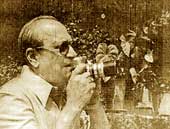
The work of the naturalist and filmmaking went hand-in-hand. It is useless to just lecture people. People remember and realise the importance of anything when they see, hear and feel it. I made the movies to let the world see and know the beauty of Nature.
The paintings and other creative work which I did and still guide my men at home to do, are gifts of Santiniketan, where I did my early schooling. Painting, singing, craft-making — all these were part of our curriculum.
I am not a conscious curio-collector. Most of them are gifts I received from people all over the world, many of them children.
I am no great philanthropist either, just a simple man. But I cannot and I did not do it just for myself. This is for the people, the children. The land I donated for the Vivekananda School and the other help I gave was because I wanted the children to get good education and because at the same time I wanted them to learn more than just academics.
And the other facets? Oh! There is nothing much to say. Now I can’t even eat anything good. After three serious cases of food poisoning when my work made me eat all kinds of food —from raw food to insects — I have to follow stringent dietary habits. And those acting episodes are tiny parts in the Assamese films, Songhat and Agni.
Q How did a professional doctor become a naturalist?
A As a doctor in the British Navy I saw the vagaries and destruction of World War II. The inhuman cruelty at the concentration camps of the Nazis, the futility of war, the mayhem, everything shattered me. They took away my peace.
Coming to Assam, and Kaziranga in particular, gave me the peace I was looking for.
Q How was the film Kaziranga received here in the beginning?
A. Initially, no one paid much attention to me or my film or to what I had to say. Later, I showed it to Prof. Wolfgang Wulrich, director of the Zoological Gardens of Dresden, Germany, whom I happened to know and to Bernand Zeimick, professor of veterinary science at the Zoological Society of Frankfurt. They suggested that I show the film on Berlin TV.
The response was overwhelming. Tourists from all over the world started visiting Kaziranga. Gradually the government also took an interest.