 |
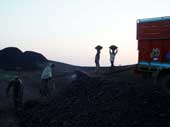
| Mining in progress at a Meghalaya pit. Pictures by Eastern Projections |
The adverse effects of coal mining in Meghalaya far outweigh its economic benefits
lThe author is a freelance writer and sociologist
Meghalaya has often been termed as the “coal state” or the “black diamond state” of the Northeast. It is endowed with some very high quality minerals like coal, limestone, sandstone and even uranium. However, the actual revenue earner is coal, which fetches the state exchequer millions of rupees. Last year, the revenue from mineral resources was Rs 50.24 crore, with over 70 per cent of it coming from coal.
The history of coal mining and trade in Meghalaya dates back to the days of the Raj. Then, there was very little extraction and most of the coal mining began from Cherrapunjee. Export of the mineral came much later. Export from the Jaintia Hills, considered the most-exploited coal belt, came much after Cherrapunjee and some other areas.
However, the actual trade with Bangladesh appears to have started with the opening of the Dawki route, which still holds the record of the being the largest trade route with Bangladesh. Other areas like Shella, Borsora and Gasuapara, too, started simultaneously, but trade flourished along the Jowai-Amlarem route like none other.
Coal trade also brought with it opportunities to strengthen bilateral relations between India and Bangladesh, at least to help tackle nagging problems on the border. It also provided an opportunity for the people to gain employment. The poor and the marginalised also gained, with a business lifeline coming into existence along various national and international highways.
For a cash-starved state like Meghalaya, things could not have been better than the coal trade. Not only did it transform into a booming trade for private mine-owners, exporters and lorry owners, but tax on trading the mineral to Bangladesh and other states also became a major source of revenue.
The Union government, too, was happy. After all, it was earning substantial royalty in terms of foreign exchange. The Union government strengthened its customs office and created its headquarters in Shillong to facilitate revenue collection.
The commissioner of customs was set up together with the Central excise. Only recently, it was bifurcated and made a separate commissionerate for not just revenue collection but to check smuggling of drugs and contraband.
Coal mining in Meghalaya is being carried out for decades in Jaintia Hills and Garo Hills in a blatant unscientific manner, leading to extreme ecological imbalance. Not only have the waters in some of the major streams of Jaintia Hills and other areas become contaminated, but unscientific mining has also resulted in other serious problems like death of miners and destruction of the groundwater table.
Studies have shown that coal and limestone, which are mostly exported to Bangladesh through Dawki, Shella and other areas like Borsora and Gasuapara in West Garo Hills, have taken its toll on the fragile landscape. It has no doubt economically benefited the people and the filled the government coffers with precious revenue, but the destruction to the environment has outweighed such benefits. There are several cases in point.
In the Nongalbibra mines of South Garo Hills, miners dying inside treacherous mines are common. Unfortunately, very little has been done for a solution. The picture is not so rosy in the Jaintia Hills and West Khasi Hills either, where “rat hole mining” is still very much in practice.
Government after government in Meghalaya promised to strengthen the infrastructure and develop proper mining industries. However, no one seems to be too concerned and the only bright feature in this big booming business is the turnover in foreign exchange.
According to reports, the government earns over Rs 3 lakh a month alone from the Dawki land custom station in royalty. There are about six land custom stations in the state. So, a logical interpretation is, the monthly earning of the government from all the land custom stations is well beyond Rs 30 lakh.
The coal and limestone deposits in the state could well have made Meghalaya’s neighbours envious of its natural resources, but an unscientific approach to dig out these minerals and sell them in the international and domestic market has robbed it of that opportunity. So much so that experts and geologists now warn of an ecological catastrophe in the near future in areas like Cherrapunjee in East Khasi Hills and Bapung in Jaintia Hills. Mining has left the hills virtually hollow in these areas.
Geologists warn that if an earthquake strikes, the majestic hills of Cherrapunjee will be the first to give in, leading to a major disaster.
Once known for its rainfall, enchanting landscape and waterfalls, the erstwhile capital of Meghalaya unfortunately is sitting on an ecological time bomb. “Rat hole mining” of coal and limestone in the fragile hills of Sohra has been a contentious issue.
If reports by organisations like Khasi Indigenous Society for Civil Liberties are to be believed, it appears that even the water problem of places like Cherrapunjee and other areas near the mines is a result of excessive unscientific mining. An inquiry report prepared by the two organisations with help from experts at the North Eastern Hill University, doctors, lawyers and scientists on the problems of water scarcity in Cherrapunjee serves the latest warning.
The report is a grim reminder of how coal mining and the proposed mining of uranium in Meghalaya would be the ultimatum power keg to explode an ecological disaster.