
Shillong, Aug. 16: The prevailing misty weather in the hills could be perfect for a cup of Assam tea or Meghalaya coffee.
A retired college lecturer and his family have come up with a coffee brand to inculcate a coffee-drinking culture and encourage farmers to plant coffee instead of broomsticks in the abode of clouds.
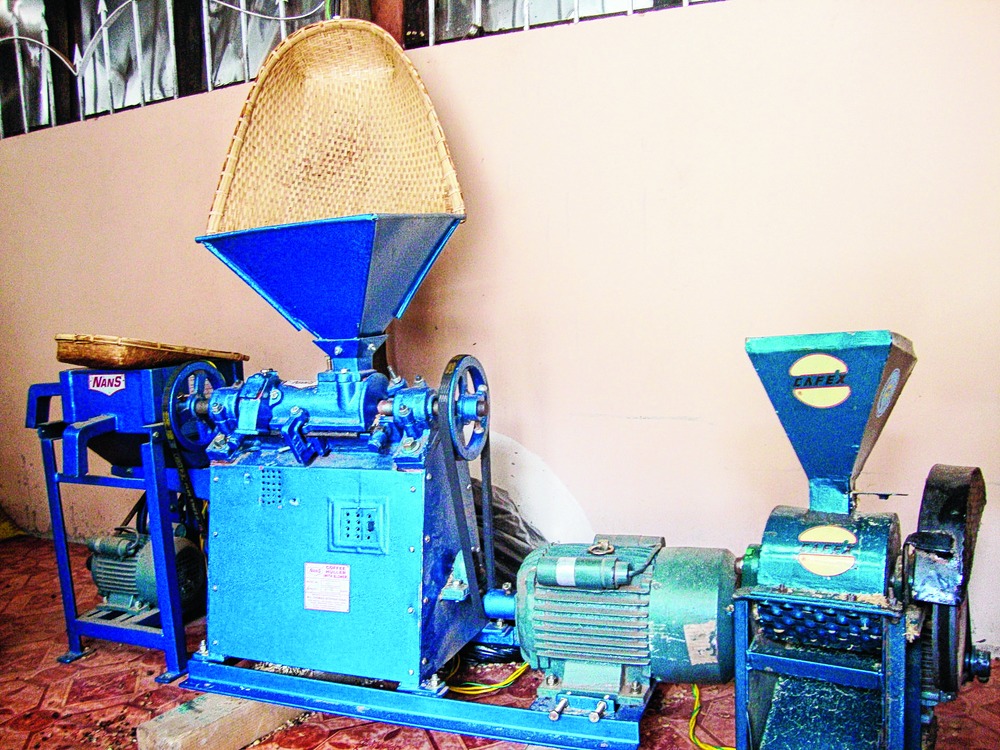
A few months ago, Dondor Giri Nongkhlaw, proprietor of Smoky Falls Tribe Coffee, started what is perhaps the first roasting and grinding coffee unit in the Northeast at Lawjynriew in Nongthymmai here. Nongkhlaw invested nearly Rs 15 lakh in the plant. The brand name has been derived from the numerous waterfalls that cascade down the hills in this part of the world.
Having undergone a month's training at Chikmagalur in Karnataka, Nongkhlaw came back to start the unit in April. The Telegraph met the former college lecturer at the unit, where he, along with his children, were engrossed in the multiple procedures of processing raw coffee beans before packaging the "pure coffee powder" into neat packets and distributing them in and around Shillong.
"Coffee plantation in the Khasi hills is not new. There was a book published in 1908 by the Assam Secretariat Press, Shillong, which wrote about coffee cultivation in the Khasi hills," Nongkhlaw said.
The raw coffee beans are transported from villages located mainly along the southern slopes of East Khasi Hills while some of the villages are in Ri Bhoi district. Arabica and Robusta are the two main varieties processed at the unit. According to Nongkhlaw, there are also indigenous coffee species like Coffea khasiana and Coffea bengalenses. However, he said these varieties are yet to be commercially considered though the process is on.
"I have visited around 46 villages where coffee trees are found but we have been able to only get coffee beans (mainly Arabica) from 12 villages," Nongkhlaw added. He purchases the coffee beans from the farmers at nearly Rs 75 per kg. The villages include Tyrna, Nongjri, Siltham in East Khasi Hills and Marngar and Umsning in Ri Bhoi district.
After the beans are roasted and grounded, the coffee is packed in 100gm and 50gm packets where instructions are also given to consumers as to how they should brew the coffee without using a coffee-maker. "Our products contain 100 per cent pure coffee with no added colour or preservatives. So far the response has been satisfactory but the problem is that a majority of the consumers do not know the art of brewing coffee. We need to create awareness on this aspect so that we can inculcate the culture of coffee-drinking here," Nongkhlaw said.
Besides creating a coffee-drinking culture, he has a larger plan behind propagating coffee plantation. "Coffee plantation is yet to be properly streamlined here. Whenever I go to the villages on the southern slopes, I tell the farmers about the advantages of coffee plantation. Since most of the farmers are into planting broomsticks, I tell them they should shift to coffee plantation instead. Broomstick cultivation is harmful for the soil as it not only turns it arid but also depletes the soil nutrients. But if farmers cultivate coffee, they can grow fruits alongside," Nongkhlaw said.
According to him, the annual coffee production in Meghalaya is around six to eight tonnes but the demand in Shillong could go up to 20 tonnes annually.
According to Coffee Board of India data, the post-blossom crop forecast for 2016-17 is 320,000 metric tonnes, comprising 100,000MT of Arabica and 2,20,000MT of Robusta. This is a decrease of 28,000MT (-8.05 per cent) over the final estimate of 3,48,000MT in 2015-16. The post-blossom estimate for the Northeast is 205MT (100MT Arabica and 105MT Robusta) whereas the final estimate for 2015-16 is 155MT (90MT Arabica and 65MT Robusta).