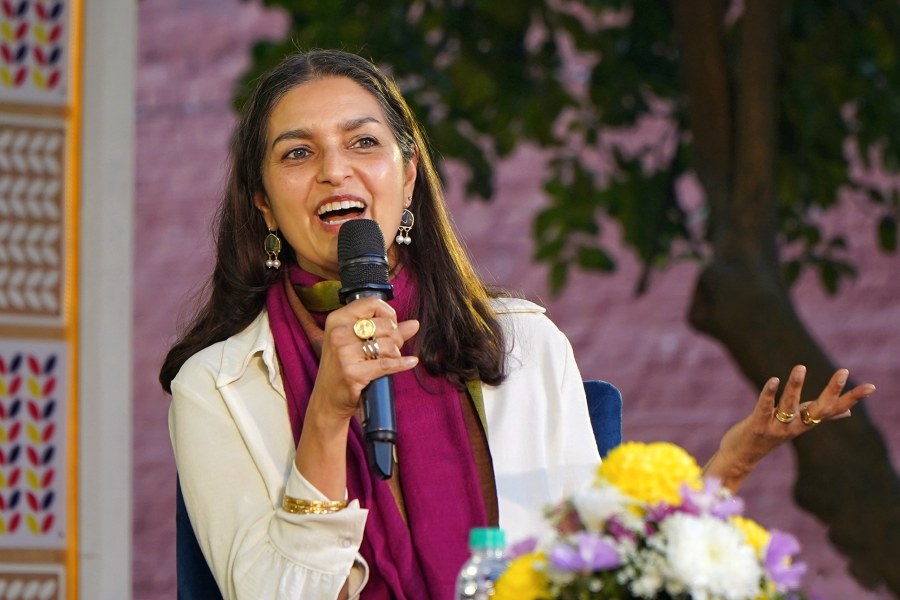
Writing may appear to be an easy task, but sustaining its impact — particularly as a Muslim woman in contemporary times — is far more challenging, Indian author Banu Mushtaq said in Kolkata on Thursday.
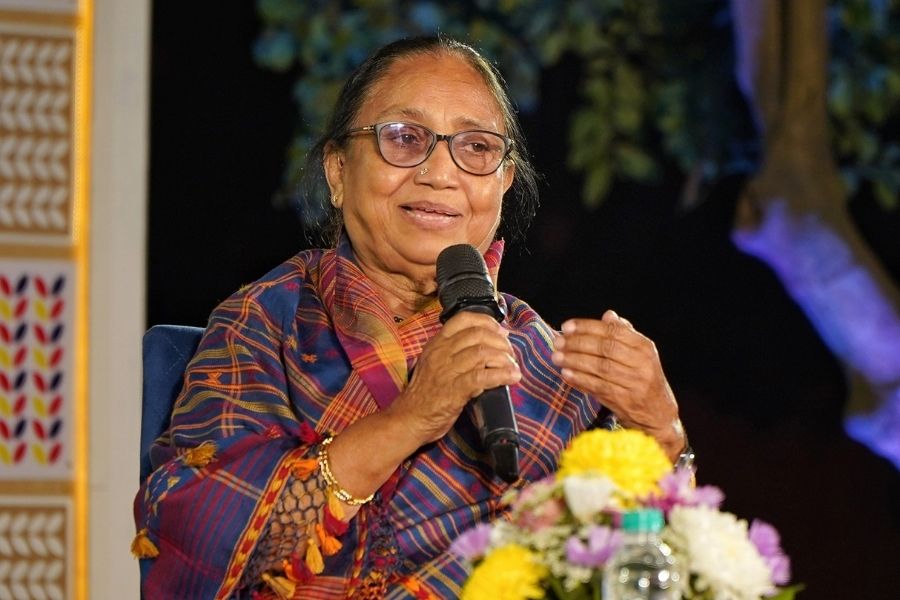
The author, who won the International Booker Prize in 2025 for her anthology Heart Lamp, spoke candidly about the intersections of gender, identity and power, drawing from both her literary work and lived experiences at the Kolkata Literary Meet 2026. The session was moderated by journalist Chinki Sinha.
Responding to a question about vernacular literature, women’s writings and the challenges a writer may face during publication, Mushtaq said that the struggle doesn’t end once the book is published, it begins after that. “Writing is easy for me,” she noted, “but sustaining it is very hard.”
She revealed that during the earlier days of her career, she has approached multiple publishers without the institutional backing of a ‘godfather’.
While her work eventually made its way to the press, the author revealed that she has faced severe criticism that led her to continue defending her writing even after they are published.
“I was made to explain my theory, condemned for my views, attacked, humiliated and trolled,” Mushtaq said, confessing that she was cancelled out of literary and social communities due to her opinions.
Mushtaq highlighted how her religious and social identity often ‘overshadows her literary merit’.
“I am not just a writer. I am a Muslim woman writer. That type always haunts me. I have to write under identities,” she said, reflecting on how such labels become inescapable.
For a broader understanding, Banu Mushtaq recalled the backlash she faced for one of her stories. Mushtaq said that she had to sustain relentless abuse from a section of the society, who practically had no involvement or engagement with literature or its nuances.
“I think I challenged that entitlement in my stories,” she said, believing that her writing might have ‘unsettled’ the entrenched power structures, especially male entitlement.
Though she hasn’t grown bitter for that person or the group, Banu Mushtaq confessed that she had to endure ‘the deep psychological impact.’
Through her reflections, Mushtaq highlighted not only the systemic barriers faced by women writers, particularly those from minority communities, but also the resilience required to continue writing in the face of sustained hostility.
The author said she believes that patriarchy is still dominating society. That reality inspired her to portray her women characters as agents of revolution.
“They are rebellious and they show courage in their own household or anywhere they want to stay on.”
Yet, the author said she believes it is her responsibility to continue writing as a form of resistance and social awareness, and that creative expression should not be bound by restrictions, driven by the ones who are upholding a position in power.
“A writer should always give hope to society. And a writer should be with the true people, not with the power. And a writer should have enough courage to say the truth to the face of the power,” Mushtaq signed off.