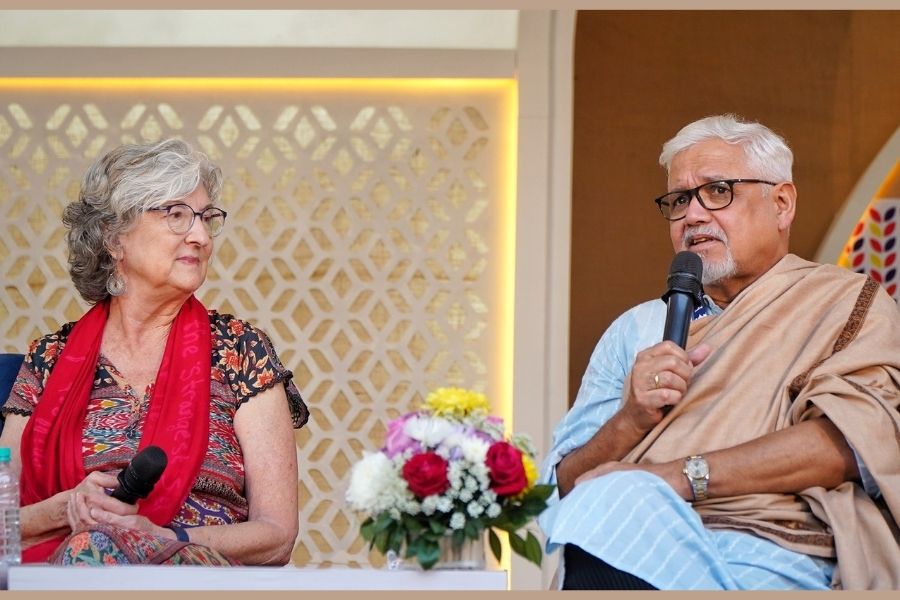
Climate change cannot be reduced to carbon numbers or recycling habits, but represents a fundamental transformation of life on Earth, writers Barbara Kingsolver and Amitav Ghosh said at the Kolkata Literary Meet on Sunday.
In conversation with writer and editor Keshava Guha, the two novelists discussed how fiction can engage with ecological crises without turning to dystopian speculation, while still conveying a sense of urgency.
Kingsolver, a trained biologist and Pulitzer Prize winner, said her environmental concerns stem from growing up in rural Appalachia, where daily life was closely tied to land and ecosystems.
“Nature isn’t a separate thing. It’s the world that makes us possible,” she said, adding that climate change was “too small a name” for what is unfolding. “It’s everything change.”
She said her novels often begin with large shared anxieties rather than personal problems. Worry, Kingsolver argued, could either paralyse or motivate action. “Worry can be a disease that paralyses you, or it can be an engine that puts you to work. You live a healthier life if you choose the engine,” she said.
Ghosh traced his own ecological consciousness to schooldays in Dehradun and early exposure to India’s people’s science movement, which combined scientific education with a critique of science’s social and political limits. That influence, he said, shaped much of his fiction, from The Circle of Reason to The Hungry Tide.
Describing research for The Hungry Tide, Ghosh recalled encountering a dead Irrawaddy dolphin in the Sunderbans, an image that became central to the novel. His interactions with conservation scientists, he said, revealed both their personal courage and the limitations of data-driven methods. “They know the species they work with are going extinct,” he said. “That knowledge is heartbreaking.”
Both writers said they deliberately avoid portraying scientists as caricatures or villains. Kingsolver said fiction has a responsibility to bridge the divide between science and the humanities, particularly in societies where scientific understanding is weak. Scientists in novels, she said, must be written as fully human characters, not as abstract authorities.
The discussion also focused on communities rather than individuals. Kingsolver linked her interest in rural and Indigenous communities to Appalachian traditions of mutual dependence, while Ghosh pointed to how development projects such as dams and mining have disproportionately harmed Adivasi and Indigenous peoples.