No modern-day machines, no fancy racks or flashy marketing. In Janai, fresh chhena is rolled by hand, dipped in thick sugar syrup and dried into a crisp shell to make what is known as Monohora, a sweet that steals hearts. After Hooghly’s iconic sweet received the GI tag, My Kolkata travelled to the town of Janai to witness how the sweetmakers continue to preserve this sweet legacy.
At a shop where history lives on in modesty
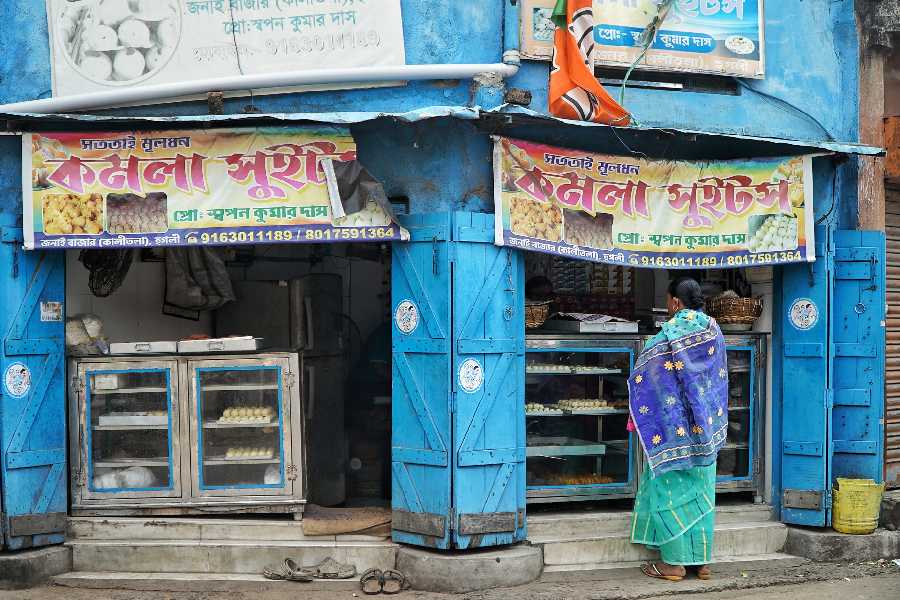
Local residents claim that Kamala Sweets is the oldest shop making monohora in Janai
About 28km from Kolkata, as one enters Janai, one can spot several small sweet shops. Most of these shops make their own sweets and do not get them from factories. We stopped at Kamala Sweets at Janai Bazaar More. The little shop (local residents claim it to be the oldest sweet shop in Janai) does not announce itself with bright signboards or elaborate interiors.
It is like any modest neighbourhood sweet shop with blue wooden doors and glass showcases displaying rows of Monohora alongside Nikuti, Boro Bonde (another popular sweet of the town), Gujiya and Rosogolla. A basket of freshly fried kochuris sits on one corner on the top of the shelf, waiting for the morning crowd.
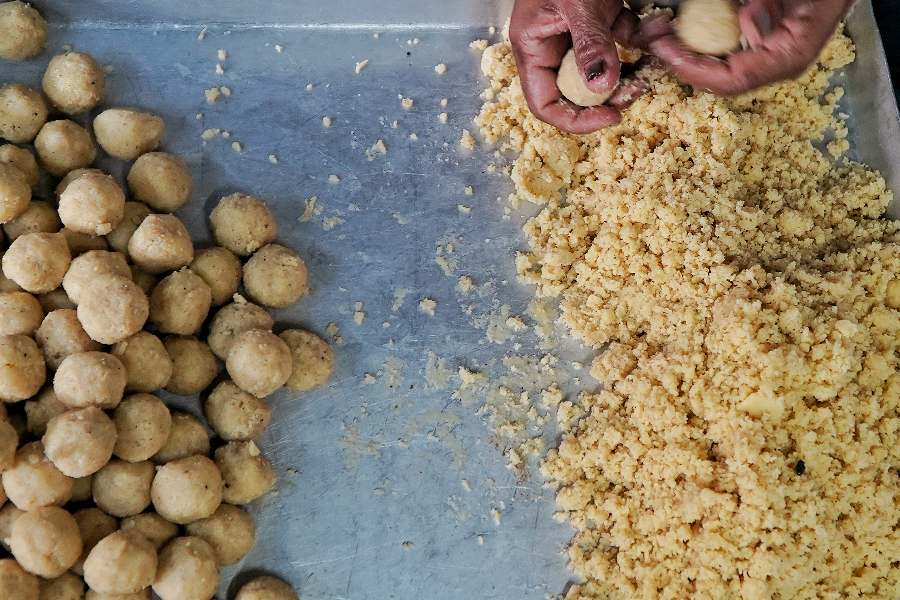
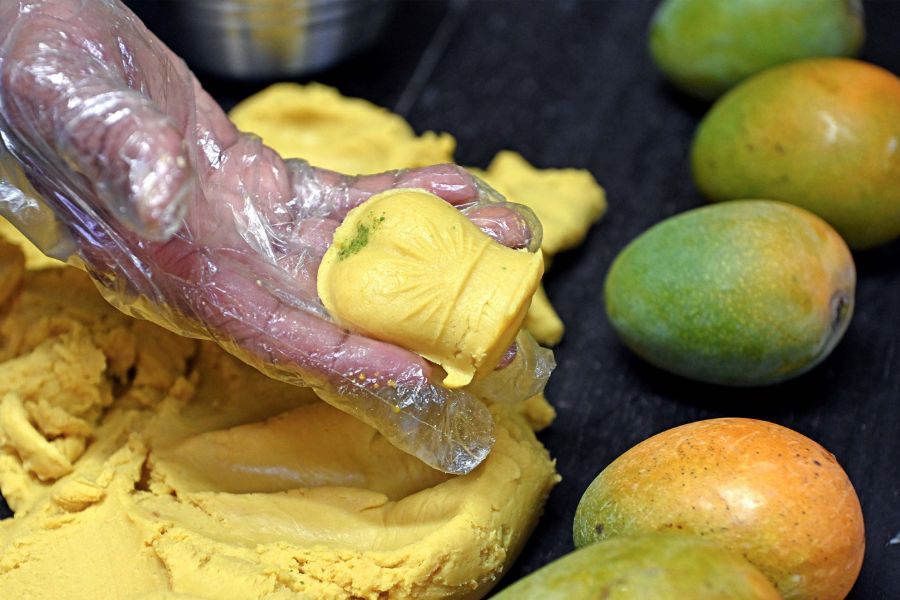
Chenna is rolled out with grated coconut and rolled in pistachio
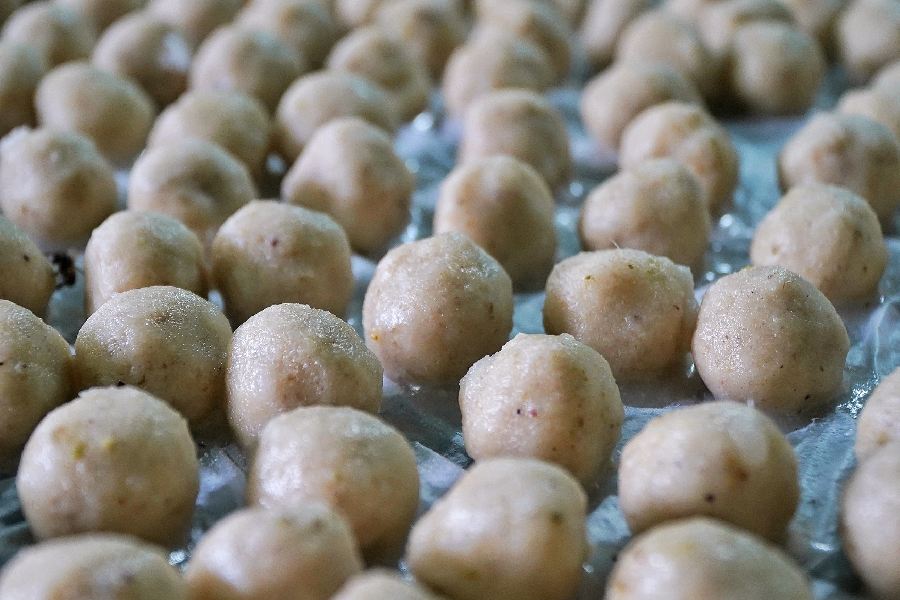
Inside, the space is cramped. On a wooden bench sits the shop’s fifth-generation owner, Swapan Kumar Das, with a large tray of fresh chhena before him. His hands move swiftly with remarkable ease as he scoops up a generous portion, gently rolls them into smooth balls and places them neatly on the tray. Within minutes, nearly a hundred identical spheres have taken shape that look like Kanchagolla.
Nearby, another worker crushes pistachios using a traditional iron mortar and pestle. He sprinkles the coarse pieces over the chhena balls. A gentle shake of the tray coats each one evenly before they are carried into the workshop.
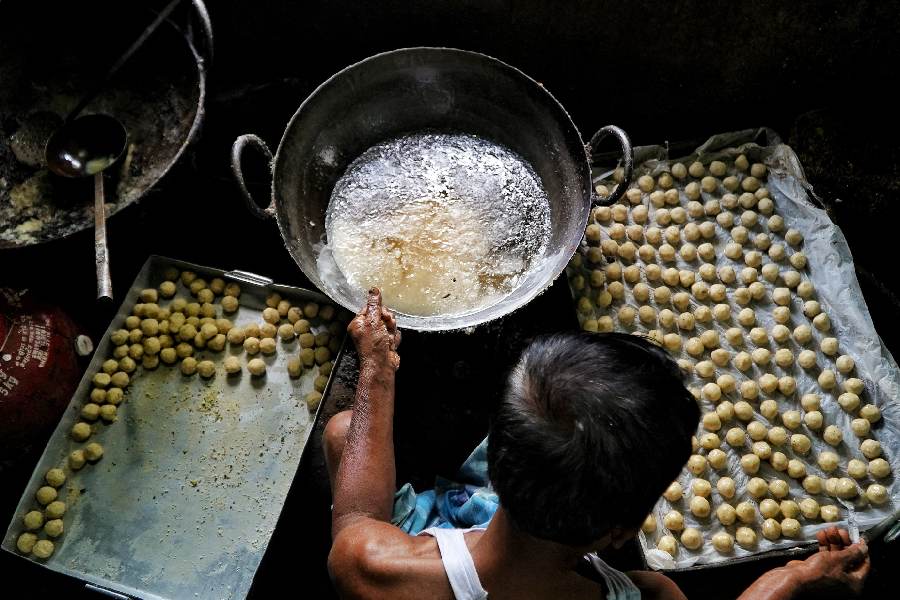
The sugar syrup used is thicker than that of rosogolla
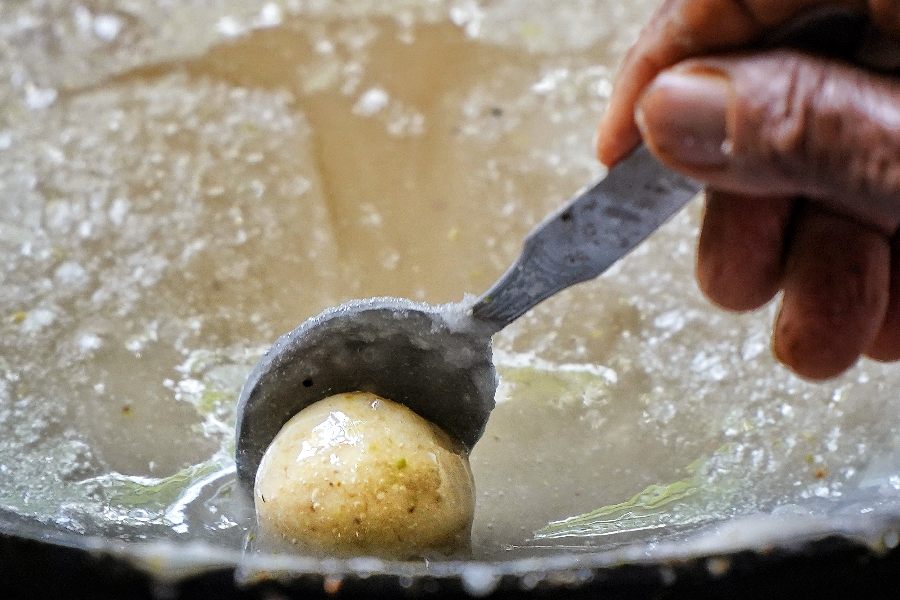
Behind the old family home with a traditional chatal and thakur dalan, is a room where an elderly artisan sits with a large kadai filled with thick sugar syrup. The syrup that is used is thicker than the one used to dip rosogolla. What caught our attention was another kadai of syrup kept to divert the attention of wasps flying around.
One by one, the chhena balls are dipped into the thick sugar syrup and lifted out almost immediately with a small spoon. They are arranged carefully on parchment paper with a pedestal fan drying them out. Slowly, the syrup crystallises into the signature hard shell that gives Monohora its identity while protecting the soft sandesh hidden inside. This is then taken back to the shop front.
A generation upholding the legacy
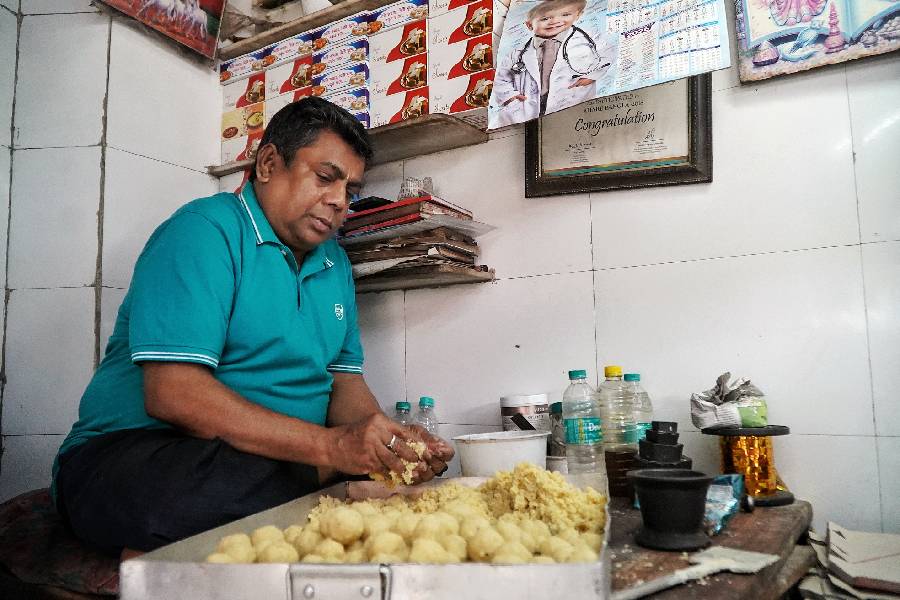
Fifth-generation owner Swapan Kumar Nag rolls out chenna by hand for Monohora
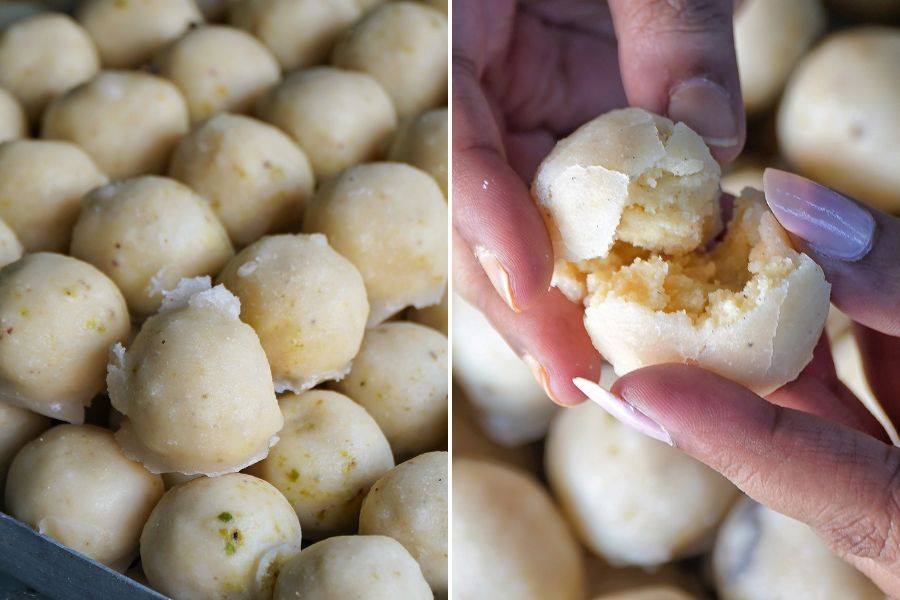
Das, also chairman of Janai Monohara Silpo Samabay Samity Limited, which applied for the GI tag, smiles as he hands over a Monohora to us. “Break the sugar coating first and then eat the sandesh inside,” he said. The crisp shell gives way to a soft, moist centre with delicate notes of coconut and pistachio.
“My father's name is Narayan Chandra Das. We have been in this business for five generations. We were trying for the GI tag since 2021 and finally got it today. After receiving the GI tag, our sales have increased,” he said.
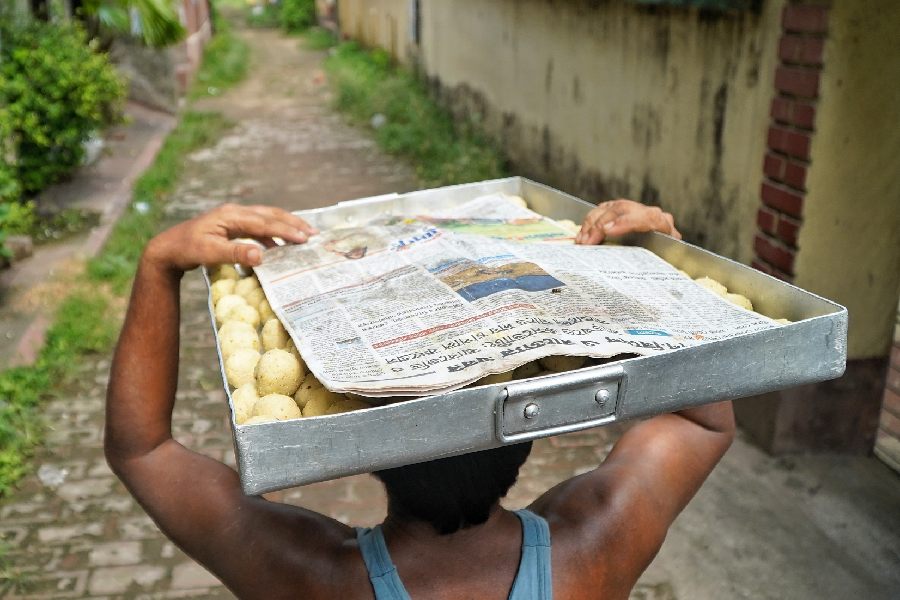
The process of making Monohora involves manual labour and machines haven’t entered the traditional sweet shops yet
Das, however, says he doesn’t know the real story. “I don't know the real story of how Monohora was invented. Neither did my father nor grandfather. But we have been making it for generations. Our ancestors were connected to Bhim Chandra Nag in Kolkata. When I was young, I used to carry boxes of sweets on the local train every day and sell them around Dharmatala while my father managed the shop here. That is the story of our hard work. Today I am carrying this legacy forward, and after me, my sons will continue it.”
The shop continues to receive requests for giant Monohoras too.
"We can make a single Monohora weighing up to three kilograms if someone places an order," says one of the workers as he packs freshly bought sweets into simple paper boxes secured with rubber bands and hands them to the customer.
A sweet wrapped in folklore
Monohora is a sweet with multiple folklores
No one can say with certainty how Monohora first came into being, but Janai has preserved more than one story.
Food historian and researcher Dipankar Debnath traces its origins to Paran Chandra Nag.
He said, “A Dewan under the Burdwan Maharaja, Paran Chandra Nag later opened a sweet shop in his native Janai. According to the story, a zamindar requested fresh sandesh before leaving for a hunting expedition. Delayed on his return, he risked finding the sweets spoiled. Paran Chandra Nag solved the problem by coating each sandesh in hardened sugar syrup, creating a protective shell long before refrigeration existed.”
Another local legend credits Nyara Moira, a confectioner from Janai. Around 1870, it is believed that Kali Prasad Mukhopadhyay, the Dewan of the East India Company, challenged him to create a sweet that would be soft and juicy inside but hard outside. The result, locals believe, was the Monohora.
Local sweetmakers welcome the GI tag with hopes for more business
For cultural documentarian and food historian Amar Mukherjee, the Monohora represents much more than a beloved Bengali dessert.
“Monohara is much more than a sweet. It is a story of Bengal's craftsmanship, memory and identity. Every traditional sweet carries the history of the people and places that created it. A GI tag gives recognition to that legacy, protects its authenticity and ensures that the original makers receive the credit they deserve.”