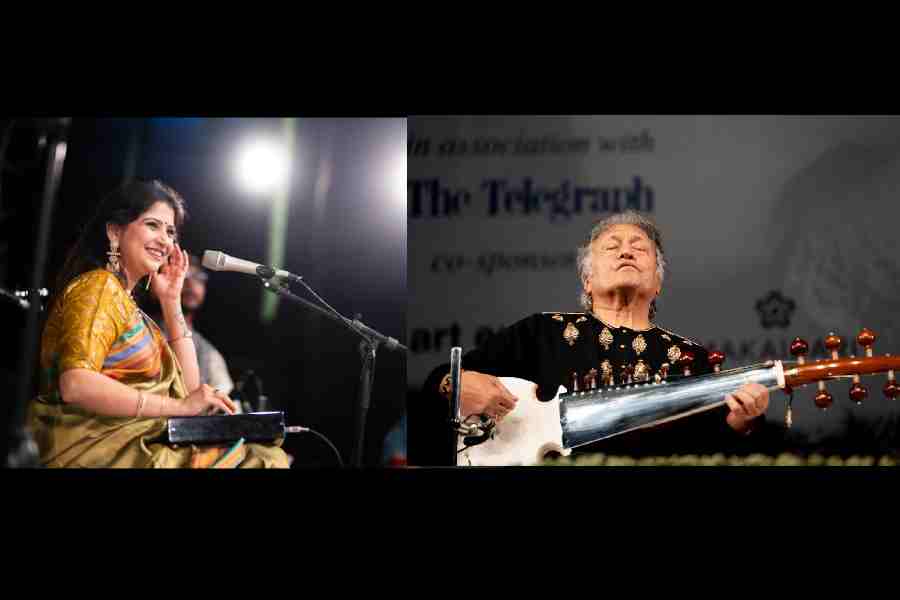
It was a stormy evening and Kaushiki Chakraborty (picture, left) began her recital with Raga Shyam Kalyan. She created a contemplative atmosphere through the serene and luminous contours of Shyam Kalyan, which beautifully intertwines the emotive shades of the ragas, Shyam and Kalyan. The programme where she was performing was held at Kala Mandir and organised by the Ballygunge Maitreyee Music Circle in memory of the late sarod maestro, Pandit Buddhadev Dasgupta. It unfolded as both a tribute and a celebration of his artistic legacy. Chakraborty’s opening vilambit khayal was marked by poise and depth; her voice, supple and assured, traversed three octaves with effortless ease. As the recital progressed into madhyalay jhaptaal and drut teentaal khayals, intricate taans and fluid sargams lent a dynamism to her performance. She concluded with a poignant thumri in Raga Pilu and a graceful, rare dadra, “Teri katili nigahe”, both rendered with lyrical sensitivity, leaving the audience enchanted. Murad Ali on the sarangi and Ojas Adhiya on the tabla enhanced the immersive resonance of the presentation through their skilful accompaniment.
The second half of the evening brought with it the timeless presence of Ustad Amjad Ali Khan (picture, right). Following a brief interlude that included a book launch and the sharing of personal memories by both Chakraborty and Ustad Amjad Ali Khan, the latter began his recital accompanied by two young and promising tabla players, Aarchik Banerjee and Debajit Patitundi, the son and the disciple of the late Pandit Shubhankar Banerjee, respectively. Ustad Amjad Ali Khan opened with an expansive ragmala, weaving together ragas like Kamod, Hameer, Behag, Nand, Bihari and so on. Each was delicately introduced and developed within the framework of deepchandi taal (14 beats), creating a seamless yet varied musical journey. The transitions between the ragas were handled with remarkable finesse, reflecting his deep roots in tradition and instinctive creativity.
A noteworthy presentation was Raga Nayaki Kanada, one of the oldest and most profound forms of the Kanada family. Beginning with a contemplative alaap, Ustad Amjad Ali Khan gradually unfolded the raga with subtle gayaki ang vistaar, allowing each phrase to breathe and resonate. His taans carried a quiet brilliance, and his playing reflected a rare combination of introspection, clarity, and emotional depth. The rare Raga Chandrayog added another dimension to the evening. With its unusual tonal character, the maestro crafted an atmosphere that seemed to transcend the physical space of the auditorium, creating a sense of expansiveness. The audience was spellbound, drawn into the meditative quality of his music that lingered long after the notes had faded.
To conclude, Ustad Amjad Ali Khan presented a delightful medley that bridged classical and semi-classical idioms. Beginning with his beloved Raga Khamaj, he gently led the audience into the evocative strains of “Ekla chalo re”, followed by a seamless blending of the ragas, Saraswati, Durga and Bihu, and Bhatiali dhuns, each rendered with a distinct flavour yet woven into a cohesive whole. Both Aarchik and Debjit showed remarkable expertise.
Kala Mandir stood witness to yet another unforgettable musical experience. Ustad Amjad Ali Khan, with undiminished vitality and an ever-evolving creative spirit, reaffirmed that true artistry transcends the limitations of age.